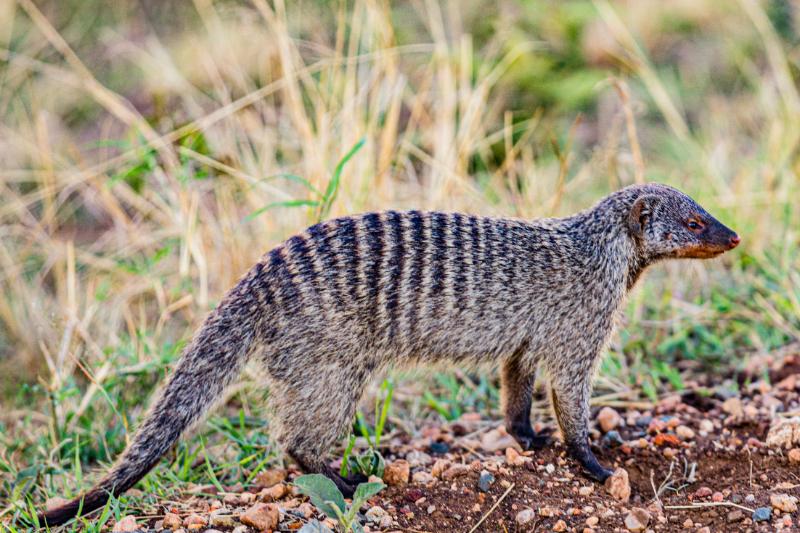
Grandidier’s Mongoose (Galidictis grandidieri)

Mongoose in the wilderness

IUCN Red List Conservation Status


Vulnerable

LC
NT
VU
EN
CR
EW
EX

Official assessment evaluated in accordance with the IUCN Red List of Threatened Species criteria: Vulnerable.


Species Quick Facts

Scientific Name
Galidictis grandidieri

Average Lifespan
5-7 years in wild, 10-12 years in captivity

Average Weight
1.4-2.5 kg (3.1-5.5 lbs) – Males: 1.8 kg, Females: 1.5 kg

Average Length
35-45 cm (14-18 inches) – head-body length excluding tail

Overview & Identification

Grandidierโ€™s mongoose (Galidictis grandidieri) is a small carnivorous mammal endemic to the eastern highlands of Madagascar. Belonging to the family Eupleridae, it is one of the islandโ€™s unique Malagasy mongooses that evolved after the islandโ€™s isolation from mainland Africa. The species inhabits humid montane and subโ€‘montane evergreen forests between 800 and 1,600โ€ฏm elevation, favoring dense understory and bamboo thickets where it can move stealthily among leaf litter. Its reddishโ€‘brown pelage, elongated body, short legs and relatively long tail give it a weaselโ€‘like silhouette, while a distinctive dark facial mask and white throat patch aid in individual recognition. Grandidierโ€™s mongoose is primarily nocturnal, hunting on the forest floor and occasionally climbing low branches. The International Union for Conservation of Nature (IUCN) classifies the species as Vulnerable, with an estimated population of fewer than 10,000 mature individuals. Ongoing deforestation for agriculture, timber extraction, and charcoal production fragments its habitat, while hunting pressure remains low but localized. Conservation actions include protectedโ€‘area management in the Marojejy and Anjanaharibeโ€‘Sahalava reserves, communityโ€‘based forest stewardship, and research programs monitoring population trends and ecological requirements.

Behavior & Social Structure

Grandidierโ€™s mongoose is a solitary forager for most of the year, with individuals maintaining overlapping home ranges that are defended through scent marking and occasional vocalizations. Territories average 2โ€“3โ€ฏkmยฒ for males and slightly smaller for females, and are delineated by urine sprays from anal glands and scratch marks on fallen logs. The species is chiefly nocturnal, becoming active at dusk and hunting throughout the night, though it may exhibit crepuscular activity during the rainy season when prey is abundant. Communication relies on a repertoire of sharp chirps, low growls, and a characteristic hissing alarm that warns conspecifics of predators. Social interactions are limited to brief encounters during the breeding season, where males may engage in brief chases and scentโ€‘based contests to gain access to receptive females. Outside of reproduction, individuals avoid direct contact, reducing competition for limited prey resources in the fragmented forest matrix.

Diet & Hunting Patterns

Grandidierโ€™s mongoose is a carnivorous predator that primarily exploits the rich invertebrate and small vertebrate fauna of Madagascarโ€™s montane forests. Its diet consists of insects such as beetles, orthopterans, and lepidopteran larvae, which it extracts from leaf litter and decaying wood. Small vertebrate prey includes native rodents (e.g., Nesomys spp.), tenrecs, shrews, and occasionally amphibians and reptiles. Opportunistic feeding on bird eggs and nestlings has also been recorded. The mongoose employs a combination of active hunting and opportunistic scavenging, using its keen sense of smell to locate concealed prey and its agile body to chase and capture swift insects. Daily food intake averages 150โ€“250โ€ฏg, representing roughly 10โ€ฏ% of body mass, and varies seasonally with prey availability. In periods of insect scarcity, the animal may increase consumption of small mammals, demonstrating dietary flexibility that aids survival in fragmented habitats.

Reproduction & Life Cycle

Females of Grandidierโ€™s mongoose reach sexual maturity at about 12โ€ฏmonths, while males mature slightly later at 14โ€“16โ€ฏmonths. Breeding occurs once a year during the early rainy season (Novemberโ€“December), when increased prey availability supports the energetic demands of gestation. After a gestation period of approximately 60โ€“65โ€ฏdays, the female gives birth to a litter of one to three altricial young, most commonly two. Neonates are born blind and covered with a fine grayish fur, weighing about 80โ€ฏg. The mother provides exclusive care, nursing the kits for 8โ€“10โ€ฏweeks while keeping them concealed in dense underbrush. By three months, the juveniles begin to accompany the mother on short foraging trips, learning hunting techniques and scentโ€‘marking behavior. Weaning is completed by 10โ€ฏweeks, after which the young become independent and disperse to establish their own territories, typically after reaching one year of age.

Threats & Conservation

The IUCN Red List classifies Grandidierโ€™s mongoose as Vulnerable, reflecting a declining population trend driven primarily by habitat loss and fragmentation. Madagascarโ€™s eastern forests have been reduced by more than 30โ€ฏ% over the past three decades due to slashโ€‘andโ€‘burn agriculture, illegal logging, and expansion of commercial plantations. These activities shrink suitable habitat, isolate subpopulations, and increase edge effects that favor invasive species and predators. Although direct hunting pressure is low, occasional trapping for the pet trade and incidental capture in snares set for other wildlife pose additional risks. Climate change may further alter the montane forest microclimate, reducing prey abundance. Current estimates suggest fewer than 10,000 mature individuals remain, with some subpopulations numbering only a few dozen. Conservation measures focus on expanding and effectively managing protected areas such as Marojejy National Park, promoting communityโ€‘based forest restoration, and conducting longโ€‘term monitoring to assess population dynamics. International support for habitat corridors and antiโ€‘deforestation initiatives is essential to halt further declines.

Interesting Facts

โ€ข Endemic to Madagascarโ€™s eastern highlands, found only above 800โ€ฏm elevation.
โ€ข Possesses a unique dark facial mask that helps individuals recognize each other in lowโ€‘light conditions.
โ€ข Can locate hidden prey using a highly developed olfactory system, comparable to that of larger carnivores.
โ€ข Despite its small size, it can subdue prey up to twice its own weight, such as native rodents.
โ€ข Plays a crucial role in controlling insect populations, contributing to forest health and regeneration.

Description

Mongoose foraging in the wild
antonytrivet / Envato

Grandidier’s mongoose, also known as the giant-striped mongoose or Grandidier’s vontsira, is a small carnivoran that belongs to the Eupleridae family. This elusive species is primarily nocturnal and arboreal, displaying solitary and secretive behaviors that make it challenging to study in its natural habitat. The species is known for its striking appearance and unique ecological niche within the spiny forest vegetation of southwestern Madagascar.

Appearance
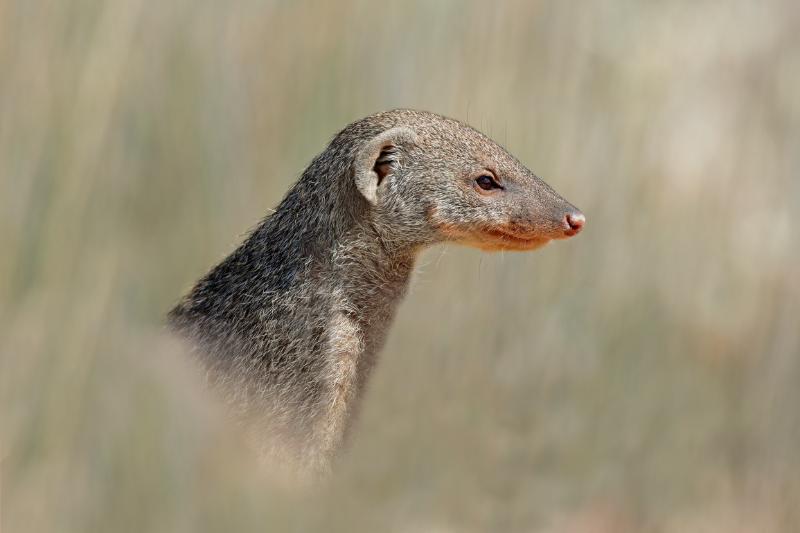
Grandidier's Mongoose upclose
EcoSound / Envato

The Grandidier’s mongoose is characterized by its distinctive coat, which features bold striping along the body, giving it a visually striking appearance. It has a slender body and a pointed snout, with a bushy tail that aids in balance and agility. These physical attributes distinguish it from other species within its range and contribute to its remarkable adaptability in its natural habitat.

Distribution

Mongoose in the grassland
antonytrivet / Envato

Grandidier’s mongoose is endemic to the spiny forest region of southwestern Madagascar, specifically in the areas of the Didiera-Euphorbia thicket. Its distribution is limited to this small area, making it a geographically restricted species. The population density of Grandidier’s mongoose is notable for its localized presence, highlighting the need for conservation efforts to protect its unique habitat.

Habitat Preferences

Grandidier’s mongoose thrives in the spiny forest vegetation of southwestern Madagascar, which is classified as subtropical or tropical dry. It is well-adapted to this unique ecosystem, utilizing the rock crevices and ground litter for foraging and shelter. The species’ survival and well-being are intricately linked to the preservation of its specialized habitat, emphasizing the importance of conservation initiatives to safeguard this critical environment.

This comprehensive species profile provides a detailed insight into the unique characteristics, appearance, distribution, and habitat preferences of Grandidier’s mongoose, shedding light on the importance of conservation efforts to ensure the survival of this remarkable species.

Facts About Grandidier’s mongoose

  1. Grandidier’s mongoose (Galidictis grandidieri) is native to Madagascar.
  2. It is known for its solitary and nocturnal habits.
  3. The species is approximately 32 to 40 cm in length.
  4. Grandidier’s mongoose weighs about 499 to 589 grams.
  5. It inhabits the spiny, desert region of South-western Madagascar.
  6. The species belongs to the Eupleridae family, which is endemic to Madagascar.
  7. Grandidier’s mongoose is a small carnivoran.
  8. It is a species of concern and is found in dry deciduous forests.
  9. The mongoose has a relatively long, pointed snout and a bushy tail.
  10. The Fossa is the largest carnivore and top predator native to Madagascar.


Scientific Provenance & Verified Sources

Biological taxonomy, conservation status, and physical traits are cross-referenced with authoritative global registers:


Peer-reviewed by Wildlife Science Editors โ€ข Updated for 2026

Explore Other Species Profiles