Golden-Crowned Sifaka

IUCN Red List Conservation Status


Critically Endangered

LC
NT
VU
EN
CR
EW
EX

Official assessment evaluated in accordance with the IUCN Red List of Threatened Species criteria: Critically Endangered.


Species Quick Facts

Scientific Name
Propithecus tattersalli

Average Lifespan
20-25 years in wild, 30-35 years in captivity

Average Weight
2.5-4.5 kg (5.5-9.9 lbs) – Males: 4.0 kg, Females: 3.0 kg

Average Length
40-45 cm (15.7-17.7 inches) – head-body length excluding tail

Overview & Identification

The goldenโ€‘crowned sifaka (Propithecus tattersalli) is a mediumโ€‘sized lemur belonging to the family Indriidae, one of the most distinctive members of Madagascarโ€™s primate fauna. Endemic to the northeastern rainforests of the island, it occupies a very restricted range of roughly 44โ€ฏkmยฒ in the Montagne dโ€™Ambre and the Maromizaha forest blocks at elevations between 800 and 1โ€ฏ200โ€ฏm. The species is named for the striking goldenโ€‘orange crown of hair that crowns its darkโ€‘brown face and contrasts with the white mantle that runs along its back. Its long, powerful hind limbs enable an elegant vertical clinging and leaping locomotion, allowing it to leap up to 10โ€ฏm between trees. Goldenโ€‘crowned sifakas are diurnal and live in small, cohesive groups of 3โ€“9 individuals that defend overlapping home ranges. The species was only described to science in 1988 and is one of the worldโ€™s most threatened primates, listed as Critically Endangered by the IUCN due to severe habitat loss and fragmentation. Genetically, it is closely related to the Coquerelโ€™s sifaka (P. coquereli) and the Milneโ€‘Edwardsโ€™ sifaka (P. edwardsi), forming the โ€œsifakaโ€ clade within Indriidae. Its diet is primarily folivorous, relying on the leaves of over 30 plant species, especially those of the families Myrtaceae and Rubiaceae, supplemented by fruits, flowers, and bark during the lean dry season. The speciesโ€™ limited distribution makes it highly vulnerable to stochastic events, and recent surveys estimate fewer than 1โ€ฏ000 mature individuals remain in the wild. Conservation actions include the establishment of protected areas, communityโ€‘based forest management, and ongoing monitoring programs aimed at mitigating illegal logging and slashโ€‘andโ€‘burn agriculture.

Behavior & Social Structure

The goldenโ€‘crowned sifaka lives in small, multimaleโ€‘multifemale groups of three to nine individuals that maintain a fluid fissionโ€‘fusion dynamic; subโ€‘groups split during foraging and reconvene at sleeping sites. Groups are highly territorial, marking boundaries with scent glands located on the wrists and chest, and they patrol the periphery each morning. Activity peaks in the early morning and late afternoon, with a midโ€‘day lull during the hottest hours. Locomotion is dominated by vertical clinging and leaping, allowing individuals to traverse the canopy with leaps of up to ten metres. Vocal communication includes a repertoire of loud โ€œwhistlesโ€ that can travel over 500โ€ฏm to signal predator presence, as well as softer โ€œpurrsโ€ and โ€œclicksโ€ used in closeโ€‘range social interactions. Visual displays such as tailโ€‘raising and earโ€‘flattening reinforce dominance hierarchies, while grooming bonds reinforce group cohesion.

Diet & Hunting Patterns

The goldenโ€‘crowned sifaka is primarily a folivore, extracting nutrients from the leaves of over thirty plant species, with a strong preference for young, tender foliage of Myrtaceae, Rubiaceae, and Lauraceae. During the wet season, fruits, flowers, and nectar supplement the diet, providing essential sugars and proteins. In the dry season, the sifaka expands its intake to include bark, lichen, and occasional seeds to meet its caloric needs. Daily intake averages 1.2โ€“1.5โ€ฏkg of plant material, which the animal processes through an enlarged, sacculated stomach that hosts symbiotic microbes capable of fermenting cellulose. Feeding occurs in short bouts of 5โ€“10โ€ฏminutes, interspersed with long periods of resting to allow microbial digestion. The species exhibits selective feeding, often discarding leaves with high tannin concentrations, and it prefers canopy heights of 10โ€“20โ€ฏm where preferred food plants are abundant.

Reproduction & Life Cycle

The species reaches sexual maturity at about three to four years for females and slightly later for males. Breeding is seasonal, coinciding with the onset of the rainy season (Novemberโ€“December), when food availability peaks. Females give birth to a single infant after a gestation of roughly 138โ€ฏdays. Newborns cling to the motherโ€™s belly for the first two weeks, then transition to riding on the motherโ€™s back as she moves through the canopy. Maternal care is intensive; the infant is weaned at about six months but remains dependent for up to a year. Males may assist in infant protection, especially in groups with multiple adult males, but paternal care is limited. Interโ€‘birth intervals average 18โ€“24 months, reflecting the high energetic cost of leafโ€‘based diets.

Threats & Conservation

The IUCN classifies the goldenโ€‘crowned sifaka as Critically Endangered, with an estimated 800โ€“1โ€ฏ000 mature individuals remaining. The principal threat is habitat loss driven by slashโ€‘andโ€‘burn agriculture, illegal logging, and mining activities that fragment the already limited forest patches. Because the species occupies a narrow elevational band, even small-scale deforestation can eliminate essential feeding and sleeping sites. Hunting pressure is low but occasional capture for the illegal pet trade adds to mortality. Climate change poses a longโ€‘term risk by altering the phenology of key food plants, potentially leading to mismatches between breeding cycles and food availability. Conservation measures include the designation of the Montagne dโ€™Ambre National Park, communityโ€‘based forest stewardship programs, and reforestation projects aimed at reconnecting isolated fragments. Ongoing population monitoring and environmental education are critical to halt the decline.

Interesting Facts

โ€ข The goldenโ€‘crowned sifakaโ€™s distinctive orangeโ€‘gold crown is unique among lemurs.
โ€ข It can leap up to 10โ€ฏmeters (33โ€ฏfeet) between trees in a single bound.
โ€ข Its entire natural range covers less than 50โ€ฏkmยฒ, making it one of the most rangeโ€‘restricted primates.
โ€ข Loud alarm whistles can be heard over 500โ€ฏm away, alerting neighboring groups to predators.
โ€ข Conservation efforts involve local communities planting native trees to restore fragmented habitats.

Description

Golden-Crowned Sifaka

The golden-crowned sifaka, also known as Tattersall’s sifaka, is a medium-sized lemur characterized by its striking appearance. It is one of the smallest sifaka species within the genus Propithecus, featuring predominantly white fur, prominent furry ears, and a distinct golden-orange crown. This unique coloration sets it apart from other lemur species and contributes to its charismatic presence in its natural habitat.

Appearance
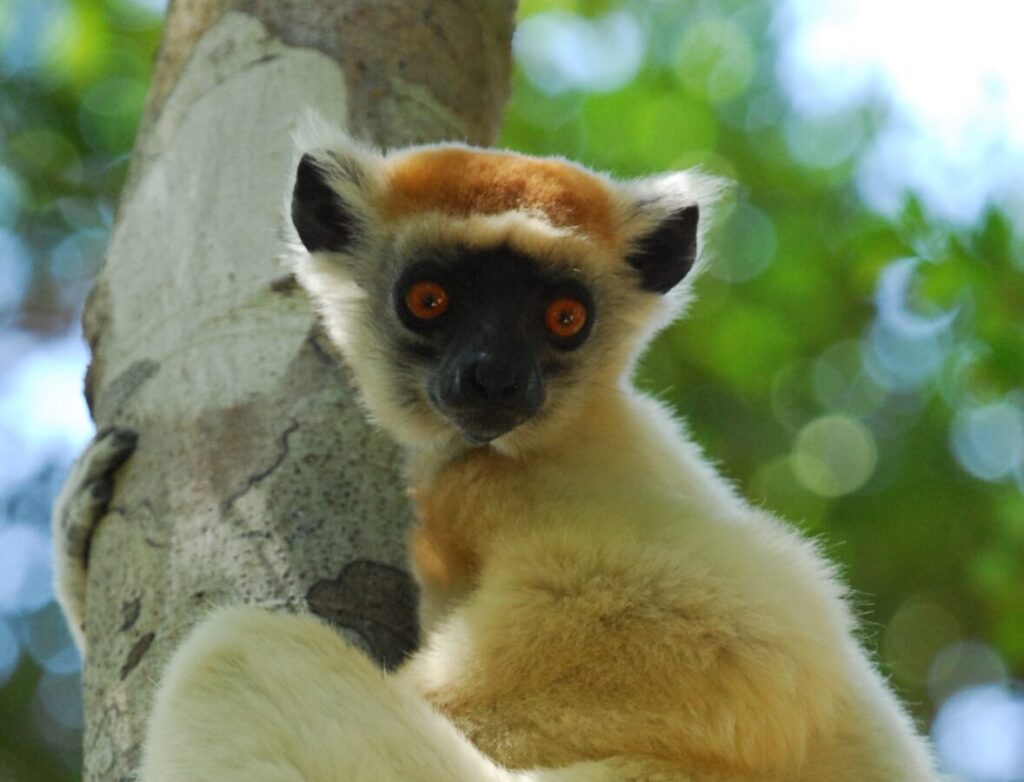
Golden-Crowned Sifaka Appearance

The golden-crowned sifaka’s most distinctive feature is the golden-orange crown that adorns its head, contrasting beautifully with its predominantly white fur. This species also possesses a robust and agile build, with long hind limbs that facilitate its remarkable leaping locomotion through the forest canopy. The combination of its physical characteristics and striking coloration makes the golden-crowned sifaka a visually captivating and easily recognizable species.

Distribution

Golden-crowned sifakas are primarily found in specific regions of Madagascar, particularly in the northwestern part of the island. They inhabit various types of forests, including dry deciduous, gallery, and semi-evergreen forests. Their distribution is restricted to altitudes of up to 500 meters, and they are known to have territorial home ranges of approximately 22 to 30 acres. Conservation efforts are crucial in these regions to ensure the continued existence of this unique species.

Habitat Preferences

Golden-Crowned Sifaka Habitat

The golden-crowned sifaka thrives in diverse forest ecosystems, relying on the rich biodiversity of these habitats for its survival. Its arboreal nature is well-suited to navigating the vertical landscape of the forest, where it forages for leaves, fruits, and flowers. The species’ preference for specific forest types underscores the importance of preserving these ecosystems to maintain the delicate balance necessary for its well-being.

In conclusion, the golden-crowned sifaka is a remarkable and visually striking lemur species with a limited distribution in Madagascar. Its unique appearance and habitat preferences make it a significant focal point for conservation efforts aimed at preserving the rich biodiversity of Madagascar’s forests and ensuring the long-term survival of this captivating species.

Facts About Golden-Crowned Sifaka

  • The Golden-Crowned Sifaka (Propithecus tattersalli) is a medium-sized lemur characterized by mostly white fur and prominent furry ears.
  • They are social animals, living in groups ranging in size from 2 to 13 individuals, usually containing 2 adults of each sex.
  • This species has one of the smallest ranges and documented population sizes of any lemur.
  • The golden-crowned sifaka is considered one of the world’s most endangered primates.
  • Their movement rates are greater in the rainy season and in more humid forests.
  • They are found in the Daraina region of Madagascar.
  • The population size is estimated to be between 6,000 to 10,000 individuals.
  • Their diet mainly consists of leaves, flowers, and fruit.
  • The average lifespan of the Golden-Crowned Sifaka is 17-20 years.
  • They weigh between 3.4-3.6 kg (7.5-7.9 lbs).


Scientific Provenance & Verified Sources

Biological taxonomy, conservation status, and physical traits are cross-referenced with authoritative global registers:


Peer-reviewed by Wildlife Science Editors โ€ข Updated for 2026

Explore Other Species Profiles