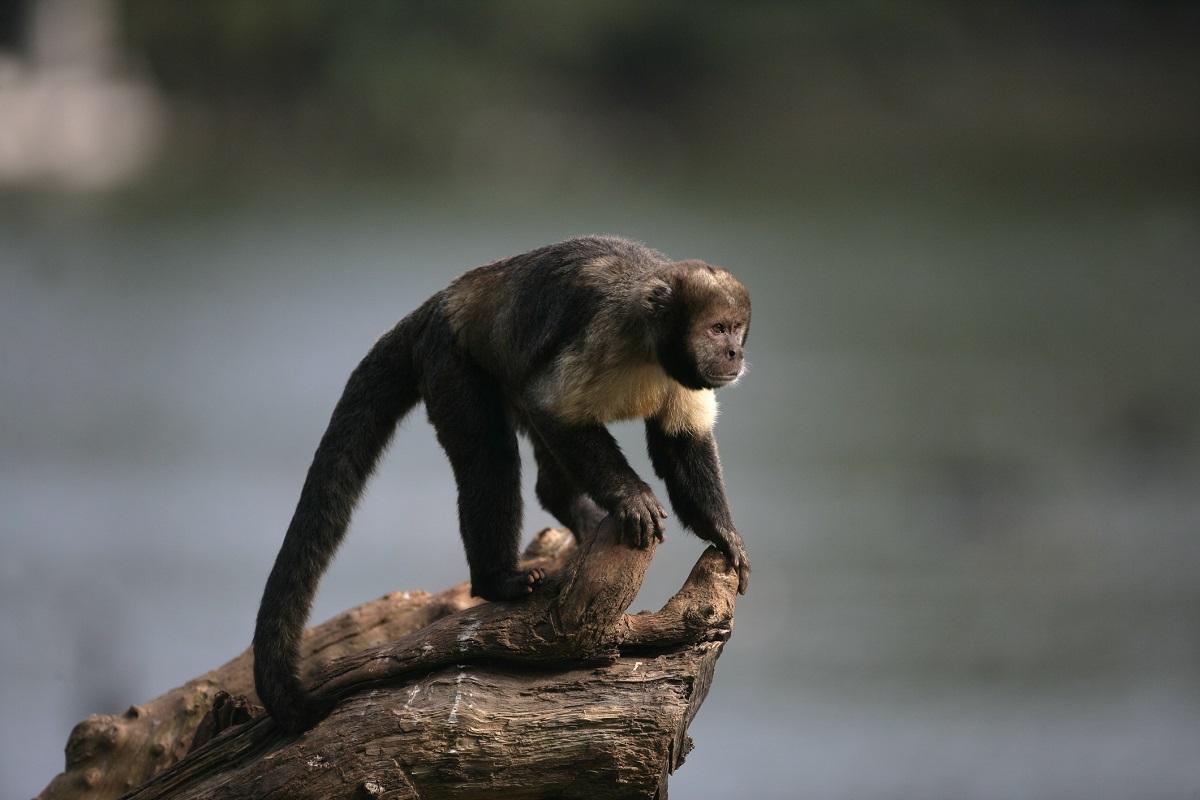
Golden-Bellied Capuchin (Sapajus xanthosternos)

IUCN Red List Conservation Status


Endangered

LC
NT
VU
EN
CR
EW
EX

Official assessment evaluated in accordance with the IUCN Red List of Threatened Species criteria: Endangered.


Species Quick Facts

Scientific Name
Sapajus xanthosternos

Average Lifespan
15-25 years in the wild, up to 30 years in captivity

Average Weight
Males approximately 4 kg (8.8 lbs), females approximately 2.5 kg (5.5 lbs)

Average Length
Males about 40 cm (15.7 inches), females about 37 cm (14.6 inches) head-body length, plus a tail of roughly equal length

Overview & Identification

The golden-bellied capuchin is a monkey of the Atlantic coastal forests of eastern Brazil, marked by a rich golden-yellow chest and shoulders. Highly intelligent and dexterous, it forages in groups for fruit, seeds, insects, and small animals, sometimes using tools to crack open hard foods. Habitat loss and hunting have made it one of the most endangered capuchins.

Behavior & Social Structure

The golden-bellied capuchin (Sapajus xanthosternos), also known as the buffy-headed or yellow-breasted capuchin, is strictly diurnal, beginning its daily activities shortly after sunrise and retreating to sleeping trees before dusk. Days are structured around alternating bouts of foraging, traveling, and social rest periods, with the hottest midday hours often spent resting in dense canopy cover to conserve energy and avoid predation. This species lives in cohesive social groups typically ranging from 8 to 30 individuals, organized around a multi-male, multi-female structure with a linear dominance hierarchy. Female philopatry is common, with females remaining in their natal groups while males typically disperse upon reaching sexual maturity, a pattern that helps reduce inbreeding and reshapes group composition over time.

Communication in Sapajus xanthosternos is highly sophisticated, involving a broad vocal repertoire that includes alarm calls, contact calls, and food-associated vocalizations that alert group members to resource locations. Tactile communicationโ€”grooming, play, and physical contactโ€”reinforces social bonds and helps maintain the group’s dominance hierarchy, particularly among females and their offspring. Scent marking, primarily through urine-washing behavior on hands and feet, plays a role in social signaling and may communicate reproductive status or individual identity to conspecifics.

Home ranges for this species vary considerably depending on habitat quality and fragmentation, generally spanning 60 to over 200 hectares in the fragmented Atlantic Forest and Caatinga-adjacent habitats of eastern Brazil where they now persist. Golden-bellied capuchins display notable behavioral plasticity and are known for sophisticated tool use, including cracking open hard-shelled nuts and fruits using stone anvilsโ€”a cognitively advanced adaptation shared with other Sapajus species. This tool-use behavior, combined with problem-solving capacity in foraging contexts, marks them among the most cognitively complex New World primates.

Diet & Hunting Patterns

As opportunistic omnivores, golden-bellied capuchins exploit an extraordinarily diverse diet that includes ripe and unripe fruits, seeds, flowers, fungi, and a wide array of invertebrates such as beetles, larvae, and spiders. They are also known to consume small vertebrates including frogs, lizards, birds’ eggs, and occasionally nestlings when opportunities arise. Foraging occurs largely in the mid-to-upper canopy, where individuals use dexterous hands to manipulate bark, dead wood, and bromeliads in search of hidden insect preyโ€”a behavior known as extractive foraging that requires considerable manual dexterity and problem-solving skill.

Seasonal dietary shifts are pronounced, with fruit consumption peaking during the wet season when Atlantic Forest and transitional dry forest trees produce abundant fleshy fruit, while insect and pith consumption increases during leaner dry-season months when fruit availability declines. This dietary flexibility is a key survival adaptation in the fragmented, seasonally variable habitats the species now occupies. Water dependency is moderate; capuchins obtain much of their hydration from fruit and plant matter but will also drink from tree-hole water reservoirs, bromeliad tanks, and streams when available, particularly during drier periods.

Reproduction & Life Cycle

Golden-bellied capuchins do not exhibit a strict, narrowly defined breeding season, though reproduction often shows some seasonal peaks correlating with periods of higher food abundance. The mating system is best described as polygynandrous (multi-male, multi-female promiscuity), with dominant males typically achieving higher mating success, though subordinate males may still sire offspring. Female sexual swellings and proceptive behaviors signal receptivity to potential mates within the group.

Gestation lasts approximately 150 to 160 days, after which females give birth to a single infant; twins are rare. Maternal care is intensive, with infants clinging to their mother’s back or ventral region for the first several weeks and gradually gaining independence over the following months. Alloparental care, including carrying and grooming by other females and occasionally juveniles, is commonly observed and thought to strengthen group cohesion. Weaning typically occurs between 9 and 12 months of age, while sexual maturity is reached laterโ€”around 4 years in females and closer to 7โ€“8 years in males, reflecting the extended developmental period characteristic of large-brained platyrrhine primates.

Threats & Conservation

The golden-bellied capuchin faces severe and ongoing threats primarily driven by extensive habitat loss and fragmentation across its restricted range in the Atlantic Forest and transitional zones of eastern Brazil, particularly in Bahia state. Agricultural expansionโ€”especially cacao, rubber, and cattle ranchingโ€”combined with logging and urban development has reduced forest cover to isolated fragments, severely limiting genetic connectivity between populations. Habitat fragmentation forces groups into smaller ranges with reduced food availability, increasing intraspecific competition and stress-related reproductive suppression.

Illegal hunting for bushmeat and, historically, capture for the exotic pet trade have further diminished wild populations, compounding pressures from habitat degradation. Natural predators include large raptors such as harpy eagles and forest-dwelling felids like ocelots and margays, though anthropogenic threats far outweigh natural predation pressure in driving population decline. The species is classified as Endangered by the IUCN, and conservation initiativesโ€”including habitat corridor restoration projects, protected area management within remaining Atlantic Forest reserves, and coordinated breeding programs under Brazilian conservation authoritiesโ€”are actively working to stabilize and eventually increase wild populations.

Interesting Facts

  • Tool-Using Primates: Golden-bellied capuchins use stone tools as hammers and anvils to crack open hard nuts and seeds, a behavior once thought unique to great apes and humans among primates.
  • Striking Golden Coloration: Their name derives from the vivid golden-yellow fur covering the chest, throat, and inner limbs, contrasting sharply with their darker brown body and black cap.
  • Critically Restricted Range: This species is endemic to a small region of Brazil’s Atlantic Forest, primarily in Bahia, making it one of the most geographically restricted capuchin species.
  • Recent Taxonomic Reclassification: Golden-bellied capuchins were reclassified from the genus Cebus to Sapajus in 2012 based on morphological and genetic evidence distinguishing robust from gracile capuchins.
  • Advanced Problem Solvers: Field and captive studies show they can learn multi-step extractive foraging tasks, demonstrating causal reasoning abilities rivaling some Old World primates.
  • Population Crash: Wild population estimates suggest fewer than 2,500 mature individuals remain, making it one of the rarest capuchin species in South America.
  • Seed Dispersal Role: As frugivores, they play a crucial ecological role in dispersing seeds throughout the fragmented Atlantic Forest, aiding forest regeneration in degraded habitats.

Description

Golden-Bellied Capuchin (Sapajus xanthosternos)

The golden-bellied capuchin, also known as the yellow-breasted or buff-headed capuchin, is a remarkable species of New World monkey. These primates are characterized by their striking appearance and fascinating behaviors. They are highly social animals and live in large groups, displaying complex social structures and communication patterns. Their omnivorous diet, consisting of a wide variety of both plant and animal matter, contributes to their adaptability in diverse ecosystems.

Appearance

Golden-Bellied Capuchin Appearance

Golden-bellied capuchins are easily distinguished by their vibrant golden or buff-colored chest and belly, which sets them apart from other capuchin species. Their fur is predominantly dark brown, and they have a cap of lighter fur on top of their heads, giving them a distinctive and charismatic appearance. These primates have long tails that are often used for balance as they move through the trees, showcasing their agility and grace in their arboreal habitat.

Distribution

This species is primarily found in the Atlantic forest of southern Bahia, Brazil. The golden-bellied capuchin’s range is restricted to this region, making it particularly vulnerable to habitat loss and fragmentation. Due to these factors, their population density has declined, leading to their classification as critically endangered by the IUCN Red List.

Habitat Preferences

Golden-Bellied Capuchin Habitat

Golden-bellied capuchins thrive in tropical rainforests and deciduous forests, where they utilize the forest canopy for foraging, resting, and social interactions. These ecosystems provide the necessary resources for their survival, including a diverse range of fruits, leaves, seeds, and small animals that form the basis of their omnivorous diet. However, ongoing deforestation and human encroachment threaten the integrity of their habitat, posing a significant challenge to the conservation of this species.

By shedding light on the unique characteristics, appearance, distribution, and habitat preferences of the golden-bellied capuchin, we can deepen our understanding of this remarkable species and emphasize the importance of conservation efforts to ensure its continued existence in the wild.

Facts About Golden-Bellied Capuchin

  • The golden-bellied capuchin (Sapajus xanthosternos) is a critically endangered species of New World monkey.
  • They are found in the Atlantic forest of southern Bahia in Brazil.
  • Golden-bellied capuchins live in large social groups of 10 to 30 individuals.
  • Their distinctive yellow to golden red chest, belly, and upper arms set them apart from other capuchin species.
  • Golden-bellied capuchins are known to emit short and frequent yipping whines, which sound similar to a newborn pup.
  • Their diet largely consists of fruits, leaves, seeds, and nuts.
  • They are recognized by their characteristic appearance and are one of the most common captive primates found in Brazilian zoos.
  • The species is highly threatened by habitat loss and fragmentation.
  • Efforts are being made to conserve the golden-bellied capuchin and its habitat through various conservation programs.
  • Research and conservation work are essential to ensure the survival of this critically endangered species.


Scientific Provenance & Verified Sources

Biological taxonomy, conservation status, and physical traits are cross-referenced with authoritative global registers:


Peer-reviewed by Wildlife Science Editors โ€ข Updated for 2026

Explore Other Species Profiles