Flat-headed cat walking through a lush forest

IUCN Red List Conservation Status


Endangered

LC
NT
VU
EN
CR
EW
EX

Official assessment evaluated in accordance with the IUCN Red List of Threatened Species criteria: Endangered.


Species Quick Facts

Scientific Name
Prionailurus planiceps

Average Lifespan
10-12 years in wild, 13-15 years in captivity

Average Weight
1.5-2.5 kg (3.3-5.5 lbs) – Males: 2.0 kg, Females: 1.7 kg

Average Length
38-44 cm (15-17 inches) – head-body length excluding tail

Overview & Identification

The flatโ€‘headed cat (Prionailurus planiceps) is a small felid belonging to the family Felidae and the genus Prionailurus, which also includes the leopard cat and the fishing cat. Endemic to the lowland tropical forests of Southeast Asia, its range stretches across the Malay Peninsula, Sumatra, Borneo, and small pockets of southern Thailand. It inhabits swampโ€‘forests, peatโ€‘marshes, mangroves and other waterโ€‘rich habitats where its uniquely flattened skull and short, rounded ears provide a lowโ€‘profile silhouette for hunting in shallow water. Its coat is a warm brown with dark rosettes and a distinctive white spot on the throat, offering camouflage among the dappled understory. The species is listed as Endangered on the IUCN Red List due to rapid loss of its specialized wetland habitat, fragmentation, and incidental capture in snares set for other wildlife. Conservation actions focus on protecting remaining peatโ€‘swamp forests, establishing wildlife corridors, and raising awareness among local communities about the catโ€™s ecological role as a predator of aquatic prey.

Behavior & Social Structure

Flatโ€‘headed cats are solitary hunters, with individuals maintaining exclusive territories that can span 5โ€“10 kmยฒ, especially around water sources. They are primarily nocturnal and crepuscular, becoming most active at dusk and during the early night hours when prey such as fish and amphibians are abundant. Territorial marking is achieved through scent glands on the cheeks and paws, as well as occasional vocalizationsโ€”soft chirps, hisses, and a low growl used during brief encounters with rivals. Their movements are stealthy; they often stalk prey along the waterโ€™s edge, pausing motionlessly before a rapid pounce. Homeโ€‘range fidelity is high, and individuals may use the same hunting pathways for years, indicating a strong spatial memory linked to the complex network of streams and flooded forest floor.

Diet & Hunting Patterns

The flatโ€‘headed cat is a specialized carnivore with a strong preference for aquatic prey. Its diet consists primarily of small fish, especially catfish and gobies, as well as amphibians like frogs and toads. It also consumes crustaceans (crabs and freshwater shrimp), waterโ€‘birds, and occasionally small mammals such as rodents. Hunting is conducted in shallow water where the cat uses its partially webbed feet to paddle silently, then employs a rapid, precise bite to the throat of fish. Its flattened skull and short muzzle reduce water resistance, allowing it to strike with minimal splash. In addition to active hunting, the cat may scavenge carrion left by larger predators. Daily food intake averages 150โ€“250 grams, varying with prey availability and seasonal fluctuations.

Reproduction & Life Cycle

Sexual maturity is reached at about 1.5โ€“2 years for both sexes, although females may not breed until they are fully grown and have secured a suitable territory near water. Breeding can occur yearโ€‘round but peaks during the rainy season when prey abundance is highest. After a gestation period of 63โ€“70 days, a female gives birth to a litter of one to four kittens, most commonly two. Kittens are born blind and helpless, weighing only 70โ€“100 grams. The mother provides intensive care, nursing for 8โ€“10 weeks and teaching hunting techniques such as wading and stalking in shallow water. Juveniles become independent at around 9โ€“12 months, after which they disperse to establish their own territories. Survival rates are low in the wild due to habitat disturbance and predation by larger carnivores.

Threats & Conservation

The flatโ€‘headed cat is classified as Endangered by the IUCN, with an estimated global population of fewer than 10,000 mature individuals and a continuing decline of at least 30% over the next three generations. The primary threat is habitat loss driven by conversion of peatโ€‘swamp forests to oilโ€‘palm plantations, logging, and drainage for agriculture, which destroys the waterโ€‘rich environments essential for its foraging. Secondary threats include illegal hunting for the pet trade, road mortality, and pollution of waterways from agroโ€‘chemical runoff. Fragmentation isolates populations, reducing genetic diversity and limiting dispersal. Conservation measures include protecting remaining peatโ€‘swamp reserves, enforcing antiโ€‘poaching laws, and promoting communityโ€‘based monitoring programs. Recent surveys in Borneo suggest that protected areas retain higher densities of flatโ€‘headed cats, underscoring the importance of habitat preservation.

Interesting Facts

โ€ข The flatโ€‘headed cat has partially webbed feet, an adaptation rare among felids, that aids in swimming and catching fish.
โ€ข Its skull is unusually flattened, giving the species its common name and allowing it to slip through narrow underwater crevices.
โ€ข Unlike most cats, it can hunt effectively in water, often submerging its head to ambush prey.
โ€ข It is one of the few felids that primarily relies on fish, sharing this niche only with the fishing cat (Prionailurus viverrinus).
โ€ข The species was only formally described in 1821, and its elusive nature means many aspects of its ecology remain poorly understood.

Description

The Flat-Headed Cat, scientifically known as Prionailurus planiceps, is a small wild cat native to Southeast Asia. This elusive feline is characterized by its unique physical features and specialized hunting behavior. Its small size, flattened head, and short, rounded ears distinguish it from other wild cat species, contributing to its distinctiveness and appeal to wildlife enthusiasts and conservationists alike.

Appearance
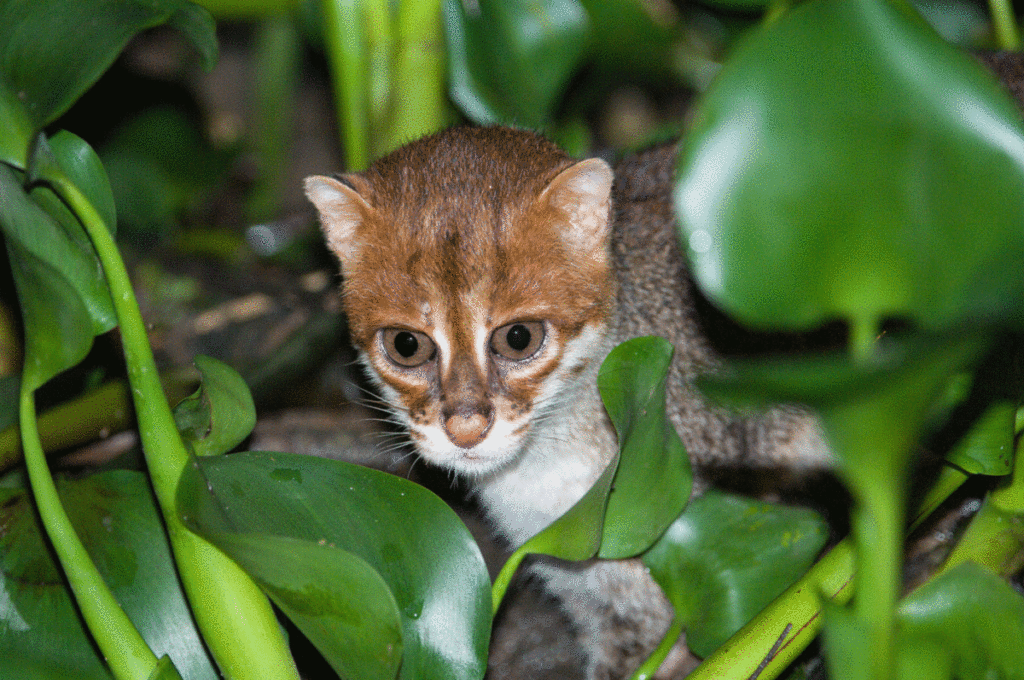
The Flat-Headed Cat’s physical appearance is marked by its flattened head, short muzzle, and rounded ears, setting it apart from other wild cat species. Its fur is a striking shade of reddish-brown with distinctive black markings, adding to its allure and making it a captivating subject for wildlife photographers and researchers.

Distribution

The distribution of the Flat-Headed Cat is restricted to specific regions in Southeast Asia, including southern Thailand, Peninsular Malaysia, Sumatra, and Borneo. This limited range underscores the species’ vulnerability and highlights the importance of targeted conservation efforts to safeguard its future. The population density of the Flat-Headed Cat is notably sparse, further emphasizing the need for conservation initiatives to protect this rare and enigmatic species.

Habitat Preferences

The Flat-Headed Cat exhibits a strong preference for wetland habitats, including lowland tropical rainforests and areas with access to shallow water bodies. These unique ecosystems support the cat’s specialized hunting behavior, as it preys mainly on fish, frogs, and other aquatic creatures. The species’ dependence on these specific habitats underscores the critical importance of preserving and restoring wetland environments to ensure the survival and well-being of the Flat-Headed Cat.

By highlighting the unique characteristics, appearance, distribution, and habitat preferences of the Flat-Headed Cat, this species profile aims to raise awareness about the importance of conservation efforts to protect this remarkable wild cat and its fragile natural habitat.

Facts About Flat-Headed Cat

  • The flat-headed cat (Prionailurus planiceps) is a small wild cat with short reddish-brown fur.
  • It has an elongated head and rounded ears.
  • The flat-headed cat is native to the Thai-Malay Peninsula, Borneo, and Sumatra.
  • This species is listed as Endangered, with a population size estimated to be around 2,500.
  • Flat-headed cats have a life span of about 14 years.
  • They weigh between 1.5-2.5 kg (3.3-5.5 lbs).
  • The length of the flat-headed cat ranges from 41-50 cm (16.1-19.7 inches).
  • These cats are found in wetlands in lowland forests on the islands of Sumatra, Borneo, and the Malayan Peninsula.
  • The flat-headed cat is part of the genus Prionailurus based on genetic analysis.
  • They are known for their unusual long, narrow head and flattened forehead.


Scientific Provenance & Verified Sources

Biological taxonomy, conservation status, and physical traits are cross-referenced with authoritative global registers:


Peer-reviewed by Wildlife Science Editors โ€ข Updated for 2026

Explore Other Species Profiles