European Wildcat

IUCN Red List Conservation Status


Least Concern

LC
NT
VU
EN
CR
EW
EX

Official assessment evaluated in accordance with the IUCN Red List of Threatened Species criteria: Least Concern.


Species Quick Facts

Scientific Name
Felis silvestris

Average Lifespan
5-7 years in wild, 12-15 years in captivity

Average Weight
3.5-8 kg (7.7-17.6 lbs) – Males: 5.5 kg, Females: 4.5 kg

Average Length
46-71 cm (18-28 inches) – head-body length excluding tail

Overview & Identification

The European wildcat (Felis silvestris) is a mediumโ€‘sized felid belonging to the family Felidae and the subfamily Felinae. It is the nominate subspecies of the wildcat species, which also includes African and Asian lineages. Its range stretches from the Iberian Peninsula across central and eastern Europe to western Siberia, and extends into parts of the Caucasus and the Near East. The cat inhabits a mosaic of deciduous, mixed, and coniferous forests, often preferring dense understory or rugged mountainous terrain where cover is abundant. It can also be found in scrubland, heath, and highโ€‘altitude grasslands up to 2,500โ€ฏm. European wildcats are solitary hunters with a cryptic coat pattern of dark stripes and spots that provides camouflage among leaf litter and shadowed trunks. Adults weigh between 3.5 and 8โ€ฏkg, measure 46โ€“71โ€ฏcm in headโ€‘body length, and possess a relatively long, bushy tail. Their reproductive biology, diet, and territorial behavior closely resemble those of other small felids, yet they retain distinct genetic markers that separate them from domestic cats. The IUCN lists the species as Least Concern, but many local populations are declining due to habitat fragmentation, hybridisation with feral domestic cats, and persecution. Conservation programs across Europe focus on habitat protection, genetic monitoring, and public awareness to preserve this emblematic predator of the continentโ€™s wild landscapes.

Behavior & Social Structure

European wildcats are primarily solitary, with males maintaining territories that may overlap the home ranges of several females. Homeโ€‘range size varies with habitat quality, ranging from 5โ€“15โ€ฏkmยฒ for females in forested areas to up to 30โ€ฏkmยฒ for males in more open landscapes. Activity peaks at dusk and dawn; they are crepuscular hunters but can also be nocturnal in regions with human disturbance. Communication relies on scent markingโ€”urine spraying, feces deposition, and cheek rubbing on vegetationโ€”to delineate boundaries and signal reproductive status. Vocalisations are limited to low growls, hisses, and occasional short mews, especially during mating encounters. While generally reclusive, individuals may tolerate brief overlap with conspecifics during the breeding season. Seasonal movements are modest; cats may shift to lower elevations in winter to exploit rodent abundance, but longโ€‘distance dispersal is rare, occurring mainly when subโ€‘adults leave their natal area to establish new territories.

Diet & Hunting Patterns

The European wildcat is an obligate carnivore, relying almost entirely on animal tissue for its nutritional needs. Its diet is opportunistic and reflects local prey availability, but small mammals dominate, comprising 70โ€“90โ€ฏ% of intake. Primary prey items include wood mice (Apodemus sylvaticus), bank voles (Myodes glareolus), and European water voles (Arvicola amphibius). In forested habitats, shrews (Sorex spp.) and juvenile hares (Lepus europaeus) supplement the diet, while in mountainous regions, marmots (Marmota marmota) and alpine rodents are taken. Birds such as groundโ€‘nesting pheasants (Phasianus colchicus) and passerines are captured opportunistically, especially during the breeding season when protein demand rises. Wildcats kill prey with a swift bite to the neck, delivering a quick, lethal blow. They typically consume the entire carcass, but may cache excess food in leaf litter or under rocks for later consumption. Daily food intake averages 150โ€“250โ€ฏg, roughly 3โ€“5โ€ฏ% of body weight, and they can survive several days without a meal during periods of prey scarcity.

Reproduction & Life Cycle

Sexual maturity is reached at 10โ€“12โ€ฏmonths for females and 12โ€“18โ€ฏmonths for males, although successful breeding often does not occur until the following year when individuals have secured adequate territories. The breeding season extends from February to April, with peak estrus in March. After a gestation period of 63โ€“68โ€ฏdays, females give birth to litters of 2โ€“4 kittens, though litters of up to 6 have been recorded in areas with abundant prey. Kittens are born blind and helpless, weighing about 100โ€ฏg, and are nursed exclusively for the first 8โ€“10โ€ฏweeks. Both parents may assist in provisioning, but the mother is the primary caregiver, teaching hunting skills through staged play and gradual release of live prey. Juveniles achieve independence at 9โ€“12โ€ฏmonths, after which they disperse to locate their own territories. Survival of the first year is low, estimated at 30โ€“40โ€ฏ% in most studies, largely due to predation, disease, and competition with domestic cats.

Threats & Conservation

The IUCN Red List classifies the wildcat species (Felis silvestris) as Least Concern, yet the European subspecies faces regionโ€‘specific pressures that have caused population declines in many countries. Habitat loss and fragmentation from intensive agriculture, urban expansion, and infrastructure development reduce suitable forest cover and isolate subpopulations, limiting gene flow. Hybridisation with feral or freeโ€‘roaming domestic cats is a major genetic threat; molecular studies indicate that up to 30โ€ฏ% of individuals in some southern European populations carry domestic cat alleles, jeopardising the taxonomic integrity of the wildcat. Direct persecution persists in areas where wildcats are mistakenly blamed for livestock predation, despite low economic impact. Road mortality, illegal trapping, and competition with introduced predators such as the American mink (Neovison vison) further exacerbate declines. Current estimates suggest a total European wildcat population of 30,000โ€“50,000 mature individuals, with numbers decreasing in the Balkans, the Iberian Peninsula, and parts of Central Europe. Conservation actions include protecting and reconnecting forest habitats, implementing strict control of feral cat populations, genetic monitoring to detect hybrid individuals, and public education campaigns to reduce humanโ€‘wildcat conflict.

Interesting Facts

โ€ข The European wildcatโ€™s coat pattern is genetically distinct from that of domestic cats, allowing scientists to identify pure individuals.
โ€ข It can leap up to 2โ€ฏmeters vertically when pursuing prey or evading threats.
โ€ข Subโ€‘adult males may travel up to 30โ€ฏkm during dispersal, the longest recorded movement for the species.
โ€ข Wildcats have been documented using abandoned burrows of other mammals as temporary shelters.
โ€ข In some Alpine regions, wildcats coexist with the endangered Eurasian lynx, sharing overlapping territories without direct competition.

Description

European Wildcat

The European wildcat (Felis silvestris silvestris) is a small wildcat subspecies characterized by its elusive nature and remarkable hunting skills. This feline species is a member of the Felidae family and shares a common ancestor with other members of the cat family, dating back approximately 10-15 million years.

Appearance

European Wildcat Appearance

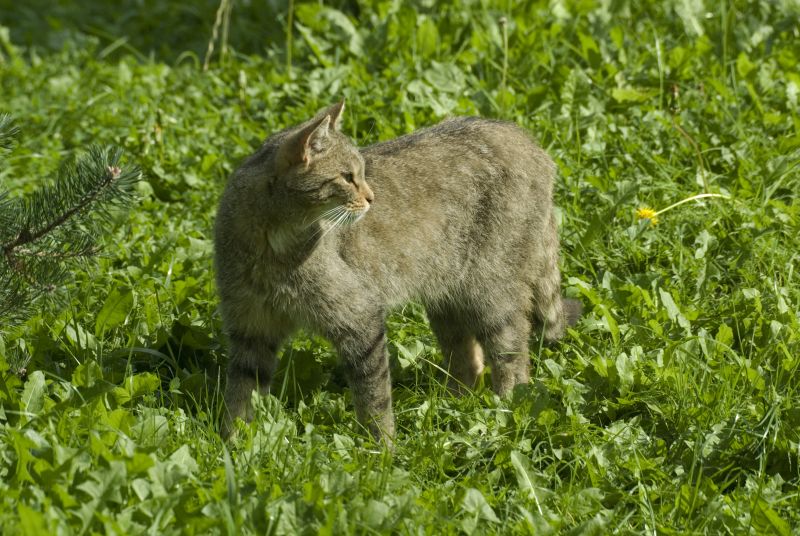
The European wildcat is distinguished by its robust build, short, dense fur, and a bushy, ringed tail. Its coat typically features a tabby pattern, with distinctive stripes and spots. Notably, the European wildcat’s appearance sets it apart from domestic cats, particularly in its larger size and more muscular physique. This subspecies also exhibits a notably wild and untamed appearance, emphasizing its strong connection to its natural habitat.

Distribution

The European wildcat is primarily found in continental Europe, with notable populations in countries such as Germany, France, Spain, Italy, and Scotland. Its distribution also extends to regions including Turkey and the Caucasus. The population density of European wildcats varies across its range, with higher concentrations in suitable habitats such as deciduous and mixed forests.

Habitat Preferences
European Wildcat Habitat

The European wildcat thrives in structurally rich deciduous and mixed forests, where it can utilize the cover provided by the dense vegetation for hunting and shelter. These habitats also offer an abundance of prey species, including small mammals and birds, which are essential for the wildcat’s survival. The presence of sufficient deadwood further contributes to the suitability of these environments for the European wildcat, providing essential resources for nesting and denning.

Overall, the European wildcat’s habitat preferences are closely tied to the availability of suitable cover, prey, and natural resources, emphasizing the species’ reliance on intact forest ecosystems for its well-being and persistence.

By [Wildlife Expert](https://www.wildlifeexpert.com)

Facts About European Wildcat

  • The European wildcat (Felis silvestris silvestris) is a small wildcat species native to continental Europe, Scotland, Turkey, and the Caucasus.
  • It inhabits forests and is predominantly nocturnal, but may also be active in the daytime when undisturbed by human activities.
  • The European wildcat is about the size of a large domestic cat, with a broad head and wide-set ears.
  • Its coat is thick and long in winter, generally gray-brown with boldly marked stripes.
  • European wildcats are extremely shy and avoid human contact whenever possible, living hidden in structurally rich broadleaf and mixed forests.
  • They have a lifespan of up to 15 years in the wild and weigh between 3-6 kg.
  • The species is classified as Felis silvestris and is considered of Least Concern (LC) in terms of endangered status.
  • European wildcats have keen sight and hearing, which are essential for their survival in the wild.
  • They primarily feed on small mammals, birds, and insects, making them skilled hunters within their forest habitats.
  • The European wildcat’s conservation status is closely monitored, with efforts in place to protect its natural habitat and ensure its long-term survival.


Scientific Provenance & Verified Sources

Biological taxonomy, conservation status, and physical traits are cross-referenced with authoritative global registers:


Peer-reviewed by Wildlife Science Editors โ€ข Updated for 2026

Explore Other Species Profiles