European ground squirrel

IUCN Red List Conservation Status


Least Concern

LC
NT
VU
EN
CR
EW
EX

Official assessment evaluated in accordance with the IUCN Red List of Threatened Species criteria: Least Concern.


Species Quick Facts

Scientific Name
Spermophilus citellus

Average Lifespan
Up to about 6โ€“10 years (maximum ~6.7 recorded in captivity).

Average Weight
About 240-340 g (8.5-12 oz).

Average Length
Body length 20-23 cm (8-9 inches), plus a short tail.

Overview & Identification

The European ground squirrel, or European souslik, is a burrowing ground squirrel of central and southeastern European grasslands and steppes. It lives in colonies, hibernates through winter, and feeds on seeds, green plant parts, and insects. Habitat loss has made it a species of conservation concern.

Behavior & Social Structure

The European ground squirrel (Spermophilus citellus), also known as the European souslik, is a strictly diurnal rodent whose activity is tightly synchronized with sunlight and temperature. Individuals emerge from their burrows shortly after sunrise to forage, bask, and engage in social interactions before retreating underground during the hottest midday hours in summer, then re-emerging in the late afternoon. This species is highly social for a ground squirrel, living in colonies that can range from a handful of individuals to several hundred in prime grassland habitat, with population densities sometimes exceeding 20-100 individuals per hectare in optimal conditions such as short-grass steppe, pastures, and airfield margins.

Communication within colonies relies heavily on a repertoire of high-pitched alarm whistles and chirps that alert conspecifics to approaching predators such as raptors, foxes, and mustelids, along with postural displays (an upright “sentinel” stance) and scent marking via cheek and anal glands to convey information about identity, reproductive status, and territory boundaries. Home ranges are relatively small and overlap extensively within a colony, though males may expand their range during the breeding season to access multiple females, occasionally leading to aggressive encounters and dominance hierarchies.

One of the species’ most remarkable adaptive behaviors is obligate hibernation, lasting from late summer or early autumn through winter (often 6-8 months), during which body temperature drops close to ambient levels and metabolic rate slows dramatically to conserve energy. This extended dormancy, combined with a short active season for fattening and reproduction, exemplifies a life-history strategy finely tuned to the seasonal extremes of continental grassland climates.

Diet & Hunting Patterns

European ground squirrels are primarily herbivorous grazers, feeding on a wide variety of grasses, herbs, seeds, flowers, and leaves found in short-grass steppe and managed grassland habitats. Preferred food plants include clover, dandelion, various grasses (Poaceae), and cultivated crops such as alfalfa, wheat, and barley when colonies occur near agricultural land. Foraging occurs close to burrow entrances to minimize predation risk, with individuals adopting a “central-place foraging” strategy that balances energy intake against exposure to aerial and terrestrial predators.

While the diet is overwhelmingly plant-based, individuals opportunistically supplement their intake with insects, snails, and occasionally the eggs or nestlings of ground-nesting birds, providing additional protein critical for reproduction and pre-hibernation fat accumulation. Seasonal dietary shifts are pronounced: in spring, squirrels favor fresh green shoots and flowers rich in water and nutrients, while in late summer they prioritize energy-dense seeds and roots to build fat reserves for hibernation. Water dependency is low, as the species derives most of its moisture from succulent vegetation, an adaptation well suited to the semi-arid grasslands it inhabits.

Reproduction & Life Cycle

Breeding begins shortly after emergence from hibernation in early spring (typically March to April), making mating a race against the short active season. The species exhibits a promiscuous/polygynous mating system, with males competing for access to receptive females through chases and physical contests; the most dominant males often achieve the majority of matings within a colony. Following a gestation period of approximately 25-26 days, females give birth to a single annual litter averaging 4-8 pups (occasionally up to 12), born blind, hairless, and highly altricial in an underground nest chamber lined with dried grass.

Maternal care is exclusive to the female, who nurses and protects the young in the natal burrow for several weeks. Pups first emerge above ground at roughly 4-5 weeks of age and are fully weaned by about 6 weeks, after which juveniles begin foraging independently while remaining loosely associated with the maternal territory. Sexual maturity is typically reached at around 10-11 months, allowing individuals to breed in the spring immediately following their birth, though survival to this first breeding season is far from guaranteed given high juvenile mortality from predation and hibernation failure.

Threats & Conservation

The European ground squirrel is classified as Least Concern by the IUCN, but this masks significant regional declines, particularly in Central and Western Europe where populations have fragmented or disappeared due to habitat loss. Agricultural intensification, cessation of traditional grazing, afforestation of steppe grasslands, and urban expansion have destroyed or degraded the short-grass habitats the species requires, while abandonment of grazing land allows vegetation to grow too tall, rendering habitat unsuitable as squirrels rely on short swards for predator detection. In several countries, including Germany, Poland, and parts of Austria, local extinctions have already occurred, prompting the species’ listing under the EU Habitats Directive (Annex II and IV) as a priority species for conservation.

Natural predators include birds of prey such as buzzards, kestrels, and eagles, as well as foxes, mustelids (polecats, weasels), and snakes, all of which exert strong top-down pressure on colonies, especially on juveniles. Climate change poses an emerging threat by altering the timing and duration of hibernation and the phenology of food plants, potentially creating mismatches between energy needs and resource availability. Conservation initiatives across the species’ range include habitat restoration through managed grazing regimes, reintroduction and translocation programs (notably in Poland, Germany, and Hungary), legal protection under national and EU legislation, and monitoring programs coordinated by organizations such as the IUCN Species Survival Commission’s Rodent Specialist Group.

Interesting Facts

  • Keystone Ecosystem Engineer: Ground squirrel burrows create microhabitats and soil aeration that benefit numerous other steppe species, including insects, reptiles, and the endangered European souslik-dependent predators, making it a keystone species in grassland ecosystems.
  • Extreme Hibernators: Individuals can spend up to 8 months of the year in hibernation, during which heart rate can drop from around 200 beats per minute to fewer than 10, and body temperature approaches ambient levels near freezing.
  • Vital Prey Base: This species is a critical food source for the globally threatened saker falcon (Falco cherrug) and imperial eagle (Aquila heliaca), linking its population health directly to raptor conservation success across Eastern Europe.
  • Colonial Sentinels: Colony members take turns acting as “sentinels,” standing upright on hind legs to scan for predators and emitting distinct alarm calls that vary depending on whether the threat is aerial or terrestrial.
  • Rapid Reproductive Window: Because the active season is so short, females must conceive, gestate, and wean an entire litter within just a few months of spring emergence, one of the tightest reproductive windows among ground squirrels.
  • Historic Range Contraction: Fossil and historical records show the species once ranged much further into Central and Western Europe, with local extirpations over the last century serving as a bellwether for steppe grassland degradation.
  • Taxonomic Reclassification: Once grouped broadly within genus Spermophilus, molecular studies have prompted debate over reclassifying some Eurasian ground squirrels into the genus Spermophilus proper versus other related genera, reflecting ongoing refinement of Sciuridae taxonomy.

The European ground squirrel, scientifically known as Spermophilus citellus and colloquially referred to as the European souslik, is a fascinating member of the squirrel family, Sciuridae. This species is one of the few European representatives in the genus Spermophilus, and it possesses a range of unique characteristics that distinguish it from other members of the squirrel family.

Description

European ground squirrel

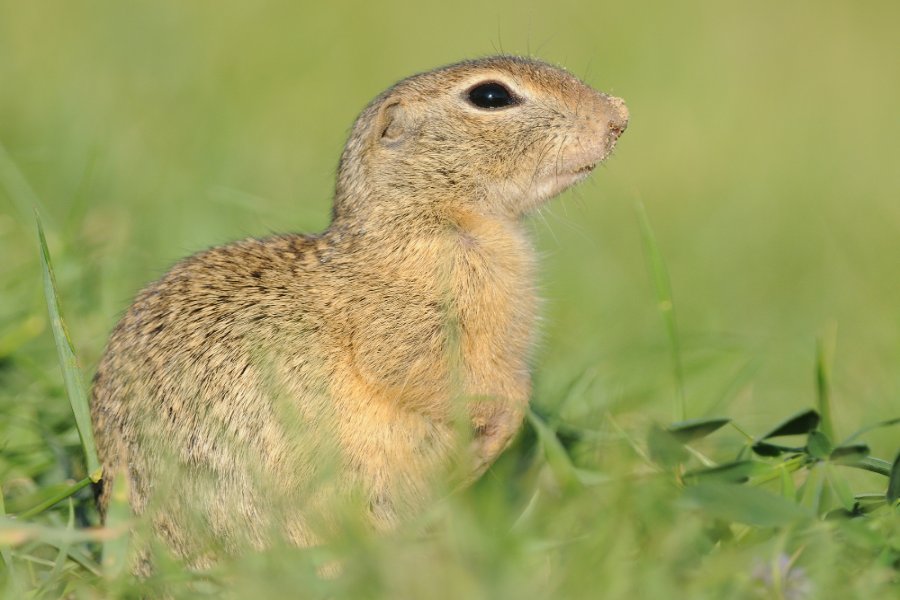
The European ground squirrel is a diurnal and social rodent, known for its distinctive shrill whistle that it emits as an early warning signal. It is a medium-sized ground squirrel with a compact, robust body, short legs, and a relatively short, bushy tail. Their fur varies in color, ranging from sandy brown to grayish-brown, often with a lighter underside. Their fur provides effective camouflage in their natural habitat.

Appearance
European ground squirrel Appearance

Distinctive features of the European ground squirrel include a relatively short tail compared to other ground squirrel species and a mottled appearance on its fur, which aids in blending with its surroundings. The species also exhibits a characteristic upright stance when alert, allowing for enhanced visibility and communication within the colony.

Distribution

The European ground squirrel is primarily found in Eastern Europe and extends into parts of Asia Minor. Its range encompasses countries such as Hungary, Romania, Bulgaria, Slovakia, and Ukraine. Although historically widespread, the population of European ground squirrels has experienced declines in certain regions due to habitat loss, agricultural intensification, and other human-induced pressures.

Habitat Preferences

European ground squirrel Habitat

European ground squirrels thrive in open landscapes such as steppes, grasslands, and meadows with loose, well-drained soil. These environments provide the ideal conditions for their burrowing behavior, as they construct complex underground burrow systems for shelter and hibernation. The presence of short grasses and low vegetation is crucial for foraging and maintaining visibility to detect potential predators.

As a conservation scientist, it is imperative to recognize the significance of preserving the natural habitats and ecosystems that support the survival of the European ground squirrel. By understanding the species’ unique characteristics and ecological requirements, conservation efforts can be tailored to ensure the long-term viability of this iconic mammal within its native range.

Facts About European Ground Squirrel

  • The European ground squirrel (Spermophilus citellus) is also known as the European souslik.
  • It is an endangered species endemic to Central and Southeastern Europe.
  • The squirrel has a slender build and can grow to a length of approximately 20cm with a 6cm-long furry tail.
  • Population densities of โ‰ฅ1-year-old European ground squirrels present during the mating season have ranged from 6.3 to 61 individuals per hectare.
  • The species inhabits burrow colonies in grasslands and steppes.
  • European ground squirrels weigh up to 8.5 ounces and can reach a length of up to 7.8 inches.
  • They are iconic to the open steppe grasslands of southeastern Europe.
  • The species is facing a decline in numbers.
  • The European ground squirrel belongs to the squirrel family, Sciuridae.
  • Conservation efforts, such as translocation programs, are being carried out to help preserve the species.


Scientific Provenance & Verified Sources

Biological taxonomy, conservation status, and physical traits are cross-referenced with authoritative global registers:


Peer-reviewed by Wildlife Science Editors โ€ข Updated for 2026

Explore Other Species Profiles