
Description

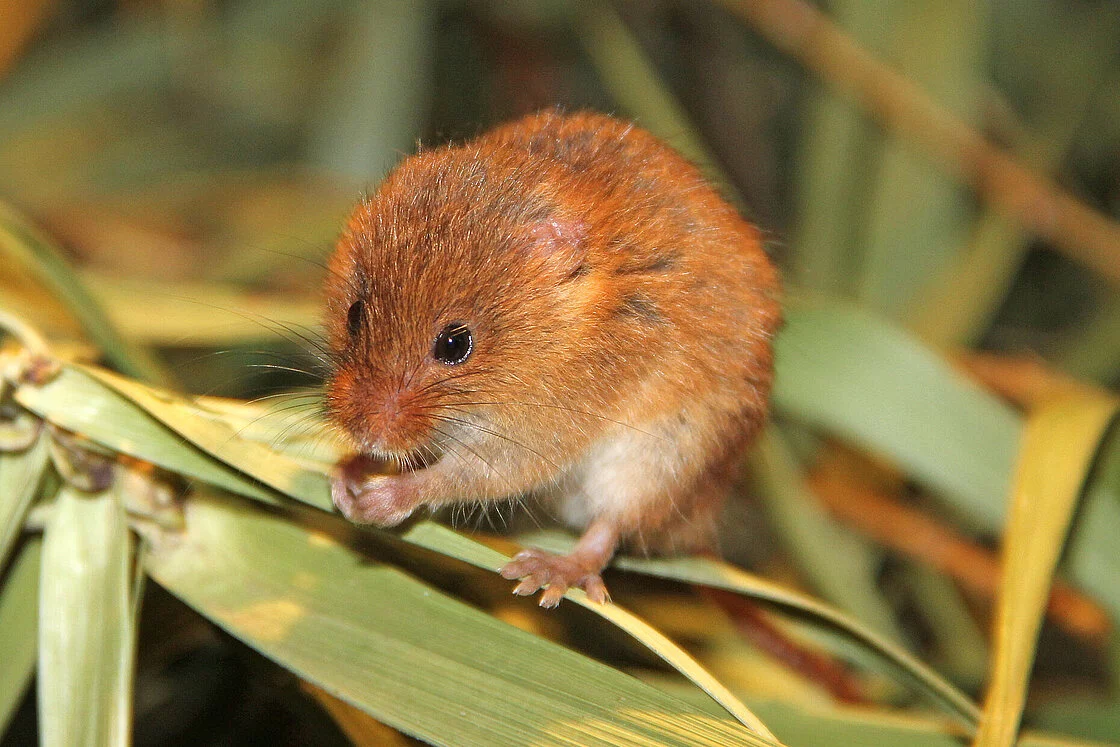
The Eurasian harvest mouse, scientifically known as Micromys minutus, is one of the smallest species of rodents, measuring around 55 to 75 millimeters in length, with a tail almost equal in length to its body. This diminutive mammal has a distinctive reddish-brown fur on its upper body and a white or cream-colored underside. Its large eyes and ears contribute to its endearing appearance, while its long prehensile tail aids in climbing and balancing in its natural habitat.
Appearance

The Eurasian harvest mouse can be distinguished by its small size, long tail, and reddish-brown fur. Its diminutive stature and unique coloration set it apart from other small rodents, making it easily recognizable in its natural habitat.
Distribution
This species is native to Europe and parts of Asia, with a distribution that spans across various countries in these regions. It can be found in a wide range of habitats, including fields of cereal crops such as wheat and oats, reed beds, and other tall ground vegetation like long grass and hedgerows. The Eurasian harvest mouse is known for its adaptability to diverse environments and can thrive in both natural and agricultural landscapes.
Habitat Preferences

The Eurasian harvest mouse exhibits a preference for habitats with tall grasses and other vegetation, including tussocky grasslands, field margins, road verges, and reed beds. These environments provide ample cover and nesting opportunities for the species, allowing it to forage for food and seek shelter effectively. The ability of the Eurasian harvest mouse to inhabit a variety of ecosystems reflects its ecological flexibility and resilience in the face of changing landscapes.
By offering a comprehensive overview of the Eurasian harvest mouse, this species profile aims to enhance understanding and appreciation for this remarkable mammal, ultimately contributing to conservation efforts and the protection of its natural habitats.
Facts About Eurasian Harvest Mouse
- The Eurasian harvest mouse (Micromys minutus) is the smallest rodent in Britain, weighing only 6g as an adult, which is less than a 2 pence coin!
- This species is typically found in fields of cereal crops, such as wheat and oats, in Europe and Asia.
- The Eurasian harvest mouse is a plant-dominated omnivore, consuming seeds, fruits, roots, moss, other plant matter, fungi, and small amounts of invertebrates.
- It resides in a wide range of complex habitats that have tall grasses and other vegetation, including tussocky grasslands, hedgerows, field margins, road verges, and reed beds.
- The average lifespan of the Eurasian harvest mouse in the wild is about 6 to 18 months.
- Eurasian harvest mice are known for their remarkable climbing abilities and can often be found in grassy areas, climbing among the stems and grass blades.
- They are primarily nocturnal, being most active during the night and resting during the day in nests made of woven grass, often built above ground in grassy tussocks or at the base of reeds.
- The breeding season for Eurasian harvest mice typically occurs from May to October, with females giving birth to litters of 3-7 young after a gestation period of about 18-21 days.
- This species has a high reproductive rate, with females being able to produce multiple litters in a year under favorable conditions.
- Eurasian harvest mice play a role in seed dispersal and contribute to ecosystem health through their foraging and nesting behaviors.


