Egyptian fruit bat hanging upside down from a tree branch

IUCN Red List Conservation Status


Least Concern

LC
NT
VU
EN
CR
EW
EX

Official assessment evaluated in accordance with the IUCN Red List of Threatened Species criteria: Least Concern.


Species Quick Facts

Scientific Name
Rousettus aegyptiacus

Average Lifespan
About 8-10 years on average in the wild, with a maximum of about 22-25 years.

Average Weight
80-170 g (2.8-6 oz).

Average Length
Body length about 15 cm (6 inches), with a wingspan of about 60 cm.

Overview & Identification

The Egyptian fruit bat (Rousettus aegyptiacus) is a medium-sized fruit bat of Africa, the Middle East, and South Asia. Unusual among fruit bats, it uses a simple form of tongue-click echolocation to navigate the dark caves where it roosts in large colonies. It flies out at night to feed on fruit and is an important seed disperser.

Behavior & Social Structure

The Egyptian fruit bat (Rousettus aegyptiacus) is strictly nocturnal, emerging from its roost shortly after sunset to forage and returning before dawn. During daylight hours, colonies retreat deep into caves, abandoned mines, rock crevices, and occasionally man-made structures like tunnels and building attics, where they roost in dense clusters on ceilings. This species is highly gregarious, forming colonies that range from a few dozen to tens of thousands of individuals, making it one of the most socially complex of the Old World fruit bats. Within these colonies, social hierarchies form around roosting position, with dominant males often controlling prime central roosting spots.

Rousettus aegyptiacus is notable for being one of the few megabats capable of echolocation, using tongue-clicking (rather than laryngeal calls typical of microbats) to navigate the pitch darkness of cave interiorsโ€”an adaptation unique among fruit bats. Beyond echolocation clicks, the species produces an extensive vocal repertoire of over 30 distinct sound types used for social communication, including aggressive squabbles over roosting space, mother-pup contact calls, and mating vocalizations. Research has shown these bats display a form of directed communication, adjusting the acoustic structure of calls depending on the identity of the individual being addressedโ€”a rare trait suggestive of advanced social cognition.

Home ranges can extend up to 20โ€“40 km round-trip per night as bats commute from cave roosts to scattered fruiting trees, often using consistent flight paths (traplines) learned through spatial memory. While not overtly territorial at the landscape scale, individuals defend small personal space bubbles within the roost, and males may guard temporary harems of females during certain periods of the reproductive cycle.

Diet & Hunting Patterns

As an obligate frugivore, the Egyptian fruit bat feeds primarily on soft, pulpy fruits including figs (Ficus species), dates, mangoes, guavas, and bananas, along with nectar and pollen from certain flowering trees. Rather than swallowing solid fruit matter, individuals typically chew fruit to extract the juice and soft pulp, spitting out the fibrous remains and seeds in distinctive ejected pelletsโ€”a behavior that makes them important long-distance seed dispersers for numerous plant species across their African and Middle Eastern range. Their foraging strategy relies heavily on spatial memory and olfaction rather than echolocation for locating ripe fruit, with individuals returning night after night to reliable fruiting trees.

Metabolically, these bats possess highly efficient digestive systems adapted for rapid fruit-sugar processing, with gut transit times often under 30 minutes to accommodate their high-energy, high-volume diet. Seasonal fruiting patterns drive local migrations and shifts in foraging locations, with colonies tracking the availability of preferred fig and date crops across wet and dry seasons. Water dependency is moderate; most hydration needs are met through fruit consumption, though bats will drink from open water sources, especially during hot, dry periods.

Reproduction & Life Cycle

Egyptian fruit bats exhibit a polygynous-promiscuous mating system, with dominant males defending small harems or preferred roosting territories that attract multiple females. Breeding often occurs biannually in favorable climates, corresponding to periods of peak fruit abundance, though populations at higher latitudes may show a single annual breeding peak. Gestation lasts approximately 4 months (110โ€“120 days), after which females typically give birth to a single pup, with twins occurring only rarely.

Maternal care is intensive; pups are born nearly naked and cling to their mother’s body, being carried during early foraging flights until they become too heavy, at which point they are left in roosting clusters (“crรจches”) with other juveniles while mothers forage. Weaning occurs at approximately 2โ€“3 months of age, and young bats achieve full flight capability around 8โ€“10 weeks. Sexual maturity is reached at roughly 6โ€“9 months for females and slightly later, around 15โ€“18 months, for males, reflecting typical mammalian patterns of delayed male reproductive competitiveness.

Threats & Conservation

Despite its Least Concern status, Rousettus aegyptiacus faces localized pressures, primarily from habitat disturbance and destruction of roosting caves due to mining, quarrying, and cave tourism development. In several countries, including Israel and Egypt, the species is persecuted as an agricultural pest due to its fondness for commercial fruit crops, leading to culling campaigns, netting, and poisoning efforts by orchard ownersโ€”despite its crucial ecological role in seed dispersal and pollination. Human disturbance of roosting caves, particularly during sensitive breeding and pup-rearing periods, can cause colony abandonment and increased pup mortality.

The species also gained public attention as a natural reservoir host for Marburg virus, prompting some regions to engage in fear-driven culling despite scientific consensus that transmission risk to humans is low with minimal direct contact. Natural predators include birds of prey, snakes, and carnivorous mammals that ambush bats at cave entrances during emergence flights. Conservation initiatives focus on public education to reduce human-caused mortality, protection of key cave roosts, and research into virus ecology to promote coexistence rather than eradication; the IUCN and regional wildlife agencies continue to monitor population trends, which remain broadly stable across its extensive range spanning Africa, the Middle East, and parts of the Mediterranean (source: IUCN Red List).

Interesting Facts

  • Tongue-Click Echolocation: Unlike most megabats, Rousettus aegyptiacus produces echolocation clicks using its tongue rather than its larynx, allowing it to navigate completely dark cave systemsโ€”a rare trait among fruit bats.
  • Extensive Vocal Vocabulary: Studies using machine learning have identified over 30 distinct call types, with evidence suggesting these bats can direct specific vocalizations at particular individuals, indicating complex social communication.
  • Massive Colonies: Roosting colonies can number in the tens of thousands, making them among the most densely social of all bat species, often sharing caves with other bat species.
  • Seed Dispersal Powerhouse: As primary dispersers of fig and other fruit seeds, they play a keystone ecological role in regenerating forest and woodland habitats across their range.
  • Natural Marburg Virus Reservoir: This species is the only known natural reservoir host of the Marburg virus, making it critically important for zoonotic disease research and surveillance.
  • Wide Geographic Range: Found from sub-Saharan Africa through the Middle East to Cyprus and Pakistan, it has one of the broadest distributions of any Old World fruit bat.
  • Fruit-Pulp Feeding Strategy: Rather than swallowing whole fruit, individuals chew and extract juice, spitting out fibrous “ejecta pellets”โ€”a foraging adaptation that reduces digestive load while maximizing caloric intake.

Description

The Egyptian fruit bat, also known as the Egyptian rousette, is a fascinating species of megabat belonging to the Pteropodidae family. These bats are characterized by their large eyes adapted for twilight and night vision, and their dark brown wing membranes with short fur extending to the proximal half of the wing. They are herbivores, primarily feeding on fruit, flowers, buds, and leaves, with occasional observations of them consuming small insects. Their social nature leads them to live in colonies, often with thousands of other bats, making them a highly social species.

Appearance
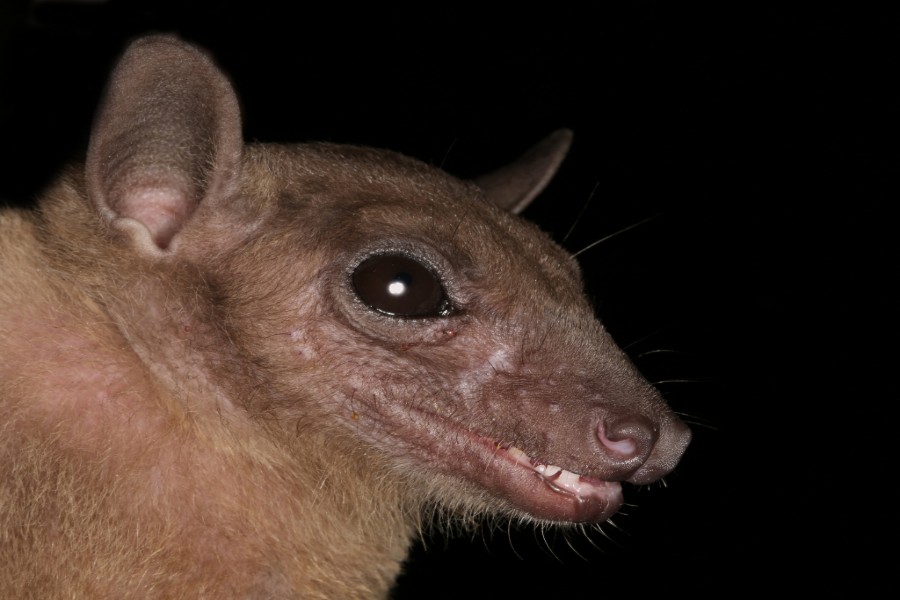
The Egyptian fruit bat exhibits unique physical characteristics that distinguish it from other bat species. With a length of about six inches and a large wingspan of about two feet, these bats are smaller in size compared to some other megabat species. Their large eyes and distinctive wing membranes contribute to their exceptional adaptation for nocturnal activities and fruit feeding. These features, combined with their social behavior, make them a remarkable species to study and observe in their natural habitat.

Distribution

The Egyptian fruit bat is found across a wide geographic range, including Africa, the Middle East, the Mediterranean, and the Indian subcontinent. Within these regions, they can be found in various countries and exhibit notable population densities in specific areas. Their distribution across these diverse regions provides researchers and conservationists with a rich opportunity to study their behavior and ecological interactions in different ecosystems.

Habitat Preferences

Egyptian fruit bats thrive in a range of habitats, including forests, woodlands, and agricultural areas where fruit-bearing trees and plants are abundant. These environments provide the necessary resources for their survival, including food sources and roosting sites. The bats’ reliance on fruit as a primary food source underscores the importance of preserving their natural habitats to maintain the delicate balance of local ecosystems and ensure their continued well-being.

As a renowned expert in animal conservation and wildlife education, I hope this comprehensive species profile provides valuable insights into the remarkable Egyptian fruit bat, highlighting its unique characteristics, distribution, and habitat preferences.

Facts About Egyptian Fruit Bat

  • Egyptian fruit bats have large eyes adapted for twilight and night vision.
  • Adults have an average total body length of 15 cm and an average wingspan of about 60 cm.
  • They are found in Africa, the Middle East, the Mediterranean, and the Indian subcontinent.
  • Egyptian fruit bats leave their roosts at sunset each evening to feed on a range of fruits.
  • They consume 50-150% of their body weight in fruits.
  • The fruit bat Rousettus aegyptiacus lives entirely on a diet of ripe fruit.
  • They are known as medium-sized megabats.
  • Egyptian fruit bats are native to the Palearctic and Ethiopia.
  • They have a unique reproductive seasonality.
  • Egyptian fruit bats are considered important pollinators and seed dispersers in their ecosystems.


Scientific Provenance & Verified Sources

Biological taxonomy, conservation status, and physical traits are cross-referenced with authoritative global registers:


Peer-reviewed by Wildlife Science Editors โ€ข Updated for 2026

Explore Other Species Profiles