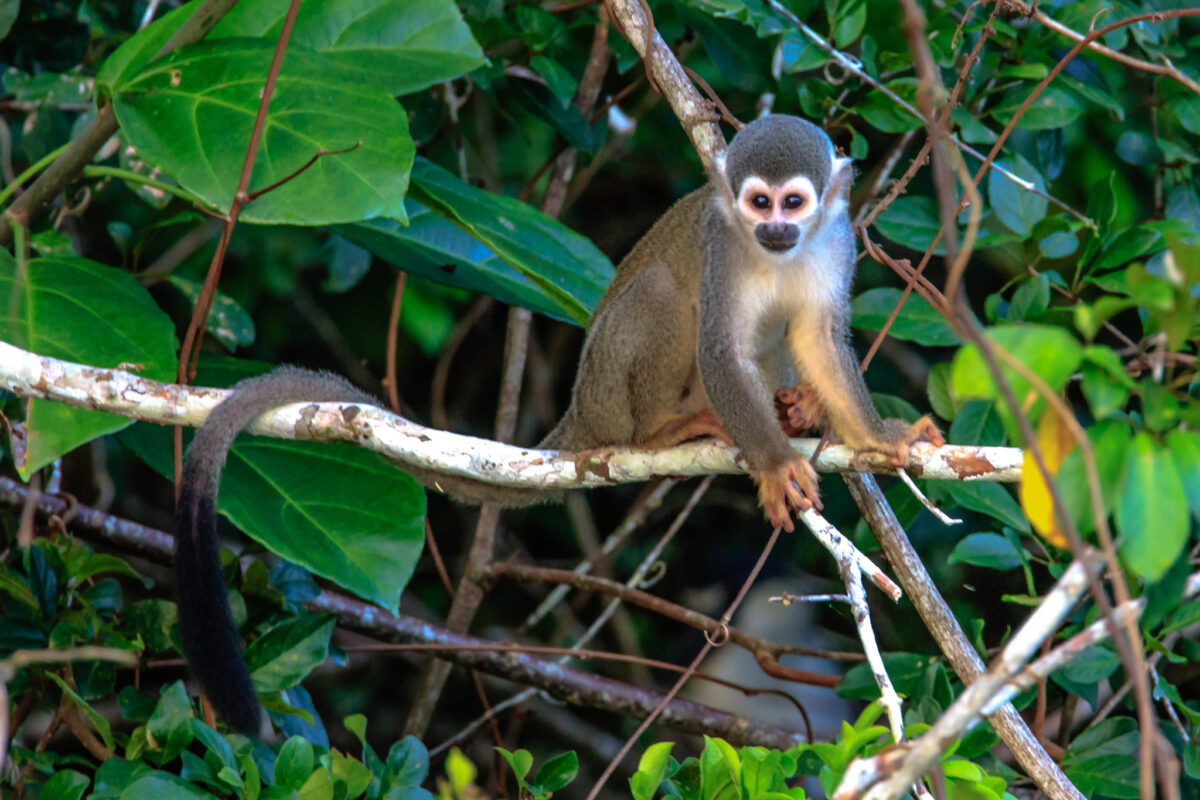
Ecuadorian squirrel monkey perched on a branch amid dense tropical foliage

IUCN Red List Conservation Status


Least Concern

LC
NT
VU
EN
CR
EW
EX

Official assessment evaluated in accordance with the IUCN Red List of Threatened Species criteria: Least Concern.


Species Quick Facts

Scientific Name
Saimiri sciureus

Average Lifespan
About 15-20 years in the wild and up to 25 years in captivity.

Average Weight
Males 885-1,380 g, females 590-1,150 g.

Average Length
Head-body 25-32 cm (10-13 inches), plus a longer 34-44 cm tail.

Overview & Identification

The Ecuadorian squirrel monkey (Saimiri oerstedii) is a small, vibrantly colored primate native to the rainforests of Ecuador and Colombia. These monkeys primarily inhabit the canopy of humid lowland forests, feeding almost exclusively on fruits, insects, and flower nectar. Notably, they are known for their incredibly agile movements and distinctive, bright orange-red faces, which are unique to the Ecuadorian subspecies.

Behavior & Social Structure

The Ecuadorian squirrel monkey (Saimiri sciureus) is strictly diurnal, beginning its activity at first light and retreating to sleeping trees before dusk. These small primates are highly social, living in large, dynamic troops that can range from 20 to over 75 individuals, among the largest group sizes of any New World primate. Troop structure is typically matrilineal, with females forming the stable social core while males may transfer between groups, especially outside of the breeding season. This fission-fusion social system allows subgroups to split for foraging efficiency and reconvene for rest and predator vigilance.

Communication is rich and multimodal, involving a wide vocal repertoire of chucks, twitters, peeps, and alarm calls used to coordinate movement, signal danger, and maintain group cohesion across dense canopy. Scent marking, particularly urine-washing on hands and feet, plays a role in individual recognition and possibly reproductive signaling. Tactile behaviors such as huddling, allogrooming, and juvenile play reinforce social bonds, particularly among females and their offspring.

Home ranges vary from 20 to over 100 hectares depending on habitat productivity and troop size, with substantial overlap between neighboring groups rather than strict territorial defense. Squirrel monkeys frequently associate with capuchin monkeys (Cebus spp.) in mixed-species foraging troops, a behavior thought to enhance predator detection and foraging success through shared vigilance and resource cues.

Diet & Hunting Patterns

As opportunistic omnivores, Ecuadorian squirrel monkeys spend the majority of their daylight hours foraging, with insectsโ€”particularly caterpillars, beetles, spiders, and orthopteransโ€”constituting a critical protein source, especially during the breeding season. They employ an active manual search strategy, meticulously inspecting curled leaves, bark crevices, and epiphytes, using rapid, precise hand movements to extract hidden prey. Fruit, particularly small, sugar-rich species from the understory and mid-canopy, supplements this insectivorous diet and provides essential carbohydrates for their high metabolic rate.

Their small body size (typically under 1.1 kg) confers a disproportionately high metabolic demand relative to larger primates, necessitating near-constant foraging and a diet high in easily digestible sugars and lipids. Diet composition shifts seasonally: during wetter months with abundant fruiting, frugivory increases, while during drier periods insect consumption rises to compensate for reduced fruit availability. Water is obtained primarily through food items and rainwater pooled in bromeliads and tree hollows, reducing dependency on ground-level water sources and consequently lowering predation risk.

Reproduction & Life Cycle

Breeding in Ecuadorian squirrel monkeys is seasonal and tightly synchronized with resource availability, with mating typically occurring during the dry season so that births coincide with peak fruit and insect abundance. The mating system is promiscuous, with dominant males exhibiting a distinctive “fatted” physiological conditionโ€”temporary weight gain and muscle hypertrophyโ€”during the breeding period to enhance competitive success. Gestation lasts approximately 152 to 170 days, culminating in the birth of a single infant, with twinning being extremely rare.

Maternal care is intensive, with infants clinging to their mother’s back within hours of birth and remaining closely dependent for several months. Alloparental care, including occasional carrying by other females, has been documented, though the mother remains the primary caregiver. Weaning occurs around 4 to 6 months of age, while sexual maturity is reached laterโ€”females typically at 2.5 to 3 years and males at 4 to 5 yearsโ€”reflecting a life history strategy weighted toward extended juvenile learning and social integration.

Threats & Conservation

The most significant threat to Ecuadorian squirrel monkey populations is habitat loss and fragmentation driven by deforestation for agriculture, cattle ranching, logging, and oil extraction infrastructure across the western Amazon basin. Fragmentation isolates troops, restricts genetic exchange, and increases edge effects that degrade forest quality and food availability. In some regions, illegal capture for the pet trade and, historically, for biomedical research has placed additional pressure on wild populations, though such practices have declined due to stricter regulations.

Natural predators include raptors such as harpy eagles, forest hawks, boas, and other constricting snakes, with anti-predator vigilance being a key driver of their large group sizes and mixed-species associations. Climate change poses an emerging threat by altering fruiting and insect emergence phenology, potentially creating mismatches between reproductive timing and resource peaks. Conservation initiatives, including protected reserves in Ecuador, Peru, Colombia, and Brazil, along with CITES Appendix II trade regulations, aim to mitigate these pressures, though enforcement and continuous habitat monitoring remain essential for long-term population stability.

Interesting Facts

  • Largest Primate Troops: Ecuadorian squirrel monkeys form some of the largest cohesive groups of any New World primate, sometimes exceeding 75 individuals, an adaptation thought to reduce individual predation risk.
  • The “Fatted” Male Phenomenon: During the breeding season, dominant males undergo a temporary physiological transformation, gaining up to 20% body mass through water retention and fat deposition to signal dominance and reproductive fitness.
  • Exceptional Brain-to-Body Ratio: Squirrel monkeys possess one of the highest brain-to-body mass ratios among primates, rivaling that of humans proportionally, linked to their complex social cognition and spatial memory for foraging.
  • Mixed-Species Alliances: They frequently forage alongside capuchin monkeys in mutually beneficial associations, leveraging the capuchins’ foraging expertise and shared vigilance against predators.
  • Rapid Reflexes: Their manual dexterity allows them to snatch fast-moving insects mid-air or from foliage with remarkable precision, a skill critical given their high metabolic insect-protein requirements.
  • Urine-Washing Behavior: Squirrel monkeys rub urine onto their hands and feet, a behavior believed to aid in scent communication, thermoregulation, and possibly antimicrobial skin maintenance.
  • Taxonomic Complexity: The Ecuadorian population was long debated among taxonomists, with some classifying it as a subspecies of the common squirrel monkey complex, reflecting the broader unresolved phylogenetic diversity within the genus Saimiri.

Description

The Ecuadorian squirrel monkey, scientifically known as Saimiri cassiquiarensis macrodon, is a fascinating species of squirrel monkey. Formerly considered a subspecies of the Guianan squirrel monkey (Saimiri sciureus), it has been elevated to full species status as S. macrodon based on distinct genetic and morphological differences.

Appearance

This species is characterized by its striking appearance, with a predominantly olive-colored fur coat and a bright yellow or orange back and limbs. Its face is adorned with a distinctive white or pale yellow mask around the eyes, giving it a unique and captivating look. These distinguishing features set it apart from other squirrel monkey species and contribute to its allure.

Distribution

The Ecuadorian squirrel monkey is found in the western Brazilian Amazon, as well as southern Colombia, eastern Ecuador, and northern and eastern Peru. This distribution encompasses a diverse range of habitats, reflecting the adaptability of this species to various environmental conditions.

Habitat Preferences

These monkeys thrive in forest and rainforest ecosystems, where they demonstrate remarkable agility and adaptability to their surroundings. Their ability to navigate the upper parts of various forest types allows them to forage for food in and around the canopy, showcasing their adeptness at utilizing their habitat for survival.

Overall, the Ecuadorian squirrel monkey’s presence in these regions underscores the importance of preserving and protecting its natural habitat in the face of environmental challenges and human encroachment.

Facts About Ecuadorian squirrel monkey

  • The Ecuadorian squirrel monkey (Saimiri cassiquiarensis macrodon) is a species of squirrel monkey found in the Amazon rainforest of Ecuador.
  • They have a body and head length of between 25 and 32 cm (9.8 to 12.6 inches) and a tail length of 35 to 41 cm (13.8 to 16.1 inches).
  • These monkeys weigh between 750 and 1100 grams (1.6 to 2.4 pounds) and exhibit little sexual dimorphism between genders.
  • Ecuadorian squirrel monkeys are highly social animals and live in large groups, often consisting of 40 or more individuals.
  • Their diet primarily consists of fruits, insects, and small vertebrates, and they are known to be excellent jumpers and climbers.
  • The species is known for its distinctive vocalizations, which are used for communication within the group.
  • Female Ecuadorian squirrel monkeys typically give birth to a single offspring after a gestation period of around 150 days.
  • These monkeys are important seed dispersers in their habitat, contributing to the maintenance of the rainforest ecosystem.
  • Conservation efforts are crucial for the Ecuadorian squirrel monkey due to habitat loss and fragmentation caused by human activities.
  • The species is listed as Near Threatened on the IUCN Red List, highlighting the need for conservation measures to protect its population.


Scientific Provenance & Verified Sources

Biological taxonomy, conservation status, and physical traits are cross-referenced with authoritative global registers:


Peer-reviewed by Wildlife Science Editors โ€ข Updated for 2026

Explore Other Species Profiles