IUCN Red List Conservation Status


Near Threatened

LC
NT
VU
EN
CR
EW
EX

Official assessment evaluated in accordance with the IUCN Red List of Threatened Species criteria: Near Threatened.


Species Quick Facts

Scientific Name
Perameles gunnii

Average Lifespan
About 2-3 years in the wild and up to 6 years in captivity.

Average Weight
600-1,000 g (1.3-2.2 lb).

Average Length
Head-body 30-43 cm (12-17 inches).

Overview & Identification

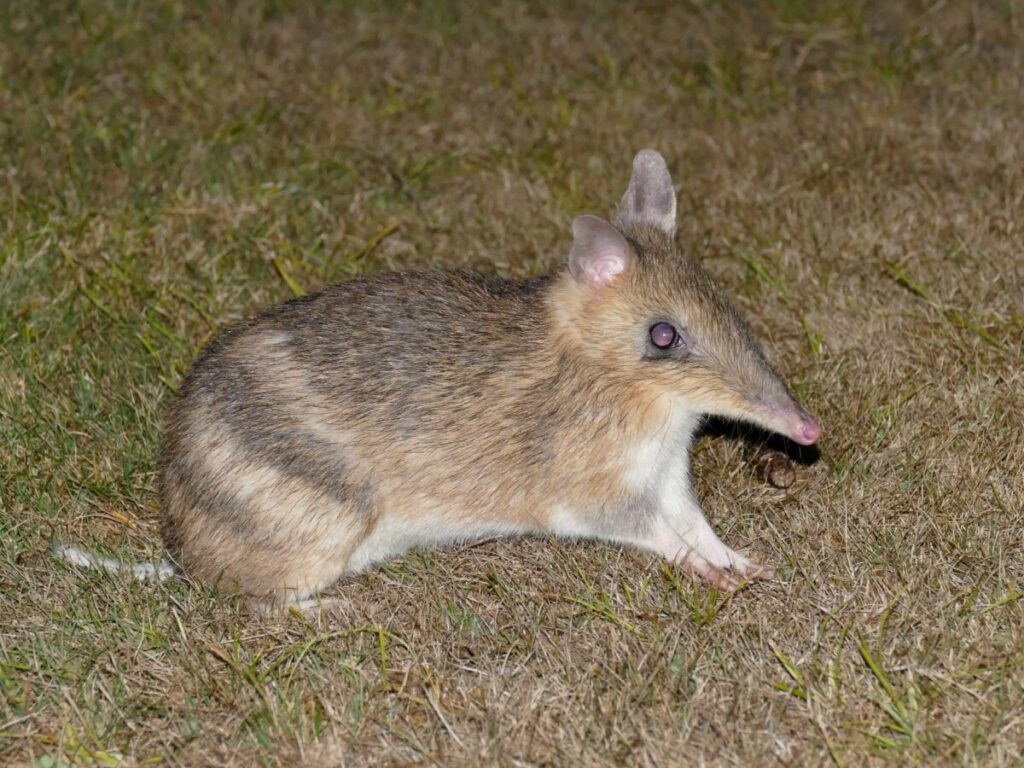
The eastern barred bandicoot (Perameles gunnii) is a small, rabbit-sized marsupial native to grasslands of southeastern Australia and Tasmania. It has greyish-brown fur with pale bars across its hindquarters and a pointed snout for digging. Nocturnal and insectivorous, it forages for invertebrates and is the focus of intensive conservation breeding on the mainland.

Behavior & Social Structure

The Eastern Barred Bandicoot (Perameles gunnii) is strictly nocturnal, spending daylight hours concealed within a nest of grass, leaf litter, and vegetation constructed in a shallow scrape, often hidden beneath dense shrubs or tussock grasses. Activity peaks in the hours after dusk and before dawn, when individuals emerge to forage across open grassland and grassy woodland edges. This species is solitary and largely asocial outside of breeding encounters, with individuals actively avoiding one another except during courtship. Home ranges typically span 2โ€“7 hectares, with male ranges generally larger than and overlapping those of several females, though bandicoots do not defend strict exclusive territories, relying instead on mutual avoidance and scent cues to minimize direct conflict.

Communication in P. gunnii relies heavily on olfactory signals, including scent marking via cloacal and other glandular secretions used to convey reproductive status and individual identity. Vocalizations are limited but include soft chittering and hissing sounds, along with sharp screeches given during aggressive encounters between rival individuals. Tactile communication becomes important briefly during mating and in mother-offspring interactions within the pouch and nest. Adaptive behaviors include a distinctive bounding gait for rapid escape, powerful foreclaws adapted for digging conical foraging pits, and an acute sense of smell and hearing that compensates for relatively poor eyesight, all of which enhance survival in predator-rich, fragmented Australian landscapes.

Diet & Hunting Patterns

As an omnivorous and opportunistic forager, the Eastern Barred Bandicoot uses its elongated snout and strong claws to dig small, characteristic conical pits in soil while searching for subterranean invertebrates such as beetle larvae, earthworms, ants, and crickets. It also consumes surface-active insects, spiders, and occasionally small vertebrates, supplementing this animal protein with fungi, seeds, berries, and underground plant material including roots, tubers, and bulbs. Foraging is solitary and methodical, with individuals working across a home range in a seemingly random but efficient pattern, relying on scent to locate buried prey rather than visual cues.

Metabolically, bandicoots exhibit a relatively high basal metabolic rate for marsupials, reflecting their energetic nocturnal foraging lifestyle, and they obtain most of their water requirements from food rather than free-standing water sources, making them well adapted to the seasonally dry grasslands of southeastern Australia. Diet composition shifts seasonally, with a greater reliance on soil invertebrates during cooler, wetter months when they are more abundant near the surface, and increased consumption of plant material and fungi during drier periods when invertebrate availability declines.

Reproduction & Life Cycle

Eastern Barred Bandicoots breed opportunistically, with reproduction possible year-round in favorable conditions but peaking from late winter through summer (roughly July to January) when food resources are abundant. The mating system is promiscuous/polygynous, with males ranging widely to locate receptive females rather than forming pair bonds. Gestation is extraordinarily briefโ€”among the shortest of any mammal at approximately 12โ€“13 daysโ€”resulting in the birth of tiny, underdeveloped young that immediately crawl into the mother’s backward-opening pouch, an adaptation that prevents soil from entering during digging.

Litters typically consist of two to four young, with females capable of producing several litters per year due to the short gestation and rapid reproductive turnover characteristic of peramelids. Joeys remain attached to a teat within the pouch for approximately 55 days before being left in a grass nest and weaned around 60โ€“70 days of age. Sexual maturity is reached remarkably quickly, with females capable of breeding by around 3โ€“4 months old, an adaptation that allows populations to recover swiftly following environmental disturbance.

Threats & Conservation

The primary threat to Perameles gunnii has been extensive habitat loss and fragmentation due to agricultural conversion, urban expansion, and changes in fire regimes across its native temperate grassland and grassy woodland range in Victoria and Tasmania. Predation by introduced red foxes (Vulpes vulpes) and feral cats (Felis catus) has been catastrophic for mainland populations, effectively eliminating wild bandicoots from much of their former Victorian range by the late 20th century; competition with introduced European rabbits for food and burrow space has compounded these pressures. Climate change poses an emerging threat through altered rainfall patterns affecting invertebrate prey availability and increased fire frequency and intensity degrading remaining grassland habitat.

Conservation initiatives have been intensive and largely successful in preventing extinction, including establishment of predator-free fenced sanctuaries and offshore island populations (such as on French Island and Phillip Island), a coordinated national recovery plan, and reintroduction programs led by Zoos Victoria’s “Eastern Barred Bandicoot Recovery Program.” These efforts led to the mainland Victorian subspecies being declared “Extinct in the Wild” in 2013 before successful reintroductions allowed its downlisting; the Tasmanian population remains more stable and is classified as Near Threatened, while ongoing genetic management and predator control remain essential to long-term species recovery.

Interesting Facts

  • Record-Breaking Gestation: At just 12.5 days, the Eastern Barred Bandicoot has one of the shortest gestation periods of any mammal on Earth, rivaled only by a few other marsupials.
  • Extinct in the Wild Comeback: Mainland Victorian populations were declared Extinct in the Wild in 2013 but have since been reestablished through one of Australia’s most successful marsupial recovery programs.
  • Backward Pouch Design: Its pouch opens rearward, an evolutionary adaptation preventing soil and debris from entering while the mother digs for food.
  • Conical Foraging Pits: The species creates small, distinctive cone-shaped digging holes in lawns and grasslands, a telltale sign of its nocturnal foraging activity.
  • Island Safe Havens: Predator-free islands like French Island and Phillip Island serve as vital strongholds, hosting insurance populations free from foxes and cats.
  • Rapid Reproductive Cycle: Females can become sexually mature at just 3โ€“4 months old, enabling populations to rebound quickly after droughts or predation events.
  • Tasmanian Stronghold: Unlike the critically depleted mainland population, Tasmania’s bandicoots have historically lacked fox predation, making the island the species’ most secure natural stronghold.

Description

The Eastern Barred Bandicoot (Perameles gunnii) is a small, nocturnal marsupial endemic to southeastern Australia. It belongs to the family Peramelidae and is characterized by its rabbit-sized stature, pointed snout, and distinctive barred markings across its fur. This elusive creature plays a crucial role in its ecosystem, contributing to the biodiversity of its native habitat.

Appearance

The Eastern Barred Bandicoot is easily recognizable by its compact size, measuring around 30 centimeters in length, and its unique fur pattern. It has brown or gray fur with three or four vertical dark stripes, or “bars,” across its hindquarters, which serve as a prominent feature distinguishing it from other bandicoot species. Its pointed snout and strong claws are well-adapted for foraging in its natural habitat.

Distribution

Historically, the Eastern Barred Bandicoot was widespread and abundant throughout Victoria’s volcanic plains and grasslands. However, due to habitat loss and predation by introduced species, its population has significantly declined. Currently, it is primarily found in localized regions of southeastern Australia, particularly in Tasmania and specific areas of Victoria. Conservation efforts are focused on protecting and restoring its remaining habitats to prevent further decline.

Habitat Preferences
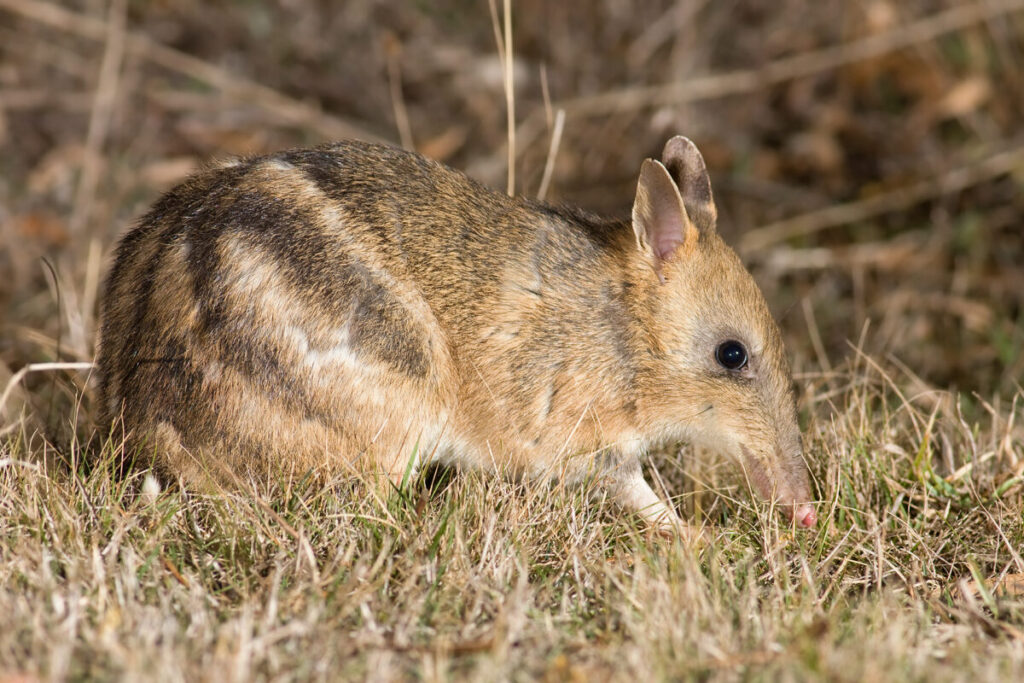
The Eastern Barred Bandicoot thrives in tall, dense native grasslands and grassy woodlands, which provide the ideal cover and foraging grounds for this species. While it has shown some adaptability to modified habitats, its survival and well-being are most supported in undisturbed ecosystems with access to suitable food sources and shelter. Conservation initiatives aim to preserve and restore these critical habitats to ensure the long-term survival of the Eastern Barred Bandicoot.

Facts About Eastern Barred Bandicoot

  • The Eastern Barred Bandicoot (Perameles gunnii) is a small, nocturnal, rabbit-sized marsupial endemic to southeastern Australia.
  • It has a lifespan of around 2 to 3 years in the wild.
  • The bandicoot’s diet consists of plants and insects, making it an omnivorous species.
  • Eastern Barred Bandicoots are known for their yellowish-brown fur with three to four pale bars across their hindquarters.
  • This species was once widespread across southwest Victoria, Australia.
  • The estimated population size for the Victorian Eastern Barred Bandicoot is around 150 individuals.
  • The species was declared extinct in the wild on mainland Australia in 2013.
  • Their habitat includes grasslands and grassy woodlands, with a preference for tall, dense grass and shrub cover.
  • Eastern Barred Bandicoots are known for their social behavior and mating habits.
  • Conservation efforts have been implemented to protect and restore the population of this threatened species.


Scientific Provenance & Verified Sources

Biological taxonomy, conservation status, and physical traits are cross-referenced with authoritative global registers:


Peer-reviewed by Wildlife Science Editors โ€ข Updated for 2026

Explore Other Species Profiles