IUCN Red List Conservation Status


Least Concern

LC
NT
VU
EN
CR
EW
EX

Official assessment evaluated in accordance with the IUCN Red List of Threatened Species criteria: Least Concern.


Species Quick Facts

Scientific Name
Lagenorhynchus obscurus

Average Lifespan
20-25 years in wild, 25-30 years in captivity

Average Weight
100-140 kg (220-310 lbs) – Males: 115 kg, Females: 100 kg

Average Length
180-240 cm (71-94 inches) – head-body length excluding tail

Overview & Identification

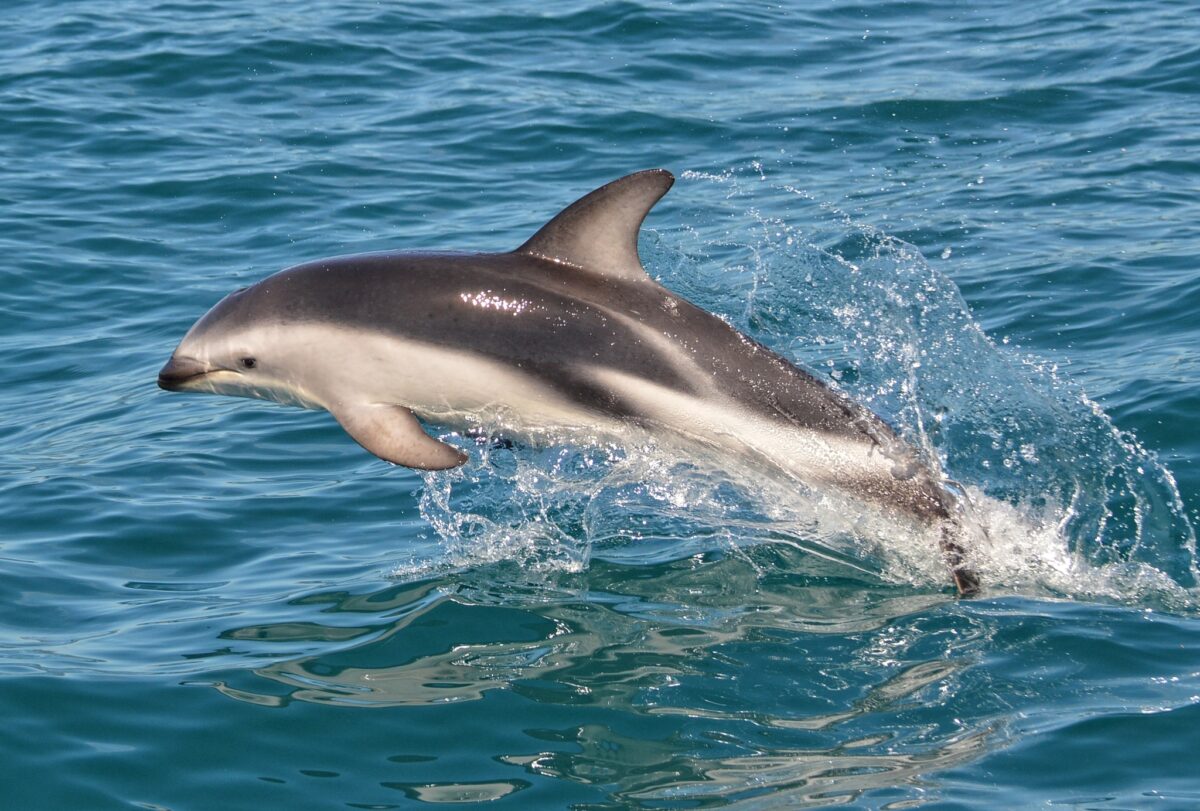
The dusky dolphin (Lagenorhynchus obscurus) belongs to the family Delphinidae within the order Cetacea. It inhabits temperate and subโ€‘tropical coastal waters of the Southern Hemisphere, with major populations off the coasts of southern South America (Patagonia, Falkland Islands), southern Africa (Namibia to South Africa), New Zealand, and southeastern Australia. Dusky dolphins favor areas of high productivity such as upwelling zones, continental shelves, and offshore islands where prey is abundant. They are mediumโ€‘sized cetaceans, typically 1.8โ€“2.4โ€ฏm in total length, with a sleek, robust body, a tall, falcate dorsal fin, and a distinctive hourโ€‘glass pattern of dark gray on the sides that fades with age. Their coloration provides camouflage in the dimly lit coastal waters. The species is classified as Least Concern by the IUCN due to its wide distribution and relatively stable population trends, although some regional stocks show declines linked to fisheries interactions and habitat disturbance. Ongoing monitoring and management of byโ€‘catch are essential to maintain healthy populations across their range.

Behavior & Social Structure

Dusky dolphins are highly social, forming dynamic groups that range from small pods of 5โ€“15 individuals to large aggregations exceeding 1,000 during feeding events. Their social structure is fluid; individuals frequently shift between groups, fostering complex alliances and information exchange. They are diurnal foragers, often engaging in coordinated hunting bouts that involve herding fish schools and employing bubbleโ€‘netting techniques. Territoriality is low; instead, they maintain overlapping home ranges that can span 200โ€“500โ€ฏkmยฒ, especially in productive coastal zones. Communication relies on a rich repertoire of clicks, whistles, and burstโ€‘pulse sounds, which facilitate coordination during foraging and maintain group cohesion. Their acrobatic displaysโ€”leaps, spins, and tailโ€‘slapsโ€”serve both social and possibly predatorโ€‘avoidance functions, and are frequently observed during mating seasons and when interacting with vessels.

Diet & Hunting Patterns

Dusky dolphins are opportunistic carnivores, primarily preying on small pelagic fish such as anchovies (Engraulis spp.), sardines (Sardinops spp.), and herring (Clupeidae), as well as cephalopods like squid (Loligo spp.) and occasionally crustaceans. Their diet reflects the highโ€‘productivity coastal ecosystems they inhabit, with prey items ranging from 5โ€ฏg to 200โ€ฏg per capture. Daily food intake can represent up to 5โ€ฏ% of body weight, equating to roughly 5โ€“7โ€ฏkg for an adult. Feeding strategies are sophisticated: they employ cooperative herding, where multiple individuals drive fish into tight schools, and bubbleโ€‘netting, creating a column of bubbles to concentrate prey. In some regions, dusky dolphins have been observed exploiting fishโ€‘aggregating devices (FADs) and following tuna schools to capture disoriented fish. Seasonal shifts in prey composition are common, with a higher reliance on squid during winter months when fish are less abundant.

Reproduction & Life Cycle

Dusky dolphins reach sexual maturity at 5โ€“7โ€ฏyears for females and 6โ€“8โ€ฏyears for males. Breeding occurs yearโ€‘round but peaks in the austral summer (Decemberโ€“February) in many regions, aligning with peak prey availability. The gestation period lasts approximately 10โ€“11โ€ฏmonths, after which a single calf is born, weighing about 15โ€ฏkg and measuring 80โ€“90โ€ฏcm. Calves are nursed for 12โ€“18โ€ฏmonths, during which they remain closely associated with their mother and receive protection from the pod. Females typically give birth every 2โ€“3โ€ฏyears, and interโ€‘birth intervals can be extended by nutritional stress. Maternal care is intensive; mothers and calves maintain surfaceโ€‘breathing synchrony, and the pod provides additional vigilance against predators. Calves achieve independence at around 2โ€ฏyears of age, after which they integrate fully into the social structure of the pod.

Threats & Conservation

The IUCN lists the dusky dolphin as Least Concern, yet several localized threats jeopardize specific populations. Byโ€‘catch in gillโ€‘net and trawl fisheries is the most significant mortality source, accounting for an estimated 5โ€“10โ€ฏ% of annual mortality in South American waters. Habitat degradation from coastal development, pollution (especially heavy metals and plastic debris), and noise from shipping and seismic surveys can disrupt communication and foraging. Climate change may alter prey distribution, potentially forcing dolphins to shift ranges or experience reduced feeding success. Population estimates suggest roughly 300,000 individuals globally, but precise numbers are uncertain due to limited surveys. Conservation measures include fisheries observer programs, marine protected areas (e.g., the Falkland Islands MPA), and regulations limiting gillโ€‘net use. Continued research and international cooperation are essential to mitigate emerging threats and ensure longโ€‘term viability.

Interesting Facts

โ€ข Dusky dolphins can perform up to 30 acrobatic leaps per hour during peak activity periods.
โ€ข They possess one of the highest known rates of vocalization among cetaceans, producing up to 200 clicks per minute while foraging.
โ€ข Their distinctive hourโ€‘glass coloration fades with age, making older individuals appear more uniformly gray.
โ€ข Dusky dolphins have been observed using seaโ€‘weed as a tool to herd fish, a rare example of tool use in marine mammals.
โ€ข They are one of the few dolphin species that regularly associate with other cetaceans, such as pilot whales and humpback dolphins, forming mixedโ€‘species groups.

Description

The dusky dolphin, scientifically known as Lagenorhynchus obscurus, is a captivating marine mammal found in coastal waters of the Southern Hemisphere. Its specific epithet “obscurus,” derived from Latin, translates to “dark” or “dim,” reflecting its distinctive coloring and enigmatic nature.

Appearance

The dusky dolphin is characterized by a sleek, slender body and a striking coloration pattern. Its dorsal side is dark gray to black, while the ventral side transitions to a lighter shade, often with a subtle white or light gray patch on the flank. This species is closely related to the Pacific white-sided dolphin, but can be distinguished by its distinctively dusky coloring and unique behavioral traits.

Distribution

The dusky dolphin is primarily found in the coastal waters of the Southern Hemisphere, with notable populations inhabiting regions such as New Zealand, South Africa, Argentina, Chile, and various islands in the southern Pacific and Atlantic oceans. This species exhibits a preference for temperate and cool waters, often frequenting areas with upwelling and cold currents. While it primarily inhabits inshore waters, it can also venture into deeper offshore regions, particularly along continental shelves.

Habitat Preferences

Dusky dolphins thrive in a variety of marine ecosystems, including coastal regions, continental shelves, and areas with rich biodiversity. They are often encountered in warm to cool temperate waters, displaying a strong affinity for areas with favorable prey availability. These highly social animals are known for their acrobatic displays and are frequently observed in areas with abundant fish populations, where they engage in energetic group behaviors and aerial acrobatics.

Conservation efforts aimed at safeguarding the dusky dolphin and its habitats are crucial for ensuring the continued well-being of this remarkable species. By understanding its unique characteristics and ecological requirements, we can work towards preserving the marine environments that support the survival of the dusky dolphin and other marine species.

Facts About Dusky Dolphin

  • The scientific name for the Dusky Dolphin is Lagenorhynchus obscurus.
  • Dusky Dolphins can live for 18 to 25 years in the wild.
  • Dusky dolphins are small to medium in length compared with other species in the family.
  • They are found in coastal waters in the Southern Hemisphere.
  • Dusky dolphins have a sturdy body with a small head tilted down and a rather short snout, almost nonexistent.
  • In Central Peru, 82.7% of captured cetaceans in gillnets in 1994 were dusky dolphins.
  • The conspicuous dorsal fin of the dusky dolphin is distinctly falcate, or sickle-shaped.
  • Dusky dolphins are known for their acrobatic displays, including leaps, flips, and somersaults.
  • They are confined to the southern hemisphere in temperate and subantarctic waters between around 26ยฐS and 55ยฐN.
  • Dusky dolphins are known for their social nature, often forming large groups of hundreds or even thousands of individuals.


Scientific Provenance & Verified Sources

Biological taxonomy, conservation status, and physical traits are cross-referenced with authoritative global registers:


Peer-reviewed by Wildlife Science Editors โ€ข Updated for 2026

Explore Other Species Profiles