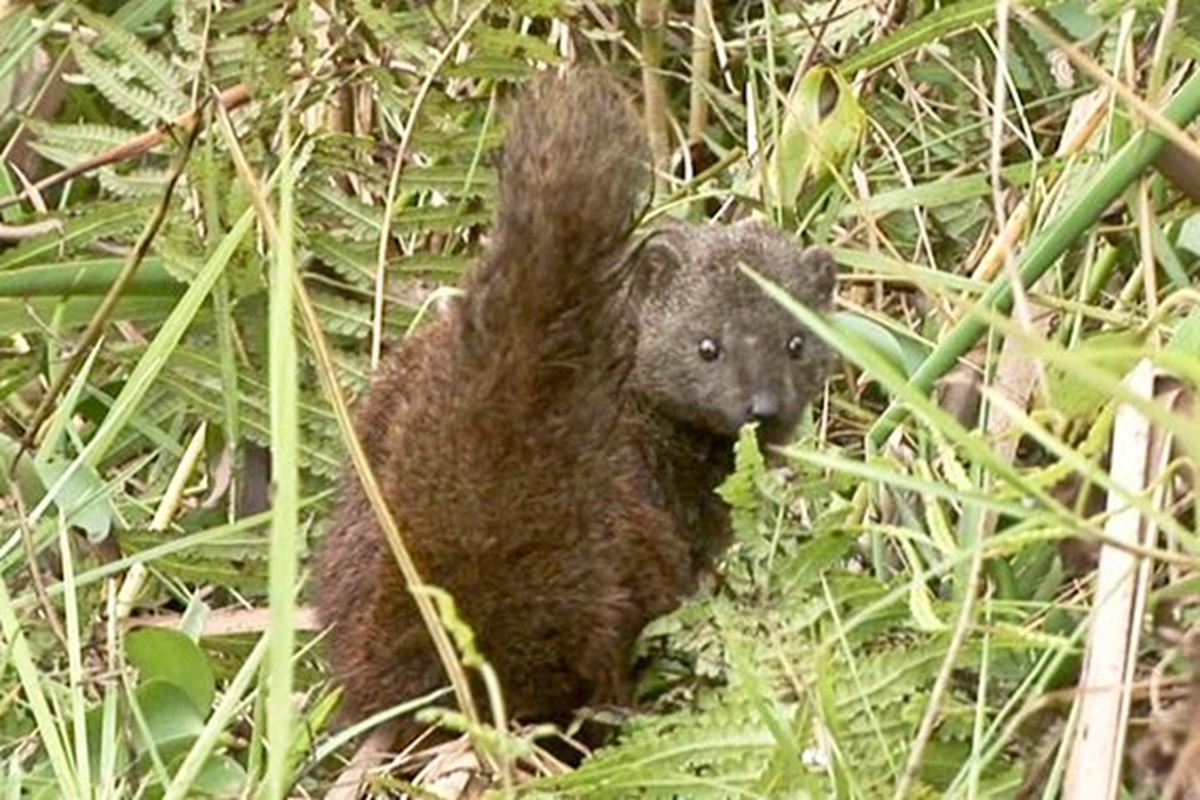
Durrell’s Vontsira

IUCN Red List Conservation Status


Endangered

LC
NT
VU
EN
CR
EW
EX

Official assessment evaluated in accordance with the IUCN Red List of Threatened Species criteria: Endangered.


Species Quick Facts

Scientific Name
Salanoia durrelli

Average Lifespan
10-12 years in wild, 12-15 years in captivity

Average Weight
0.45-0.65 kg (1.0-1.4 lbs) – Males: 0.60 kg, Females: 0.50 kg

Average Length
30-35 cm (12-14 inches) – head-body length excluding tail

Overview & Identification

Durrell’s Vontsira (Salanoia durrelli) is a small, nocturnal carnivore endemic to north‑western Madagascar. Belonging to the family Eupleridae, subfamily Salanoinae, it is one of only two species in the genus Salanoia, the other being the brown‑tailed vontsira (S. concolor). The species was described in 2005 and named after conservationist Gerald Durrell. Its known distribution is restricted to the marshy grasslands and gallery forests surrounding Lake Ravelobe in Ankarafantsika National Park, covering less than 50 km² of fragmented habitat. The animal possesses a sleek, elongated body covered in dense, dark brown to reddish‑gray fur, a short muzzle, and a relatively long, semi‑prehensile tail that aids balance among reeds. Adults weigh less than a kilogram and measure about 30 cm in head‑body length. Adaptations such as enlarged auditory bullae and whisker‑rich rostrum suggest a reliance on acute hearing and tactile cues for hunting in low‑light conditions. Because of its limited range, specialized wetland habitat, and sensitivity to disturbance, the species is classified as Endangered on the IUCN Red List. Ongoing field surveys aim to clarify its population size, while community‑based conservation projects seek to protect the surrounding marshes from agricultural conversion and fire.

Behavior & Social Structure

Durrell’s Vontsira is primarily solitary, with individuals maintaining exclusive home ranges that overlap only minimally between sexes. Home‑range sizes have not been precisely measured, but radio‑tracking of a few individuals suggests territories of 0.5–1.2 km² centered on dense reed beds and adjacent forest patches. The species is strictly nocturnal, emerging at dusk to hunt and retreating to burrows or hollow logs before sunrise. Activity peaks during the early night hours when insect prey are most abundant. Communication relies on a repertoire of high‑pitched chirps, short growls, and scent marking using anal glands; individuals also deposit urine on prominent vegetation to delineate boundaries. Although generally reclusive, overlapping ranges lead to brief encounters during the breeding season, during which males may engage in brief chases and vocal duels. The Vontsira’s keen hearing and whisker‑mediated tactile sense allow it to navigate the dense marsh vegetation with minimal visual cues.

Diet & Hunting Patterns

Salanoia durrelli is a strict carnivore with a strong preference for small vertebrates and large invertebrates found in its marshland habitat. Stomach‑content analyses of captured specimens have revealed a diet composed of 55 % amphibians (primarily endemic frogs of the genus Boophis), 25 % small mammals such as the Malagasy mouse lemur (Microcebus spp.) and shrew‑like tenrecs, and 20 % insects and arachnids, especially beetles, orthopterans, and scorpions. The Vontsira employs a sit‑and‑wait hunting strategy, positioning itself near water edges where prey congregate. It uses rapid lunges and a powerful bite to subdue amphibians, often swallowing them whole. When targeting small mammals, it may stalk and pounce, delivering a quick bite to the neck. Seasonal fluctuations in prey abundance lead to opportunistic shifts; during the dry season, the proportion of insects in the diet can rise to 35 %. Daily food intake is estimated at 8–12 % of body mass, roughly 40–70 g, consumed over several short feeding bouts throughout the night.

Reproduction & Life Cycle

Breeding in Salanoia durrelli occurs once a year during the rainy season, roughly from November to January, when prey availability peaks. Females reach sexual maturity at about 10 months, while males mature slightly later at 12 months. After a brief courtship involving scent exchange and soft vocalizations, gestation lasts approximately 45 days, resulting in litters of one to three altricial young. Newborns are blind, hairless, and weigh around 30 g. The mother alone provides all parental care, constructing a shallow nest of dry reeds and leaf litter within a protected burrow. She nurses the young for 6–8 weeks, during which time the kits develop fur and open their eyes. By three months, juveniles begin to accompany the mother on short foraging trips, gradually increasing independence. Weaning is complete by 10 weeks, after which the young disperse to establish their own territories. Longevity of reproductive females in the wild appears limited, with most individuals reproducing only twice before succumbing to predation or habitat loss.

Threats & Conservation

According to the IUCN Red List, Salanoia durrelli is classified as Endangered, with an estimated population of fewer than 1,000 mature individuals. The principal threat is habitat loss driven by expanding rice cultivation, cattle grazing, and uncontrolled burning of the surrounding savanna, which fragments the marshes essential for foraging and nesting. Additionally, invasive plant species such as water hyacinth (Eichhornia crassipes) alter the structure of reed beds, reducing prey availability. Small‑scale hunting for bushmeat, though not widespread, poses a localized risk. Climate change may exacerbate these pressures by altering rainfall patterns, leading to prolonged dry periods that shrink wetland habitats. Conservation actions currently focus on protecting the Lake Ravelobe marshes within Ankarafantsika National Park, implementing community‑based fire‑management programs, and conducting regular population monitoring. International NGOs are supporting habitat restoration projects that re‑establish native reed species and control invasive plants, aiming to stabilize and eventually increase the Vontsira’s numbers.

Interesting Facts

• Named after famed conservationist Gerald Durrell
• One of only two species in the genus Salanoia, both endemic to Madagascar
• Exclusively inhabits marshy reed beds, a habitat rare among Malagasy carnivores
• Possesses enlarged auditory bullae that give it exceptional hearing in dense vegetation
• Its diet includes a high proportion of endemic frogs, linking its survival to amphibian health

Description

Durrell’s Vontsira

Durrell’s vontsira, scientifically known as Salanoia durrelli, is a small, reddish-brown mammal belonging to the family Eupleridae within the order Carnivora. This elusive creature is most closely related to the brown-tailed mongoose (Salanoia concolor), with which it shares the genus Salanoia. Durrell’s vontsira is characterized by its fox-like appearance and gracile build, making it a distinctive member of Madagascar’s diverse wildlife.

Appearance

Durrell’s Vontsira

The Durrell’s vontsira is reddish-brown overall, with a paler hue than the brown-tailed mongoose. It possesses broad feet with prominent pads and reddish-buff underparts, along with a slender, mongoose-like physique. These physical attributes set it apart from other species within its habitat and aid in its adaptation to specific ecological niches.

Distribution

Durrell’s vontsira is native to the island of Madagascar, where it inhabits specific regions characterized by marshes and wetlands. Its distribution is limited to this unique island ecosystem, making it an endemic species with a restricted range. Notable patterns in its population density may be observed in areas with suitable wetland habitats, reflecting its dependence on specific environmental conditions for survival.

Habitat Preferences

Durrell’s vontsira thrives in the marshes and wetlands of Madagascar, relying on these specialized ecosystems for its survival and well-being. These habitats provide the necessary resources for foraging, shelter, and reproduction, contributing to the species’ ecological niche within the island’s biodiversity. The unique adaptations of Durrell’s vontsira enable it to navigate and thrive in these marshy environments, showcasing its remarkable ecological resilience.

This species profile provides a comprehensive overview of Durrell’s vontsira, shedding light on its distinctive characteristics, distribution, and habitat preferences. As a conservation scientist and wildlife expert, it is crucial to continue monitoring and protecting the natural habitats of this remarkable species to ensure its long-term survival and contribute to the conservation of Madagascar’s rich biodiversity.

Facts About Durrell’s vontsira

  • Durrell’s vontsira (Salanoia durrelli) is a small, reddish-brown, fox-like mammal native to the island of Madagascar.
  • It was discovered in 2004 and is closely related to the brown-tailed mongoose.
  • This species is characterized by broad feet with prominent pads and reddish-buff underparts.
  • Durrell’s vontsira is a marsh dweller with large paws for paddling and mighty teeth for crunching shellfish.
  • Statistical analysis of measurements of the skulls and teeth strongly separates S. durrelli from specimens of the brown-tailed mongoose.
  • It is a carnivorous mammal and has been identified as the first new carnivorous mammal to be discovered in Madagascar in 24 years.
  • The species is known for its elusive nature and limited habitat, living only in a specific area of Madagascar.
  • Durrell’s vontsira is closely related to the brown-tailed mongoose and shares some physical characteristics with this species.
  • This species has a significant impact on the ecosystem, particularly in its marshland habitat.
  • Durrell’s vontsira is an important subject of study for conservation efforts due to its limited range and specific habitat requirements.


Scientific Provenance & Verified Sources

Biological taxonomy, conservation status, and physical traits are cross-referenced with authoritative global registers:


Peer-reviewed by Wildlife Science Editors • Updated for 2026

Explore Other Species Profiles