
Description

The Diana monkey, scientifically known as Cercopithecus diana, is an Old World monkey renowned for its striking appearance and distinctive white brow. Named for its resemblance to the bow of the Roman goddess Diana, this species possesses a regal and captivating presence in its natural habitat. With its medium-sized body and long, elegant tail, the Diana monkey exudes an aura of grace and agility as it navigates the lush canopies of its forest home.
Appearance
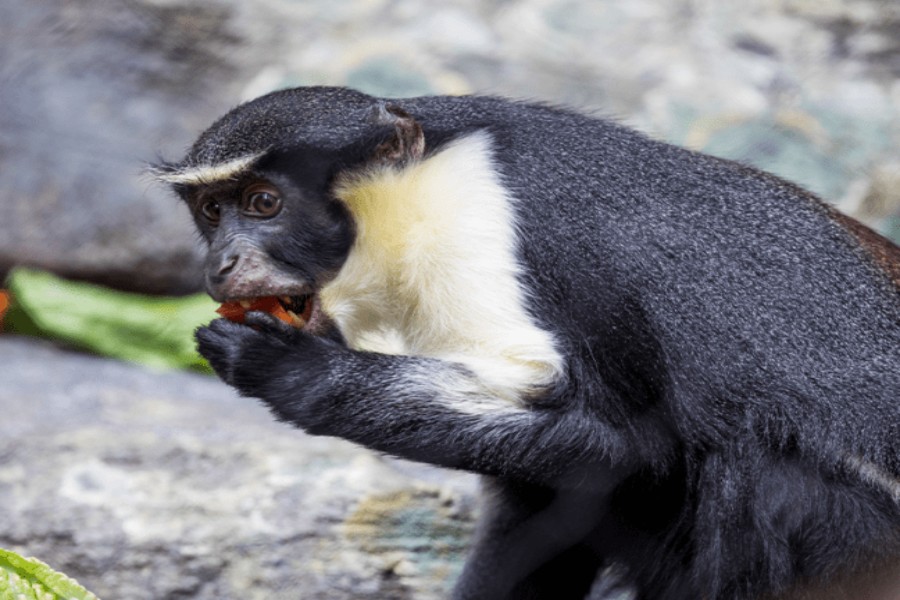
The Diana monkey is characterized by its vibrant fur, which ranges from dark olive to black, accentuated by a white throat, chest, and brow. Its most notable feature is the white semi-circle-shaped brow that extends above its eyes, adding an air of mystique to its countenance. This distinguishing feature sets the Diana monkey apart from other primate species and contributes to its status as an icon of the West African forests.
Distribution
This enchanting species is predominantly found in the high canopy forests of Sierra Leone, Liberia, and western Côte d’Ivoire. Its distribution is primarily confined to these regions, where it thrives in the verdant landscapes and diverse ecosystems. The Diana monkey’s population density exhibits a notable concentration within these specific areas, reflecting its strong association with the unique environmental conditions found in these West African countries.
Habitat Preferences

The Diana monkey demonstrates a preference for inhabiting the upper levels of primeval forest trees, where it finds refuge and sustenance amidst the dense foliage and towering canopies. These high canopy forests provide an ideal setting for the species to display its arboreal prowess, as it moves with agility and grace among the branches. The rich biodiversity and complex structure of these ecosystems offer the Diana monkey ample resources for foraging, nesting, and social interaction, contributing to its overall well-being and survival.
As a renowned conservation scientist and advocate for wildlife preservation, I hope this profile serves to illuminate the captivating nature of the Diana monkey and the importance of safeguarding its natural habitat for future generations.
Facts About Diana Monkey
- The Cape wild dog, also known as Lycaon pictus pictus, is a subspecies of the African wild dog.
- They are highly social animals, living and hunting in packs that are widely dispersed.
- Cape wild dogs have an 80% hunting success rate, which is higher than that of lions and leopards.
- This subspecies is known for its irregular, mottled coat, featuring patches of red, black, brown, white, and yellow fur.
- They are one of the world’s most endangered carnivores, with a significantly declining population.
- Cape wild dogs have been estimated to live up to 17 years in the wild, and up to 15.1 years in captivity.
- The IUCN estimates that there are around 6,600 adults (including 1,400a
- The Diana monkey (Cercopithecus diana) is an Old World monkey found in the high canopy forests in Sierra Leone, Liberia, and western Côte d’Ivoire.
- They live in small but stable social groups with one adult male and several adult females with their offspring.
- Diana monkeys dwell in upper levels of primeval forest trees and sleep in trees in closed forest canopies, never making nests.
- The species is named after the Roman goddess Diana due to the white fur on its throat, resembling a bow tie, which is associated with the goddess’s symbol.
- These monkeys primarily feed on fruits, seeds, and insects, and occasionally consume leaves and flowers.
- Diana monkeys exhibit forms of locomotion including walking, running, climbing quadrupedally through the forest canopy, and leaping between canopy gaps.
- The species is listed as endangered, facing threats from habitat loss, hunting, and the pet trade.
- Female Diana monkeys typically give birth to a single offspring after a gestation period of around 5 months.
- Diana monkeys have a life expectancy of around 20 years in the wild and up to 35 years in captivity.
- The species is known for its distinctive vocalizations, including alarm calls and specific sounds for different predators. mature individuals) of African wild dogs, including the Cape wild dog subspecies, living in the wild.
- Formerly widespread throughout sub-Saharan Africa, the Cape wild dog’s geographical distribution has significantly declined.
- They are effective predators, known for their cooperative hunting strategies and high success rate.
- Conservation efforts are crucial for the survival of the Cape wild dog and other African wild dog subspecies.


