Diademed Sifaka

IUCN Red List Conservation Status


Endangered

LC
NT
VU
EN
CR
EW
EX

Official assessment evaluated in accordance with the IUCN Red List of Threatened Species criteria: Endangered.


Species Quick Facts

Scientific Name
Propithecus diadema

Average Lifespan
20-25 years in wild, 25-30 years in captivity

Average Weight
3.5-5.5 kg (7.7-12.1 lbs) – Males: 4.5-5.5 kg, Females: 3.5-4.5 kg

Average Length
40-50 cm (15.7-19.7 inches) – head-body length excluding tail

Overview & Identification

The diademed sifaka (Propithecus diadema) is a large lemur belonging to the family Indriidae, one of the most striking primates of Madagascar. Endemic to the eastern and northern highland rainforests of the island, it inhabits primary humid forest, montane cloud forest, and occasionally secondary growth at elevations between 800 and 2,200โ€ฏm. The species is named for the distinctive white โ€œdiademโ€ that crowns its head, framing dark eyes and contrasting with its silky, predominantly blackโ€‘brown pelage. Its powerful hind limbs and long, balancing tail enable extraordinary vertical clinging and leaping, allowing individuals to cover distances of up to 10โ€ฏm between trees. Diademed sifakas are diurnal and live in small, femaleโ€‘dominant groups of three to ten members that defend overlapping territories through vocal displays and scent marking. The IUCN classifies the species as Endangered, with an estimated 5,000โ€“10,000 mature individuals remaining, primarily due to rapid deforestation and habitat fragmentation. Conservation efforts focus on expanding protected areas, communityโ€‘based forest management, and captive breeding programs aimed at preserving this emblematic lemur for future generations. Its diet is highly flexible, shifting seasonally from young leaves in the wet season to fruits, flowers, and bark in the dry months. The species exhibits a complex repertoire of alarm calls, ranging from highโ€‘pitched whistles to deep croaks, which coordinate group movement and predator avoidance. Juveniles remain clung to the motherโ€™s belly for several months before transitioning to dorsal riding. The diademed sifakaโ€™s striking appearance and acrobatic locomotion have made it a flagship species for Madagascarโ€™s forest conservation initiatives.

Behavior & Social Structure

Diademed sifakas live in cohesive groups of three to ten individuals, typically led by a dominant female. Groups are femaleโ€‘centric; females inherit rank matrilineally while males disperse at sexual maturity. The species is strictly diurnal, spending mornings foraging and afternoons resting in high canopy branches. Territories, averaging 5โ€“10โ€ฏha, are marked with scent glands on the wrists and chest, and defended through loud, resonant โ€œwailโ€ calls that can travel over a kilometer. Social grooming reinforces bonds, and individuals communicate with a repertoire of vocalizations, visual displays (tail flicks, ear postures), and tactile signals. Homeโ€‘range overlap between neighboring groups is limited, reducing direct conflict but leading to occasional boundary disputes resolved by vocal duels rather than physical fights. Daily activity budgets are roughly 60โ€ฏ% feeding, 20โ€ฏ% locomotion, 10โ€ฏ% resting, and 10โ€ฏ% social interaction.

Diet & Hunting Patterns

The diademed sifaka is primarily a folivore but displays opportunistic frugivory, making it a flexible feeder in the fluctuating Malagasy forest environment. Its diet consists of young leaves, mature foliage, fruits, flowers, seeds, and occasional bark. During the wet season, young leaves of understory trees such as Macaranga and Psychotria provide high protein and low fiber, comprising up to 70โ€ฏ% of intake. In the dry season, the sifaka shifts to fruiting trees like Ficus and Pandanus, as well as bark and lichen, to meet energy demands. Daily food intake averages 200โ€“300โ€ฏg of dry matter, with individuals spending 4โ€“6โ€ฏhours foraging. Feeding is performed while perched on vertical trunks, using a precise handโ€‘mouth coordination to select tender leaflets. The species employs selective browsing, avoiding toxic secondary compounds by rotating feeding sites and preferring leaves with lower tannin concentrations. Water is obtained from succulent fruits and occasional dew, reducing the need for standing water sources.

Reproduction & Life Cycle

Females reach sexual maturity at about 2.5โ€“3โ€ฏyears, while males mature slightly later at 3โ€“4โ€ฏyears. Breeding is seasonal, peaking during the early rainy season (Novemberโ€“December) when food availability is high. Gestation lasts 140โ€“150โ€ฏdays, after which a single infant is born, weighing roughly 150โ€ฏg. Twins are extremely rare. Newborns cling to the motherโ€™s belly for 4โ€“5โ€ฏmonths, then transition to dorsal riding while still nursing. Weaning occurs at 5โ€“6โ€ฏmonths, and juveniles become fully independent by 12โ€ฏmonths, though they may remain in the natal group for several years. Females typically give birth every 18โ€“24โ€ฏmonths, depending on resource abundance. Parental care is primarily maternal, but other group members, especially older siblings, assist in infant surveillance and grooming, enhancing offspring survival.

Threats & Conservation

The IUCN lists the diademed sifaka as Endangered, with an estimated 5,000โ€“10,000 mature individuals remaining. The principal threat is habitat loss: slashโ€‘andโ€‘burn agriculture, illegal logging, and mining have reduced primary forest cover by over 40โ€ฏ% in the past three decades. Fragmentation isolates populations, limiting gene flow and increasing vulnerability to stochastic events. Hunting for bushmeat, though less common than for other lemurs, still occurs in remote areas. Climate change exacerbates these pressures by altering precipitation patterns, which affect the seasonal availability of young leavesโ€”a critical food resource. Conservation actions include the establishment and enforcement of protected areas such as Marojejy and Anjanaharibeโ€‘Sahalava, communityโ€‘based forest management schemes, and exโ€‘situ breeding programs at facilities like the Duke Lemur Center. Ongoing population monitoring using lineโ€‘transect surveys indicates a continued decline of 10โ€“15โ€ฏ% per decade if current trends persist.

Interesting Facts

โ€ข The diademed sifakaโ€™s white crown resembles a royal diadem, giving the species its name.
โ€ข It can leap up to 10โ€ฏmeters between trees, using its long hind limbs like springโ€‘loaded pistons.
โ€ข Unlike many lemurs, it has a highly developed scent gland on its wrist that it rubs on branches to mark territory.
โ€ข Its vocal repertoire includes a lowโ€‘frequency โ€œroarโ€ that can travel over a kilometer, useful for longโ€‘range communication in dense forest.
โ€ข The species is a flagship for Madagascarโ€™s conservation, featured on several international wildlife campaigns and in ecotourism programs.

Description

Diademed Sifaka

The Diademed Sifaka, scientifically known as Propithecus diadema, is an endangered species of sifaka and one of the lemurs endemic to the lush rainforests of eastern Madagascar. Alongside the indri, it is one of the two largest living lemurs and is distinguished by its striking appearance and unique behavioral characteristics.

Appearance
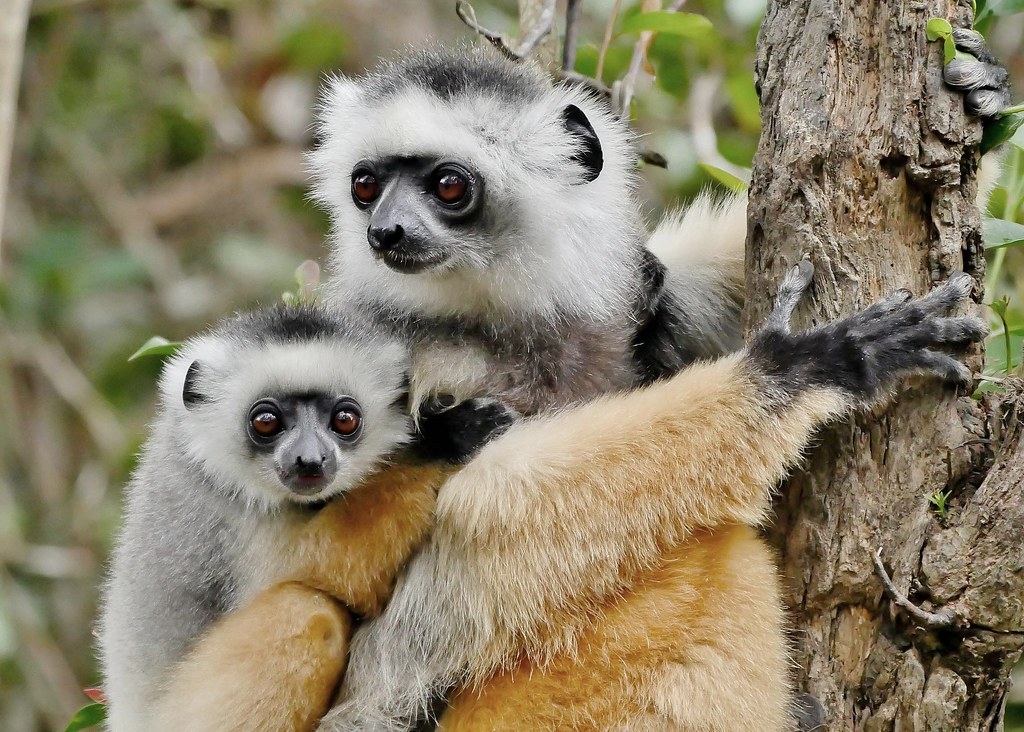
Diademed Sifaka (Propithecus diadema) Appearance

The Diademed Sifaka is renowned for its remarkable appearance, featuring a luxurious coat of thick, silky fur that varies in color from white to light golden with distinctive patches of darker fur adorning its face, crown, and down its back. Its most distinguishing feature is the elegant “diadem” or crown of white fur encircling its head, which gives the species its name. This striking physical trait sets it apart from other lemur species and adds to its allure as a captivating and charismatic primate.

Distribution

The Diademed Sifaka inhabits the eastern regions of Madagascar, primarily ranging from the Mananara Nord River to the Mangoro and Onive Rivers in the south. This species demonstrates a preference for montane rainforests and exhibits a somewhat limited distribution within these specific areas. The population density of Diademed Sifakas is notable for its localized concentration, with specific pockets of habitat serving as crucial strongholds for the survival of the species.

Habitat Preferences

Diademed Sifaka Habitat

Diademed Sifakas thrive in the montane rainforests of eastern Madagascar, where they have adapted to the diverse ecosystems and microhabitats within this region. These rainforests provide the ideal environment for the species, offering abundant food sources, suitable nesting sites, and a complex vertical structure that facilitates their distinctive leaping locomotion. The sifakas’ ability to traverse the forest canopy with agility and grace is a testament to their specialized adaptation to this unique habitat.

Overall, the Diademed Sifaka’s presence in the rainforests of eastern Madagascar underscores the species’ ecological significance and the importance of conserving these vital habitats to ensure the continued well-being of this remarkable lemur.

This profile provides a comprehensive overview of the Diademed Sifaka, highlighting its distinctive characteristics, distribution, and habitat preferences, and aims to inspire a deeper appreciation for the conservation of this endangered species and its natural habitat.

Facts About Diademed Sifaka

  • The diademed sifaka (Propithecus diadema) is one of the largest lemur species.
  • They are known for their striking appearance, with long, silky fur that is grey on their back and shoulders.
  • Diademed sifakas are arboreal and primarily inhabit the rainforests of Madagascar.
  • These lemurs are characterized by their unique method of locomotion known as “vertical clinging and leaping.”
  • Diademed sifakas are herbivores, primarily feeding on leaves, flowers, and fruit.
  • Their population size is estimated to be between 6,000 to 10,000 individuals.
  • The average lifespan of diademed sifakas in the wild is around 18 to 20 years.
  • They live in small social groups, typically consisting of a mated pair and their offspring.
  • Diademed sifakas are listed as endangered due to habitat loss and hunting.
  • Conservation efforts are underway to protect the remaining populations of diademed sifakas in their natural habitat.


Scientific Provenance & Verified Sources

Biological taxonomy, conservation status, and physical traits are cross-referenced with authoritative global registers:


Peer-reviewed by Wildlife Science Editors โ€ข Updated for 2026

Explore Other Species Profiles