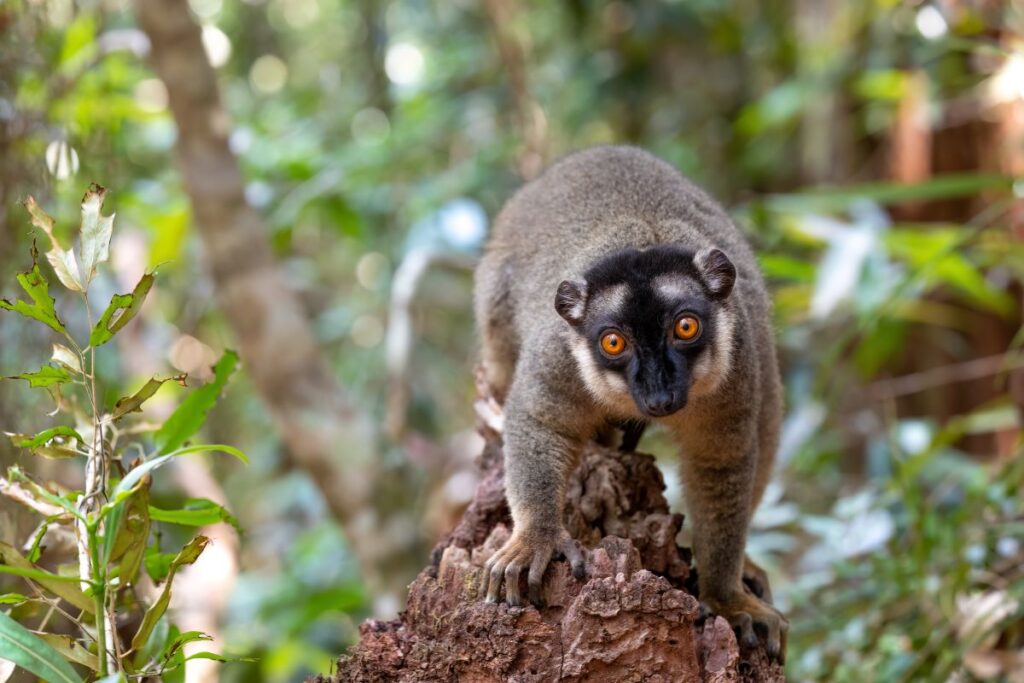
Common Brown Lemur

IUCN Red List Conservation Status


Near Threatened

LC
NT
VU
EN
CR
EW
EX

Official assessment evaluated in accordance with the IUCN Red List of Threatened Species criteria: Near Threatened.


Species Quick Facts

Scientific Name
Eulemur fulvus

Average Lifespan
20-30 years (up to 35 years in captivity)

Average Weight
2-3 kg (4.4-6.6 lbs)

Average Length
40-50 cm (16-20 inches) head-body length; tail 41-51 cm; total length 84-101 cm

Overview & Identification

The common brown lemur is a medium-sized lemur native to Madagascar and also found on Mayotte. It has a brownish-gray coat and is active by both day and night, a pattern known as cathemerality. It lives in social groups and feeds mainly on fruit, leaves, and flowers.

Behavior & Social Structure

The common brown lemur (Eulemur fulvus) exhibits a flexible activity pattern often described as cathemeral, meaning individuals are active both during daylight and nighttime hours, with activity peaks shifting seasonally in response to temperature, moonlight, food availability, and predation pressure. This cathemeral rhythm is somewhat unusual among primates and is thought to be an adaptive strategy that allows the species to exploit resources across a broader temporal niche while reducing competition with strictly diurnal or nocturnal lemur species sharing the same forest habitat.

Common brown lemurs live in small, cohesive multi-male, multi-female social groups typically ranging from 4 to 12 individuals, with group cohesion maintained through mutual grooming, close-contact resting huddles, and vocal contact calls. Unlike many other lemur species, dominance hierarchies in Eulemur fulvus tend to be less strictly female-dominant, with more egalitarian relationships observed between sexesโ€”a notable behavioral distinction within the genus. Communication relies on a repertoire of grunts, screeches, and alarm calls, as well as olfactory signals from scent glands used to mark territory boundaries and communicate reproductive status.

Home ranges vary considerably depending on habitat quality and forest fragmentation, typically spanning 3โ€“15 hectares, with groups showing moderate territoriality that is defended through vocal displays rather than physical aggression. Their arboreal quadrupedal locomotion, strong grasping hands and feet, and long tail used for balance are key adaptations enabling efficient movement through the multi-layered forest canopy.

Diet & Hunting Patterns

As frugivores, common brown lemurs derive the majority of their dietโ€”often more than 70%โ€”from ripe fruit, supplemented with young leaves, flowers, bark, and occasionally invertebrates when preferred foods are scarce. They play a critical ecological role as seed dispersers, consuming fruit from a wide variety of native Malagasy trees including species of Ficus, Tamarindus, and Canarium, and passing viable seeds through their digestive tract, thereby promoting forest regeneration and genetic diversity of plant populations.

Foraging occurs in small subgroups that move systematically through the canopy, using excellent color vision and spatial memory to locate seasonally fruiting trees. During dry seasons or periods of fruit scarcity, the species shifts toward greater consumption of leaves and bark, demonstrating dietary plasticity that buffers against resource fluctuation. They obtain most of their water needs from succulent fruits and morning dew, though they will drink from tree hollows and water sources during particularly arid periods.

Reproduction & Life Cycle

Common brown lemurs are seasonal breeders, with mating typically occurring between May and July (the austral winter) and births concentrated between September and November, timed to coincide with the onset of the rainy season and peak fruit availability. The mating system is best described as polygynandrous, with multiple males and females within a group mating over a short, synchronized estrus period, reducing the ability of any single male to monopolize reproductive access.

Gestation lasts approximately 120 days, after which females typically give birth to a single infant, though twins occur occasionally. Infants cling to the mother’s belly initially before transitioning to dorsal riding after a few weeks, with weaning occurring around 5โ€“6 months of age. Females reach sexual maturity at approximately 2 years old, while males mature slightly later, and maternal care is intensive, with allomothering by other group females occasionally observed to aid infant survival.

Threats & Conservation

The primary threat facing Eulemur fulvus is habitat loss driven by slash-and-burn agriculture (locally known as “tavy”), illegal logging, and charcoal production, which have fragmented Madagascar’s eastern and western forest corridors and isolated lemur populations into smaller, less genetically viable subpopulations. Hunting for bushmeat remains a significant localized pressure in certain regions, compounding the stress caused by shrinking and degraded habitat, while climate change-induced shifts in rainfall patterns threaten to disrupt the fruiting cycles the species depends upon.

Natural predators include the fossa (Cryptoprocta ferox), Madagascar harrier-hawks, and large boa constrictors, though anthropogenic pressures far outweigh natural predation as a conservation concern. Conservation initiatives include habitat protection within reserves such as Ankarafantsika National Park, participation in the IUCN SSC Primate Specialist Group’s Madagascar action plans, community-based reforestation programs, and ex-situ breeding populations maintained in accredited zoos to serve as a genetic safety net (source: IUCN Red List).

Interesting Facts

  • Cathemeral Rarity: Common brown lemurs are among the few primates exhibiting true cathemeral activity, being active in both light and dark conditions depending on ecological pressures.
  • Sexual Dichromatism: Males and females display distinct fur coloration and facial markings, a trait relatively uncommon among lemur species and useful for field identification.
  • Seed Dispersal Powerhouse: A single group can disperse seeds from dozens of tree species daily, making them keystone species for Madagascar’s forest regeneration.
  • Hybridization Zones: In areas where their range overlaps with other Eulemur species, natural hybridization has been documented, complicating taxonomic classification.
  • Egalitarian Society: Unlike many lemurs where females are strictly dominant, common brown lemur groups show more balanced male-female social dynamics.
  • Thermoregulatory Huddling: During cooler months, group members huddle together in tight balls to conserve body heat, an important adaptation to Madagascar’s variable climate.
  • Ancient Lineage: Lemurs like Eulemur fulvus descend from primate ancestors that rafted to Madagascar over 50 million years ago, evolving in isolation from mainland African and Asian primates.

Description

Common Brown Lemur

The Common Brown Lemur, scientifically known as Eulemur fulvus, is a captivating species of lemur belonging to the family Lemuridae. These charming primates are native to the captivating island of Madagascar and have also been introduced to Mayotte. They are known for their engaging social structures, distinctive appearance, and remarkable adaptability to diverse habitats.

Appearance

Common Brown Lemur (Eulemur fulvus) Appearance

The Common Brown Lemur exhibits a striking appearance, characterized by its warm brown fur and a contrasting lighter underside. Their large, expressive eyes and fox-like faces contribute to their endearing charm. Notably, they possess a long, bushy tail, which aids in balance and agility as they navigate their arboreal habitats. These unique physical features distinguish them from other lemur species, contributing to their charismatic allure.

Distribution

This species is primarily found in the northern regions of Madagascar, where they inhabit a variety of ecosystems, including tropical and sub-tropical deciduous forests, rainforests, moist montane forests, and dry deciduous forests. Additionally, the Common Brown Lemur has been introduced to the island of Mayotte. Their distribution in these regions reflects their adaptability to diverse environments and their ability to thrive in varying climatic conditions.

Habitat Preferences

Common Brown Lemur Habitat

Common Brown Lemurs display a remarkable ability to thrive in a range of habitats, from lush rainforests to deciduous forests. Their survival and well-being are supported by the rich biodiversity of these ecosystems, which provide an abundant supply of fruits, leaves, nectar, and flowers that form the core of their diet. The presence of tall trees offers them ample opportunities for arboreal locomotion and shelter, while the diverse flora and fauna contribute to their sustenance and overall ecological balance.

In summary, the Common Brown Lemur is an enchanting species with a unique appearance and remarkable adaptability to diverse habitats. Their presence in the captivating landscapes of Madagascar and Mayotte underscores the importance of preserving these ecosystems for the conservation of this charismatic primate species.

Facts About Common Brown Lemur

  • The Common Brown Lemur (Eulemur fulvus) is endemic to Madagascar, and has been introduced to Mayotte (source: Animal Diversity Web).
  • Adult Common Brown Lemurs weigh around 2.6 kg and have a body length of 50 cm, with a tail length also measuring 50 cm (source: Animal Diversity Web).
  • This lemur species has a maximum longevity of 35.5 years in captivity (source: Genomics of Aging).
  • The Common Brown Lemur belongs to the genus Eulemur, which contains 8 known extant species (source: Animal Diversity Web).
  • They are sometimes confused with mongoose lemurs, which are grayer and sexually dichromatic (source: The Monkey Sanctuary).
  • Common Brown Lemurs live in social groups, with females being dominant (source: Duke Lemur Center).
  • They are primarily frugivorous, but also consume leaves, flowers, and nectar (source: New England Primate Conservancy).
  • Common Brown Lemurs are important seed dispersers, contributing to the regeneration of the forest (source: Wikipedia).
  • This lemur species is known for its vocal communication, using a variety of calls to convey different messages (source: Animalia Bio).
  • The Common Brown Lemur is classified as “Least Concern” on the IUCN Red List of Threatened Species (source: Wikipedia).


Scientific Provenance & Verified Sources

Biological taxonomy, conservation status, and physical traits are cross-referenced with authoritative global registers:


Peer-reviewed by Wildlife Science Editors โ€ข Updated for 2026

Explore Other Species Profiles