Central Chimpanzee

IUCN Red List Conservation Status


Endangered

LC
NT
VU
EN
CR
EW
EX

Official assessment evaluated in accordance with the IUCN Red List of Threatened Species criteria: Endangered.


Species Quick Facts

Scientific Name
Pan troglodytes

Average Lifespan
About 15โ€“25 years in the wild for this subspecies; chimpanzees overall can reach 45โ€“50 years.

Average Weight
Males 34-70 kg (75-154 lb); females 26-50 kg (57-110 lb).

Average Length
Head-body 64-92 cm (25-36 inches); stands about 1-1.7 m upright.

Overview & Identification

The central chimpanzee is a subspecies of common chimpanzee found in the rainforests of Central Africa, including Gabon and the Congo basin. Highly intelligent and social, it lives in communities and uses tools to obtain food. It is endangered due to habitat loss, hunting, and disease.

Behavior & Social Structure

The Central Chimpanzee (Pan troglodytes troglodytes) is a diurnal primate, active primarily from dawn to dusk, spending its time foraging, socializing, and traveling through dense rainforest and mixed forest-savanna mosaics of Central Africa. Chimpanzees construct fresh nightly nests in trees using folded branches and leaves, a behavior thought to reduce parasite exposure and predation risk. Social organization follows a fission-fusion dynamic: individuals belong to large communities of 20โ€“150+ members but travel in smaller, fluid subgroups (parties) that change composition throughout the day depending on food availability, reproductive status of females, and social alliances.

Communication is highly sophisticated, involving an extensive vocal repertoireโ€”including pant-hoots, screams, barks, and gruntsโ€”that convey identity, location, and emotional state across long distances in dense forest. Tactile communication (grooming, embracing, hand-holding) reinforces social bonds and reduces tension within hierarchical male-dominated societies, while facial expressions and body postures signal submission, aggression, or playfulness. Chimpanzees also use rudimentary tool-assisted signaling, such as branch-shaking displays, to assert dominance.

Males are philopatric and cooperatively defend community home ranges, which can span 5โ€“50 kmยฒ depending on resource density, through boundary patrols and, occasionally, lethal intergroup aggression. Adaptive behaviors include sophisticated tool useโ€”termite fishing, nut-cracking with stone or wooden hammers, and leaf-sponging for waterโ€”demonstrating cultural transmission of learned techniques across generations and populations.

Diet & Hunting Patterns

Central Chimpanzees are opportunistic omnivores with a diet dominated by ripe fruit (up to 60โ€“70% of intake), supplemented by leaves, seeds, flowers, bark, and pith. They exploit over 200 plant species across their range, showing strong seasonal tracking of fruiting trees such as figs (Ficus spp.), Dacryodes, and Uapaca. Foraging parties often split and merge in response to the size and distribution of fruiting trees, an efficient strategy for exploiting patchily distributed resources while minimizing feeding competition.

Protein and fat intake is supplemented through insectivory (termites, ants, and social insects extracted using tools) and occasional cooperative hunting of small to medium vertebrates, particularly red colobus monkeys, duikers, and bushpigsโ€”behavior more prevalent in males. Water is obtained both by drinking from streams and tree hollows and by consuming moisture-rich fruits; during dry seasons, chimpanzees may travel farther and rely more heavily on fallback foods like bark, pith, and terrestrial herbaceous vegetation to meet metabolic demands.

Reproduction & Life Cycle

Central Chimpanzees breed year-round without a fixed mating season, exhibiting a promiscuous mating system in which females mate with multiple males during their sexually receptive period, signaled by pronounced anogenital swelling. Dominant males often attempt to monopolize access to fertile females, though sneaky matings and consortships (temporary pair-bonds away from the group) also occur. Gestation lasts approximately 230โ€“240 days (about 8 months), typically resulting in a single offspring; twins are rare.

Maternal care is intensive and prolongedโ€”infants are entirely dependent on their mothers for the first several years, nursing until roughly 4โ€“5 years of age, with weaning occurring gradually. Offspring remain in close association with their mothers for social learning of foraging techniques and tool use for up to 8โ€“10 years. Females reach sexual maturity around 11โ€“13 years and typically have their first offspring near age 13โ€“15, while males mature slightly later, around 12โ€“15 years, though social maturity within the dominance hierarchy may take additional years.

Threats & Conservation

The primary threat to Central Chimpanzees is habitat loss and fragmentation driven by logging, agricultural expansion (particularly palm oil and cocoa plantations), and infrastructure development across the Congo Basin. Commercial bushmeat hunting remains a severe and ongoing pressure, as chimpanzees are targeted despite legal protections, and infants are often captured for the illegal pet trade following the killing of protective mothers. Disease transmission from humansโ€”including respiratory illnesses and outbreaks of Ebola virusโ€”has caused catastrophic local population declines, given the close genetic relatedness between chimpanzees and humans.

Climate change is increasingly altering fruiting phenology and rainfall patterns, potentially reducing food availability and increasing competition for dwindling resources. Human-wildlife conflict arises as habitat encroachment pushes chimpanzees into agricultural areas, leading to crop-raiding and retaliatory killings. Natural predation from leopards is minor compared to anthropogenic threats. Conservation initiatives include IUCN-endorsed regional action plans, protected area expansion (e.g., in Gabon, Cameroon, and the Republic of Congo), community-based conservation and ecotourism programs, and great ape health monitoring networks aimed at disease surveillance and mitigation.

Interesting Facts

  • Genetic Kinship: Central Chimpanzees share approximately 98.7% of their DNA with humans, making them one of our closest living relatives alongside bonobos.
  • Cultural Tool Traditions: Different chimpanzee communities exhibit distinct “cultural” tool-use traditions, such as nut-cracking with stones in some populations but not others, indicating social learning rather than instinct.
  • Ebola Vulnerability: Central Chimpanzee populations have suffered devastating Ebola virus outbreaks, with some local populations declining by over 90% in affected regions of Gabon and the Republic of Congo.
  • Reservoir Subspecies Origin: Genetic studies suggest Central Chimpanzees may have been the original reservoir host from which HIV-1 emerged after cross-species transmission of SIV to humans.
  • Nest Architecture: Chimpanzees build a fresh sleeping nest almost every night of their lives, taking only minutes to weave a sturdy platform of interlocked branches high in the forest canopy.
  • Complex Alliances: Male chimpanzees form strategic political-style coalitions to gain and maintain dominance rank, involving deception, reconciliation, and long-term social memory.
  • Highest Genetic Diversity: Central Chimpanzees possess the greatest genetic diversity among all chimpanzee subspecies, reflecting their large historical population size and central position within the species’ evolutionary range.

Description

Central Chimpanzee

The Central Chimpanzee, scientifically known as Pan troglodytes troglodytes, is a subspecies of the common chimpanzee and is closely related to other great apes such as gorillas, orangutans, and humans. Renowned for their high level of intelligence, Central Chimpanzees exhibit complex social behaviors and cognitive abilities, making them a fascinating subject of study for primatologists and conservationists.

Appearance
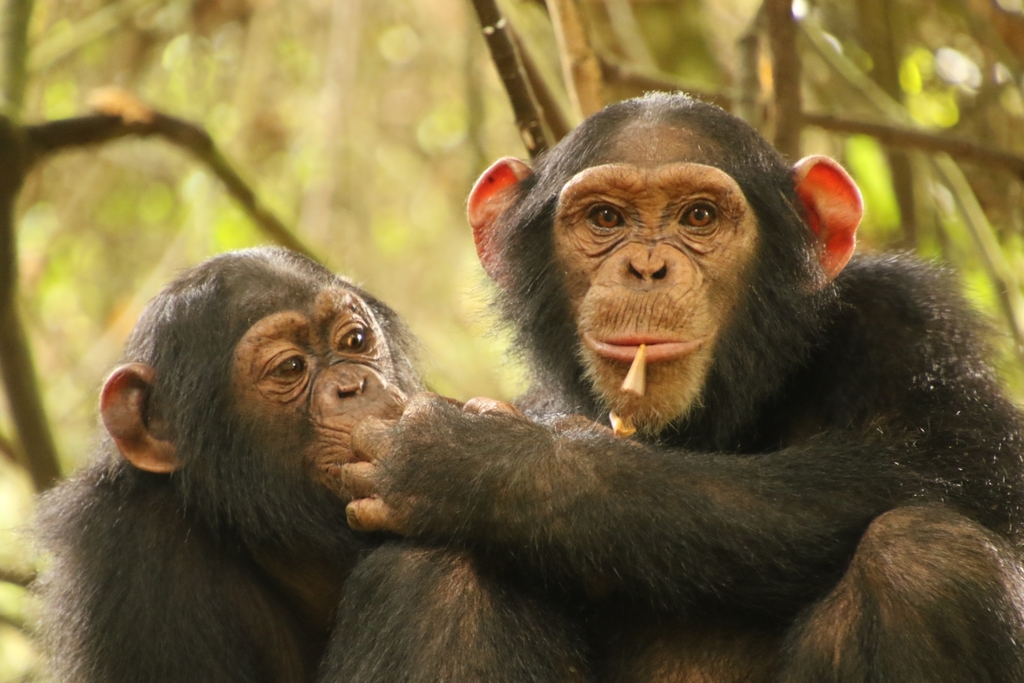
Central Chimpanzee (Pan troglodytes troglodytes)

Central Chimpanzees possess a robust and muscular build, with long arms and a relatively hairless face. Their bodies are covered in dark brown or black fur, which may appear lighter in color on their hands and feet. Notably, they have opposable thumbs, allowing for dexterous manipulation of objects, and their facial features are marked by expressive eyes, a prominent brow ridge, and a strong jaw.

Distribution

These intelligent apes are primarily found in the dense tropical rainforests and wet savanna woodlands of Central Africa. Their range extends across countries such as Gabon, Cameroon, and the Congo, where they thrive in diverse habitats that offer ample food resources and suitable nesting sites. The Central Chimpanzee population is most concentrated in these regions, with an estimated population of up to 115,000 individuals, demonstrating their adaptability to various ecological conditions.

Habitat Preferences

Central Chimpanzee Habitat

Central Chimpanzees exhibit a preference for a range of habitats, including tropical rainforests and montane rainforests at varying altitudes. These environments provide an abundant supply of fruits, leaves, seeds, and insects, which form the basis of their omnivorous diet. The forest-savanna mosaics also serve as important habitats for these apes, showcasing their ability to thrive in diverse ecosystems.

Overall, the Central Chimpanzee’s survival and well-being are intricately linked to the preservation of these rich and biodiverse habitats, emphasizing the significance of conservation efforts aimed at protecting their natural environment.

Facts About Central Chimpanzee

  • The Central Chimpanzee (Pan troglodytes troglodytes) is the most numerous of all chimpanzee subspecies, with a population of up to 115,000 individuals, mostly in Gabon, Cameroon, and Congo (source: WWF).
  • Central Chimpanzees inhabit the dense tropical rainforests of Central Africa, characterized by hot weather and heavy rain (source: New England Primate Conservancy).
  • The scientific name for the Central Chimpanzee is Pan troglodytes troglodytes (source: World Wildlife Fund).
  • Central Chimpanzees are endangered, with a population ranging from 172,700 to 299,700 (source: World Wildlife Fund).
  • They are found in the tropical forests of central Africa, distributed from about 10 degrees N to 8 degrees S (source: Animal Diversity Web).
  • Central Chimpanzees share 98.7 percent of genetic material with humans (source: National Geographic).
  • Their habitats include moist and dry forests, as well as savannah woodlands (source: World Wildlife Fund).
  • Central Chimpanzees are known for using tools, such as rocks and sticks, for various purposes including foraging and communication (source: Britannica).


Scientific Provenance & Verified Sources

Biological taxonomy, conservation status, and physical traits are cross-referenced with authoritative global registers:


Peer-reviewed by Wildlife Science Editors โ€ข Updated for 2026

Explore Other Species Profiles