IUCN Red List Conservation Status


Least Concern

LC
NT
VU
EN
CR
EW
EX

Official assessment evaluated in accordance with the IUCN Red List of Threatened Species criteria: Least Concern.


Species Quick Facts

Scientific Name
Saimiri oerstedii

Average Lifespan
15-20 years in wild, 20-25 years in captivity

Average Weight
0.5-0.8 kg (1.1-1.8 lbs) – Males: 0.7 kg, Females: 0.6 kg

Average Length
30-40 cm (12-16 inches) – head-body length excluding tail

Overview & Identification

The Central American squirrel monkey (Saimiri oerstedii) belongs to the family Cebidae within the order Primates. Endemic to the Pacific lowlands and foothills of Costa Rica and Panama, it inhabits primary and secondary tropical rainforests, mangrove swamps, and forest edges up to 1,200 meters elevation. Adults are among the smallest New World monkeys, measuring 30โ€‘40 cm in headโ€‘body length and weighing 0.5โ€‘0.8 kg. Their pelage is a striking mix of orangeโ€‘cream on the back, black on the face and limbs, and a white eyebrow stripe that gives the species its common name. Highly arboreal and diurnal, they spend most of the day foraging in the canopy, leaping between branches with remarkable agility. The IUCN classifies S. oerstedii as Least Concern, but localized habitat loss and fragmentation have caused population declines in parts of its range. Conservation efforts focus on protecting forest corridors and monitoring demographic trends within protected areas.

Behavior & Social Structure

Central American squirrel monkeys live in multimaleโ€‘multifemale troops of 30โ€‘50 individuals, although smaller groups of 10โ€‘15 are common in fragmented habitats. Group cohesion is maintained through frequent grooming, play, and coordinated vocalizations that include alarm calls, contact chirps, and predator-specific screams. They are diurnal, with peak activity during early morning and late afternoon when they travel 1โ€‘2 km per day in search of food. Home ranges average 15โ€‘30 hectares and overlap with those of other primate species, leading to both competition and mixedโ€‘species foraging benefits. Territorial defense is limited; instead, troops rely on vigilance and rapid flight to avoid raptors and snakes. Social hierarchy is relatively fluid, with dominant males gaining priority access to receptive females during the breeding season.

Diet & Hunting Patterns

Saimiri oerstedii is an omnivorous forager with a strong insectivorous bias. Its diet comprises 60โ€‘70% arthropodsโ€”caterpillars, beetles, ants, and spidersโ€”supplemented by 20โ€‘30% fruit, including figs, mangoes, and palm berries. The remaining intake consists of nectar, flower buds, young leaves, and occasional small vertebrates such as lizards or bird eggs. Foraging occurs primarily in the midโ€‘canopy, where monkeys use quick, precise hand movements to extract insects from leaf axils and bark crevices. Seasonal fruit flushes trigger increased frugivory, while dry periods see a shift toward higher insect consumption. They also exploit anthropogenic food sources near forest edges, which can increase humanโ€‘wildlife conflict.

Reproduction & Life Cycle

Females reach sexual maturity at 3โ€‘4 years, while males mature slightly later at 4โ€‘5 years. Breeding is seasonal, typically coinciding with the onset of the rainy season (Mayโ€‘July), which maximizes food availability for lactating mothers. Gestation lasts 140โ€‘150 days, after which a single infant is born, weighing about 120โ€‘150 grams. Newborns cling to the motherโ€™s belly for the first 2โ€‘3 weeks before transitioning to riding on the back. Infants are weaned at 5โ€‘6 months but remain dependent on maternal care for up to a year. Females may produce one litter every 12โ€‘18 months, and interbirth intervals are influenced by resource abundance and social stability within the troop.

Threats & Conservation

The IUCN lists the Central American squirrel monkey as Least Concern, yet the species faces several localized threats. Deforestation for cattle ranching, oil palm plantations, and urban expansion has reduced suitable habitat by an estimated 30% over the past three decades. Fragmentation isolates populations, limiting gene flow and increasing vulnerability to stochastic events. Although the pet trade is not a major driver, occasional capture for the illegal wildlife market occurs. Climate change may alter fruiting phenology, affecting food availability during critical breeding periods. Current population estimates range from 100,000 to 200,000 mature individuals, with declines noted in the southern part of its range. Conservation actions include expanding protected corridors, community-based forest stewardship programs, and longโ€‘term monitoring of troop demographics.

Interesting Facts

โ€ข The species has a distinctive white eyebrow stripe that resembles a squirrelโ€™s tail.
โ€ข It is the only squirrel monkey species that inhabits Central America, while its relatives are confined to South America.
โ€ข Central American squirrel monkeys can leap up to 5 meters between trees.
โ€ข They possess a specialized grooming claw on the second toe of each foot.
โ€ข Their vocal repertoire includes over 20 distinct calls, each serving specific social functions.

Description

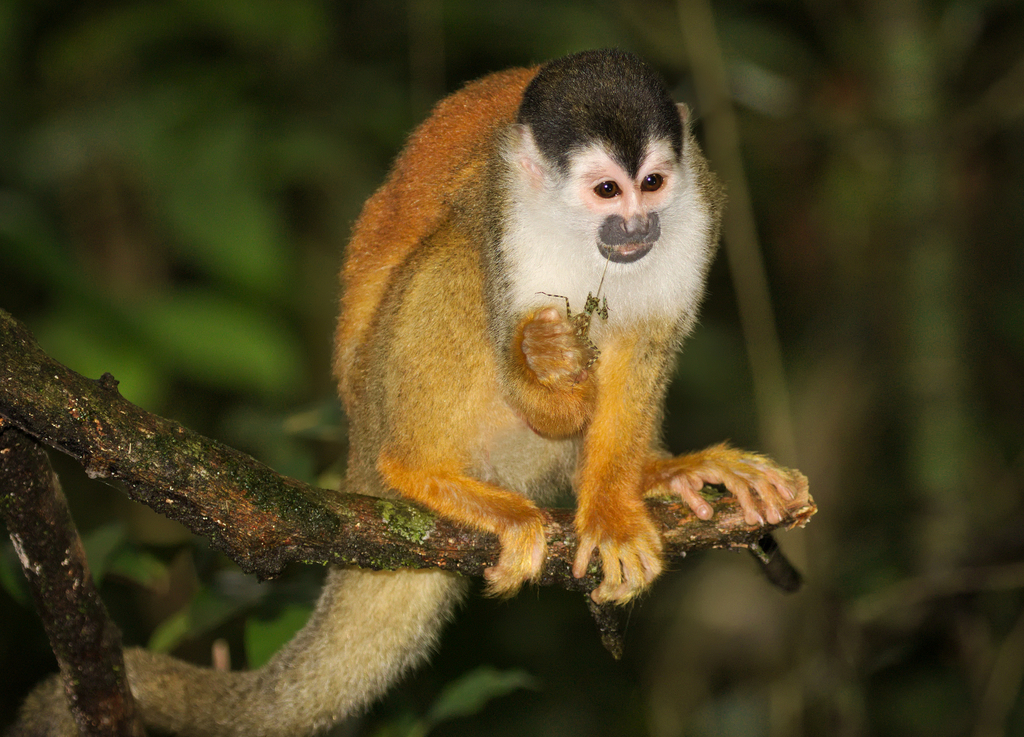
The Central American squirrel monkey (Saimiri oerstedii), also known as the red-backed squirrel monkey, is a captivating species of New World monkey. This small primate is characterized by its striking red-orange back, contrasting with its yellowish limbs and black hands and feet. Known for its agile and acrobatic nature, the Central American squirrel monkey possesses a slender build, a long tail, and a distinctive white mask around its eyes.

Appearance

The Central American squirrel monkey can be distinguished from other squirrel monkey species by its unique red-orange back, which sets it apart from the bare-eared squirrel monkey found in central Brazil. This vibrant coloration is a key feature of the species and plays a significant role in its visual identification.

Distribution

This species is primarily found along the Pacific coast of Costa Rica and the northwestern tip of Panama. The distribution of the Central American squirrel monkey is restricted to these specific regions, where it inhabits the lush tropical forests and coastal mangroves. Notable patterns in its population density include its preference for the aforementioned geographic areas, where it thrives in the diverse ecosystems present.

Habitat Preferences

Central American squirrel monkeys are arboreal and diurnal, thriving in the primary and secondary forests, thickets, and mangrove swamps of their native range. These monkeys are highly adapted to life in the trees, where they move with agility and grace. The diverse ecosystems of the Pacific coast of Costa Rica and Panama provide essential resources for their survival, including an abundance of fruits, insects, and other food sources.

This comprehensive profile provides a detailed understanding of the Central American squirrel monkey, highlighting its unique characteristics, distribution, and habitat preferences.

Facts About Central American Squirrel Monkey

  • The Central American squirrel monkey (Saimiri oerstedii) is a small, slender monkey with a long tail and excellent eyesight.
  • This species has black crowns and reddish backs, with much of their body fur being yellow-brown in color.
  • Central American squirrel monkeys spend the majority of their lives in the middle and high canopy layer of the forest.
  • They are also known as the red-backed squirrel monkey.
  • The Central American squirrel monkey occurs in the forests and cultivated areas of Panama and southern Costa Rica.
  • This species is endangered in Costa Rica and nearly extinct in Panama due to habitat loss, development, and the pet trade.
  • Conservation efforts are in place to protect the Central American squirrel monkey, including in the Corcovado National Biological Reserve in southern Costa Rica.
  • Central American squirrel monkeys have hair on their ears, unlike the bare-eared squirrel monkeys.
  • They are highly social animals and live in multi-male, multi-female groups.
  • The Central American squirrel monkey is a subspecies of the Saimiri oerstedii species.


Scientific Provenance & Verified Sources

Biological taxonomy, conservation status, and physical traits are cross-referenced with authoritative global registers:


Peer-reviewed by Wildlife Science Editors โ€ข Updated for 2026

Explore Other Species Profiles