IUCN Red List Conservation Status


Least Concern

LC
NT
VU
EN
CR
EW
EX

Official assessment evaluated in accordance with the IUCN Red List of Threatened Species criteria: Least Concern.


Species Quick Facts

Scientific Name
Xerus inauris

Average Lifespan
5-7 years in wild, 10-12 years in captivity

Average Weight
0.8-1.2 kg (1.8-2.6 lbs) – Males: 1.0 kg, Females: 0.9 kg

Average Length
30-38 cm (12-15 inches) – head-body length excluding tail

Overview & Identification

The Cape ground squirrel (Xerus inauris) belongs to the order Rodentia and family Sciuridae. It inhabits the arid and semiโ€‘arid regions of southern Africa, ranging across Namibia, Botswana, western South Africa, and parts of Angola. Preferred habitats include open savanna, grassland, and rocky outcrops where sparse vegetation provides both cover and foraging opportunities. Adults are mediumโ€‘sized squirrels with a robust body, large rounded ears, and a bushy tail that can be as long as the body. Their coat is a grizzled brownโ€‘gray with a distinctive white stripe along the sides. The species is diurnal, forming stable social groups that defend territories and share vigilance duties. The IUCN classifies the Cape ground squirrel as Least Concern, reflecting its wide distribution and apparently stable population, although localized pressures from agriculture and overgrazing are monitored. Conservation actions focus on habitat preservation within protected areas and research on population dynamics.

Behavior & Social Structure

Cape ground squirrels live in cohesive colonies of 20โ€“30 individuals that are organized around a dominant male and several breeding females. The groups maintain a home range of 2โ€“4 hectares, which they patrol daily using a system of scent marking from cheek glands and urine. Foraging is conducted in the early morning and late afternoon, with individuals acting as sentinels while others feed on grasses, seeds, and tubers. Vocalizations include sharp alarm calls that alert the colony to aerial predators such as hawks, while lowโ€‘frequency chirps maintain contact within the burrow network. Burrows are complex, with multiple entrances and chambers used for nesting, food storage, and refuge from extreme temperatures. The species exhibits strong territoriality; intruders are chased and may be subjected to aggressive displays, including tail flicking and teeth baring.

Diet & Hunting Patterns

The Cape ground squirrel is principally herbivorous, consuming a varied diet of grasses, seeds, succulent leaves, tubers, and occasional fruits such as the berries of the camelthorn (Vachellia erioloba). Insects, especially beetles and larvae, are taken opportunistically, providing supplemental protein during the dry season. Individuals can ingest up to 15% of their body weight in food daily, and they practice food caching by burying seeds and tubers near burrow entrances for later consumption. Water needs are largely met through the moisture content of vegetation, allowing the squirrels to endure prolonged droughts. Foraging strategies include systematic quadrat sampling of the ground surface and digging for underground storage organs, with a keen sense of smell guiding the search for hidden food items.

Reproduction & Life Cycle

Sexual maturity is reached at about 10โ€“12 months for both sexes, though females may breed earlier under favorable conditions. Breeding is synchronized with the rainy season, typically from October to March, when food resources are abundant. After a gestation period of roughly 48 days, females give birth to litters of one to three pups, with two being the most common. Newborns are altricial, blind and hairless, and remain in the nest for about three weeks before they begin to explore. The mother nurses the young for 6โ€“8 weeks, after which they are weaned but continue to stay within the natal group for several months, learning foraging and antiโ€‘predator behaviors. Parental care is primarily maternal, though older siblings may assist in vigilance and food provisioning.

Threats & Conservation

The IUCN lists the Cape ground squirrel as Least Concern, with an estimated total population exceeding 100,000 mature individuals and a stable trend. Nevertheless, the species faces localized threats from habitat conversion to agriculture and livestock grazing, which reduce the availability of native grasses and increase soil compaction around burrow systems. Predation by introduced species such as domestic cats and feral dogs adds mortality pressure in periโ€‘urban areas. Climate change poses a longerโ€‘term risk by intensifying drought frequency, potentially limiting food resources. Conservation measures include monitoring population dynamics within protected reserves like the Kalahari Gemsbok National Park, promoting sustainable landโ€‘use practices, and conducting community outreach to mitigate humanโ€‘wildlife conflict.

Interesting Facts

โ€ข Cape ground squirrels can remain active for up to 12 hours a day during the hot season, using burrows to escape midday heat.
โ€ข They have a unique โ€œsunโ€‘bathingโ€ behavior where they spread on warm rocks to raise body temperature before foraging.
โ€ข Their large, rounded ears not only aid hearing but also help dissipate heat through vascularization.
โ€ข Unlike many squirrels, they do not hoard large quantities of nuts; instead, they cache seeds and tubers close to their burrows.
โ€ข Social grooming is rare; instead, individuals rely on scent marking to maintain group cohesion.

The Cape ground squirrel, also known as the South African ground squirrel, is a fascinating mammal found in the drier regions of southern Africa. Its scientific name is Xerus inauris, and it is known for its unique characteristics and behavior that set it apart from other species.

Description

The Cape ground squirrel is a diurnal and social animal that does not hibernate. It is a burrowing species, known for living in clusters of burrows and displaying complex social behaviors within its groups. These squirrels are also recognized for their keen sense of smell, which they use to detect predators and potential food sources.

Appearance

The Cape ground squirrel is distinguished by its sandy to light brown fur, with a white stripe running along each side of the body. This stripe is a key feature that sets it apart from similar species. The squirrel’s body is compact and well-adapted to its burrowing lifestyle, with strong claws for digging and maneuvering through its underground habitat.

Distribution

The Cape ground squirrel is found in various regions across southern Africa, including South Africa, Botswana, and Namibia, with notable populations in places such as Etosha National Park. It thrives in the drier parts of these countries, adapting to a range of habitats from savannas to woodlands and scrublands.

Habitat Preferences
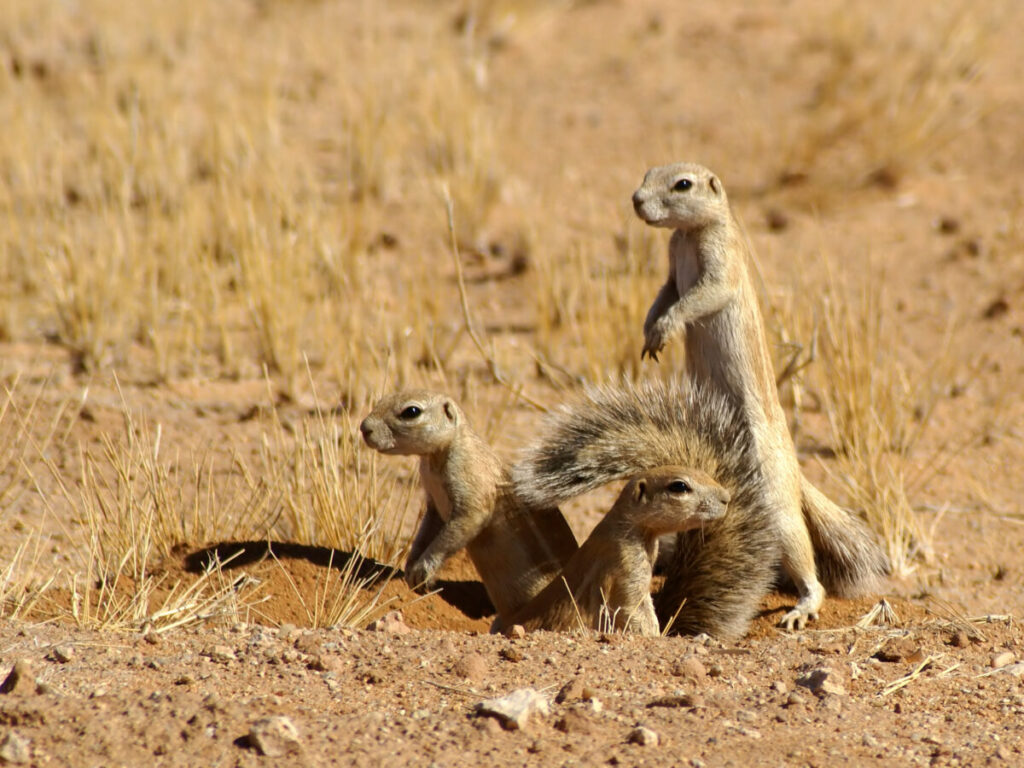
These squirrels are well-suited to the arid and semi-arid environments of southern Africa, where they can be found in a variety of habitats. They are particularly prevalent in the Kalahari Desert and other similar regions, where their burrowing behavior and social structure contribute to their survival. The ability of Cape ground squirrels to thrive in these challenging environments underscores their resilience and adaptability as a species.

Overall, the Cape ground squirrel is a remarkable mammal with unique characteristics and a significant presence in the ecosystems of southern Africa. Its ability to navigate and thrive in arid environments makes it an important and intriguing species for wildlife conservation and research.

Facts About Cape Ground Squirrel

  • The Cape ground squirrel (Xerus inauris) is found in most of the drier parts of southern Africa.
  • They are diurnal herbivores, meaning they are active during the day and primarily eat plants.
  • Cape ground squirrels are highly social animals and live in groups.
  • Both males and females are promiscuous, mating with multiple partners throughout the year.
  • Unlike the Damara Ground Squirrel, the Cape ground squirrel has no arboreal tendencies and is purely ground-living.
  • Breeding takes place all year long, and females give birth to litters of 1-4 offspring.
  • They have a body length of approximately 450 mm and weigh up to 900 grams.
  • Cape ground squirrels are known for their distinctive white stripes on their sides and a bushy tail.
  • This species does not hibernate and is active throughout the year.
  • Foraging in the presence of colony members increases their chances of detecting predators.


Scientific Provenance & Verified Sources

Biological taxonomy, conservation status, and physical traits are cross-referenced with authoritative global registers:


Peer-reviewed by Wildlife Science Editors โ€ข Updated for 2026

Explore Other Species Profiles