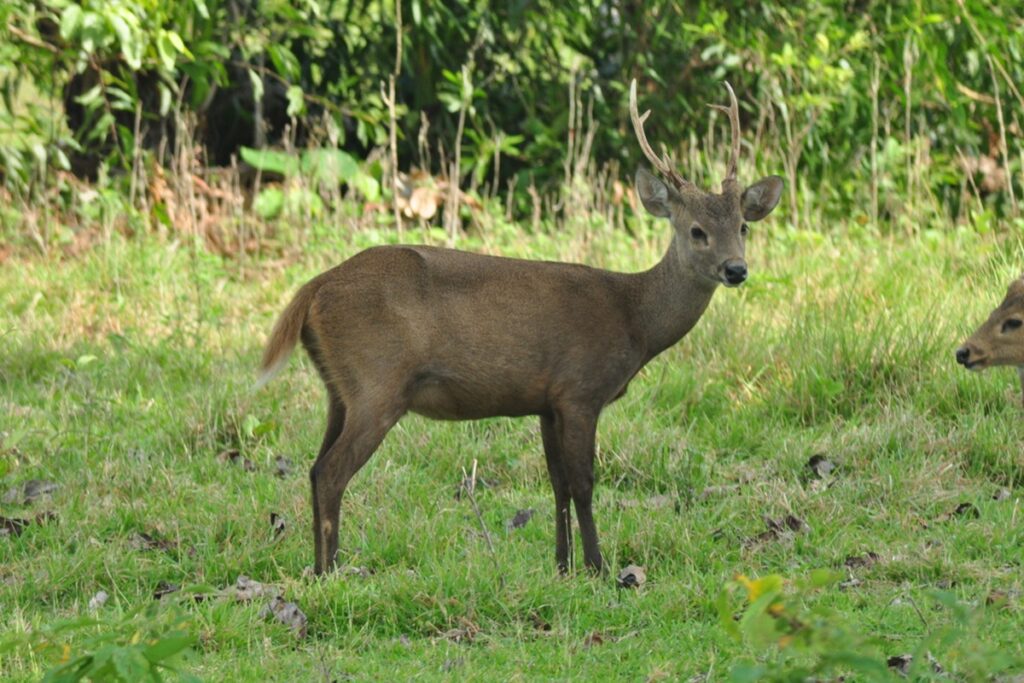
Calamian Deer

IUCN Red List Conservation Status


Near Threatened

LC
NT
VU
EN
CR
EW
EX

Official assessment evaluated in accordance with the IUCN Red List of Threatened Species criteria: Near Threatened.


Species Quick Facts

Scientific Name
Hyelaphus calamianensis

Average Lifespan
10-12 years in wild, 15-20 years in captivity

Average Weight
30-45 kg (66-99 lbs) – Males: 40 kg, Females: 32 kg

Average Length
115-150 cm (45-59 inches) – head-body length excluding tail

Overview & Identification

The Calamian deer (Hyelaphus calamianensis) belongs to the family Cervidae and the genus Hyelaphus, a group of small to mediumโ€‘sized spotted deer native to Southeast Asia. It is endemic to the Calamian Islands of the Philippines, primarily Busuanga, Culion, and Coron, where it occupies lowland primary and secondary forests, open grasslands, and scrubby coastal areas. Adults display a reddishโ€‘brown coat marked with white spots that fade with age, and males grow short, threeโ€‘tined antlers that are shed annually. The species is listed as Near Threatened on the IUCN Red List, with an estimated total population of roughly 2,500โ€“3,000 mature individuals. Ongoing habitat conversion for agriculture, logging, and mining, combined with illegal hunting, have caused a steady decline. Conservation measures include protectedโ€‘area designation on several islands, communityโ€‘based monitoring, and captiveโ€‘breeding programs aimed at augmenting wild stocks.

Behavior & Social Structure

Calamian deer are primarily crepuscular, becoming most active at dawn and dusk when they forage and move between feeding sites. They form small, fluid groups of 3โ€“8 individuals, usually consisting of a dominant male, several females, and their offspring. Males maintain overlapping territories marked by scent glands on the preorbital region and by rubbing antlers on vegetation. Social cohesion is reinforced by soft whistling calls and low grunts, especially during the breeding season. When threatened, individuals emit a sharp alarm bark and seek dense understory cover. Home ranges are modest, typically 0.5โ€“1.2 kmยฒ for females and up to 2 kmยฒ for territorial males, reflecting the fragmented island landscape.

Diet & Hunting Patterns

The Calamian deer is a strict herbivore, feeding primarily on a variety of foliage, grasses, shoots, and fallen fruits. During the wet season, it prefers young leaves of dipterocarp trees, fern fronds, and herbaceous understory plants, while in the dry season it shifts to more fibrous grasses and bark. Seasonal fruiting trees such as Ficus spp. and Pandanus provide supplemental carbohydrates and vitamins. An adult consumes roughly 2.5โ€“3.5 kg of plant material daily, selecting highโ€‘protein buds and tender shoots to meet nutritional needs. Foraging occurs in small patches, and individuals often use their keen sense of smell to locate nutrientโ€‘rich patches, especially after fire or logging disturbances that expose fresh growth.

Reproduction & Life Cycle

Females reach sexual maturity at about 1.5โ€“2 years, while males mature slightly later at 2โ€“3 years. The breeding season peaks between November and January, coinciding with the onset of the dry season. Mating is polygynous, with dominant bucks defending harems of receptive does. Gestation lasts approximately 210 days, after which a single fawn is born, weighing 3.5โ€“4.5 kg. Fawns are concealed in tall grass for the first 10โ€“12 days, nursing frequently and gaining about 0.5 kg per day. Maternal care continues for 8โ€“10 months, during which the young learn browsing habits and predator avoidance. Juveniles attain independence by the end of their first year and may remain in their natal group for several years.

Threats & Conservation

The IUCN classifies the Calamian deer as Near Threatened, with the primary threats being habitat loss, hunting, and introduced predators. Deforestation for timber extraction, agricultural expansion, and mining activities have reduced suitable forest cover by an estimated 30% over the past two decades. Illegal hunting for meat and antlers persists despite legal protection, contributing to an observed 15% population decline between 2000 and 2020. Feral dogs and cats prey on fawns, further limiting recruitment. Small, isolated populations increase vulnerability to stochastic events such as typhoons. Conservation actions include the establishment of the Calamian Islands Wildlife Sanctuary, community education programs, and a captiveโ€‘breeding initiative that has successfully reared 12 fawns for potential future releases.

Interesting Facts

โ€ข The Calamian deer is the only endemic deer species in the Philippines.
โ€ข Its antlers are relatively short and lack the large tines seen in larger cervids.
โ€ข Spot patterns fade with age, making older individuals appear more uniformly brown.
โ€ข The species can swim short distances, allowing it to move between nearby islands during high tides.
โ€ข Local folklore regards the deer as a forest spirit, which has helped foster community support for its protection.

Description

Calamian Deer

The Calamian deer, scientifically known as Hyelaphus calamianensis and colloquially referred to as Calamian hog deer, is an endangered species of deer native to the Calamian Islands of Palawan province in the Philippines. It is one of three species of deer native to the Philippines, with a unique set of characteristics and habitat preferences that distinguish it from other deer species.

Appearance

Calamian Deer Appearance

The Calamian deer is characterized by its relatively small size, with adults typically weighing between 45 to 50 kilograms. It has a distinct reddish-brown coat with white spots that are more prominent in juveniles. The species is known for its slender legs and graceful build, with the males (bucks) sporting impressive lyre-shaped antlers that can reach up to 50 centimeters in length. These antlers are a key distinguishing feature that sets the Calamian deer apart from other deer species.

Distribution

The Calamian deer is endemic to the Calamian Islands, specifically Busuanga, Calauit, and Culion, within the Palawan province of the Philippines. Due to habitat loss and hunting pressures, the species has experienced a significant decline in population, leading to its classification as an endangered species by the International Union for Conservation of Nature (IUCN). Conservation efforts are focused on protecting the remaining populations and restoring suitable habitats to ensure the survival of this unique deer species.

Habitat Preferences

Calamian Deer Habitat

The Calamian deer thrives in diverse habitats including grasslands, open forests, riverine areas, marshes, and swamps with tall grasses. These habitats provide the deer with essential resources for foraging, shelter, and reproduction. The species’ survival and well-being are intricately linked to the conservation of these ecosystems, making habitat preservation a critical component of conservation initiatives aimed at safeguarding the Calamian deer.

As a renowned expert in animal conservation and wildlife biology, I hope this detailed species profile provides valuable insights into the unique characteristics, distribution, and habitat preferences of the Calamian deer. It is imperative that concerted efforts are made to protect and conserve this endangered species to ensure its continued existence for future generations.

Facts About Calamian deer

  • The Calamian deer (Hyelaphus calamianensis) is an endangered species found only in the Calamian Islands of Palawan, Philippines.
  • They have a stocky build with short legs and slightly elevated hindquarters.
  • The overall body color is uniform golden-brown with paler underparts.
  • These deer stand up to 28 inches at the shoulder and have a body length of roughly 3.5 feet.
  • They weigh between 79 to 110 pounds and live in riverine habitats, marshes, and grasslands.
  • Calamian deer are primarily active during the early morning and late afternoon.
  • Their diet consists of grasses, leaves, and fruits.
  • The species faces threats from habitat loss, hunting, and competition with introduced species.
  • Calamian deer are known for their elusive nature and are often solitary or found in small groups.
  • Conservation efforts are being made to protect and preserve this endangered species.


Scientific Provenance & Verified Sources

Biological taxonomy, conservation status, and physical traits are cross-referenced with authoritative global registers:


Peer-reviewed by Wildlife Science Editors โ€ข Updated for 2026

Explore Other Species Profiles