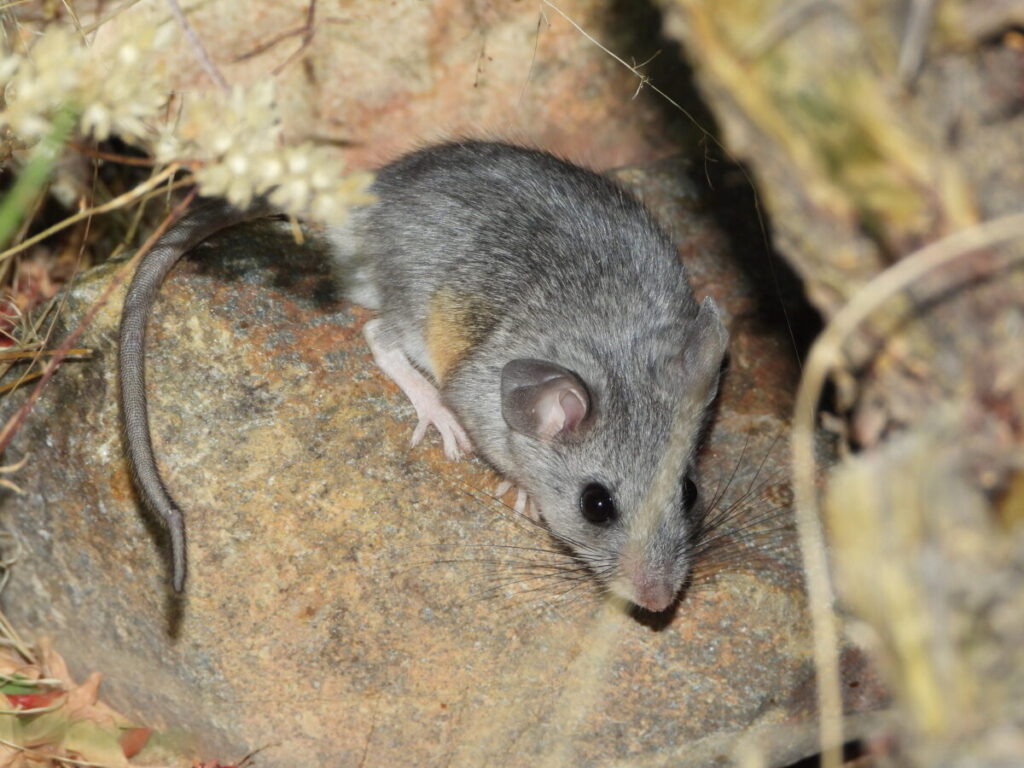
Cactus Mouse

IUCN Red List Conservation Status


Least Concern

LC
NT
VU
EN
CR
EW
EX

Official assessment evaluated in accordance with the IUCN Red List of Threatened Species criteria: Least Concern.


Species Quick Facts

Scientific Name
Peromyscus eremicus

Average Lifespan
1-2 years in wild, 3-4 years in captivity

Average Weight
0.010-0.020 kg (0.022-0.044 lbs) – Males: 0.012 kg, Females: 0.011 kg

Average Length
7-10 cm (2.8-4.0 inches) – head-body length excluding tail

Overview & Identification

The cactus mouse (Peromyscus eremicus) is a small nocturnal rodent in the family Cricetidae, order Rodentia. Endemic to the arid and semiโ€‘arid regions of the southwestern United States and northern Mexico, its range extends from southern California and Arizona through Texas into the Baja California peninsula and the Mexican states of Sonora, Chihuahua, and Coahuila. It inhabits desert scrub, thornโ€‘scrub, and chaparral communities where it shelters under rocks, in crevices, or in abandoned burrows of other mammals. Adults weigh between 10 and 20โ€ฏg and measure 7โ€“10โ€ฏcm in headโ€‘body length, with a relatively long, hairless tail that often exceeds the body length. The fur is a pale sandyโ€‘gray on the dorsal side, fading to whitish ventrally, providing camouflage against the desert substrate. Large, dark eyes and prominent whiskers aid navigation in lowโ€‘light conditions. Genetic studies have revealed low mitochondrial divergence among populations, indicating recent expansion across the Sonoran and Chihuahuan deserts. Seasonal coat changes are minimal, but individuals may develop a slightly thicker pelage during winter months. The species is strictly nocturnal; activity peaks shortly after sunset and again before sunrise, coinciding with cooler temperatures. The cactus mouse is one of the few North American rodents that can tolerate high ambient temperatures exceeding 40โ€ฏยฐC, relying on behavioral thermoregulation such as nocturnal foraging and burrow use. Its ecological role includes seed dispersal and serving as prey for a variety of raptors, snakes, and carnivorous mammals. The species is classified as Least Concern by the IUCN due to its broad distribution and adaptability, although local populations can be sensitive to habitat disturbance and extreme drought.

Behavior & Social Structure

Peromyscus eremicus is primarily solitary, with individuals maintaining exclusive home ranges that overlap only minimally with conspecifics of the same sex. Homeโ€‘range sizes average 0.2โ€“0.5โ€ฏha for males and 0.1โ€“0.3โ€ฏha for females, varying with resource availability. The species is strictly nocturnal; activity peaks shortly after sunset and again before sunrise, coinciding with cooler temperatures. Foraging trails are short and irregular, and mice use scent marking from dorsal glands to communicate territorial boundaries. Vocalizations are limited to soft chirps emitted during courtship or when juveniles solicit parental care. Aggressive encounters are resolved through brief chases and tailโ€‘slapping displays rather than prolonged fighting. Seasonal shifts in activity are observed, with reduced movement during the hottest summer months and increased foraging in early spring when seed abundance rises.

Diet & Hunting Patterns

The cactus mouse is an opportunistic omnivore, with a diet that shifts according to seasonal resource fluctuations. Primary food items include seeds of desert annuals such as Atriplex spp., grasses, and the fruits of cacti like Opuntia spp. In the spring, insectsโ€”particularly beetles, grasshoppers, and moth larvaeโ€”constitute up to 30โ€ฏ% of stomach contents, providing essential protein for growth and reproduction. During periods of seed scarcity, individuals increase consumption of green vegetation and succulent plant tissues, extracting moisture to reduce dependence on free water. Food intake averages 2โ€“3โ€ฏg per day, roughly 15โ€“20โ€ฏ% of body mass, and is obtained through short foraging bouts that minimize exposure to predators and extreme heat. Cactus mice exhibit scatterโ€‘hoarding behavior, caching seeds in shallow depressions or beneath rocks, which also serves as a food reserve during droughts. Their dentitionโ€”highโ€‘crowned incisors and molars with complex occlusal patternsโ€”facilitates efficient grinding of both hard seeds and soft plant matter.

Reproduction & Life Cycle

Sexual maturity in cactus mice is reached at approximately 6โ€ฏweeks for both sexes under favorable conditions, though females in the wild often delay breeding until the onset of the spring rains. Breeding is seasonal, typically occurring from March through September, with peak litters in May and July. Gestation lasts 22โ€“24โ€ฏdays, after which females give birth to litters of 2โ€“5 pups, averaging 3.5. Neonates are altricial, hairless and blind, and are nursed exclusively for the first 10โ€“12โ€ฏdays. Females wean pups at about 21โ€ฏdays and may produce up to three successive litters per breeding season if food resources remain abundant. Parental care is solely maternal; males do not participate in nest defense or provisioning. Juveniles attain independence at roughly 30โ€ฏdays and disperse to establish their own territories, contributing to the high turnover rate observed in desert rodent communities.

Threats & Conservation

The International Union for Conservation of Nature (IUCN) currently lists Peromyscus eremicus as Least Concern, reflecting its wide distribution and presumed large population, estimated at several million individuals across its range. Nevertheless, localized threats can cause population declines. Habitat loss from urban expansion, agricultural conversion, and mining activities fragments the desert scrub that the species relies upon. Climate change poses a growing risk; increased frequency of extreme heat waves and prolonged droughts can reduce seed production, leading to food shortages. Predation pressure from introduced feral cats (Felis catus) and domestic dogs (Canis lupus familiaris) is higher near human settlements. Pesticide application in agricultural edges may also impact insect prey availability and cause secondary poisoning. Conservation measures focus on preserving contiguous desert habitats, monitoring population trends through liveโ€‘trapping surveys, and mitigating humanโ€‘induced mortality. Recent studies suggest that protected areas such as the Sonoran Desert National Monument support stable cactus mouse densities, underscoring the importance of landโ€‘conservation policies.

Interesting Facts

โ€ข Can survive without drinking water by extracting moisture from seeds and succulent plants
โ€ข Exhibits one of the highest thermal tolerances among North American rodents, active at temperatures above 40โ€ฏยฐC
โ€ข Uses scent glands on its back to mark territory, a behavior uncommon in many Peromyscus species
โ€ข Displays seasonal coat thickening, providing insulation during cooler winter nights
โ€ข Serves as a key prey species for the endangered desert night lizard (Xantusia vigilis) and several raptor species

Description

Cactus Mouse

The Cactus Mouse, scientifically known as Peromyscus eremicus, is a species of rodent native to western North America. It belongs to a closely related group of New World mice often called “deermice.” These small mammals are known for their adaptability to arid environments and unique behavioral and physiological characteristics that enable them to thrive in harsh desert conditions.

Appearance

Cactus Mouse Appearance

The Cactus Mouse is characterized by its sandy-brown fur, large eyes, and relatively long tail. It has large ears and a pointed snout, which aid in its sensory perception and foraging activities. One of the distinguishing features of the Cactus Mouse is its ability to store fat in its tail, a physiological adaptation that allows it to survive in environments with limited food and water resources.

Distribution

Cactus Mice are primarily found in dry desert habitats, steppe, and mountain foothills in arid regions of the southwestern United States and northern Mexico. They are known to inhabit areas with sparse vegetation, rocky terrain, and limited water sources. Their distribution extends across states such as Arizona, California, Nevada, New Mexico, and Texas, as well as northern Mexico. The population density of Cactus Mice fluctuates in response to environmental factors such as precipitation and food availability.

Habitat Preferences

Cactus Mouse Habitat

Cactus Mice thrive in a variety of arid ecosystems, including desert scrub, chaparral, and semi-arid regions. They are well-adapted to environments with low moisture content and high temperatures, where they display remarkable resilience in finding food and water sources. Their ability to utilize a diverse range of plant materials and seeds allows them to survive in habitats with limited resources. Cactus Mice play a crucial role in these ecosystems by contributing to seed dispersal and serving as prey for various predators, thus maintaining ecological balance.

By understanding the unique characteristics, distribution, and habitat preferences of the Cactus Mouse, conservation efforts can be tailored to protect and sustain the populations of this remarkable species in their natural environment.

Facts About Cactus Mouse

  • The Cactus Mouse (Peromyscus eremicus) primarily inhabits desert areas with cacti, hence its name “cactus mouse.”
  • It is a small rodent native to the deserts of southwestern North America and has adapted to the extreme conditions of its habitat.
  • Cactus mice are solitary, nocturnal omnivores with a diet predominantly based on seeds, insects, and green vegetation, with proportions varying according to seasonal availability.
  • Females weigh slightly more than males and are significantly larger in body length, ear length, and tail length.
  • The weight of cactus mice ranges between 18 and 40 grams.
  • Cactus mice have a life span of about one year.
  • They are known to live in steppes and semi-arid deserts.
  • The species is classified as “Least Concern” on the IUCN Red List due to its wide distribution and presumed large population.
  • Cactus mice play a role in the ecosystem as seed dispersers and consumers of insects and vegetation.
  • They are important prey for various predators in their natural habitat.


Scientific Provenance & Verified Sources

Biological taxonomy, conservation status, and physical traits are cross-referenced with authoritative global registers:


Peer-reviewed by Wildlife Science Editors โ€ข Updated for 2026

Explore Other Species Profiles