Bush pig foraging among aquatic plants in shallow muddy water

IUCN Red List Conservation Status


Least Concern

LC
NT
VU
EN
CR
EW
EX

Official assessment evaluated in accordance with the IUCN Red List of Threatened Species criteria: Least Concern.


Species Quick Facts

Scientific Name
Potamochoerus larvatus

Average Lifespan
10-12 years in wild, 15-20 years in captivity

Average Weight
45-115 kg (99-254 lbs) – Males: 70-115 kg, Females: 45-80 kg

Average Length
90-130 cm (35-51 inches) – head-body length excluding tail

Overview & Identification

Bushpig (Potamochoerus larvatus) is a mediumโ€‘sized suid native to subโ€‘Saharan Africa. Classified in the order Artiodactyla, family Suidae, it is one of two species in the genus Potamochoerus, the other being the warthog (Phacochoerus africanus). Its range extends from the Sahelian woodlands of Senegal and Sudan southward through the savannas and forestโ€‘edges of Kenya, Tanzania, Mozambique, Zambia, Angola, and into the Cape region of South Africa. Bushpigs prefer dense thickets, riverine forests, and swampy grasslands where cover is abundant, but they also exploit cultivated fields and periโ€‘urban gardens. Adults display a coarse, bristly coat ranging from brown to reddishโ€‘black, a distinctive white facial stripe, and a set of small, curved tusks that are more pronounced in males. Unlike warthogs, bushpigs lack facial warts and have a more robust body shape. Their ecological role includes seed dispersal, soil turnover through rooting, and serving as prey for large carnivores such as lions, leopards, and hyenas. The species is listed as Least Concern by the IUCN due to its wide distribution and adaptability, although localized declines occur where hunting pressure and habitat loss intensify.

Behavior & Social Structure

Bushpigs are primarily nocturnal or crepuscular, retreating to thick cover during the heat of day and emerging at dusk to forage. They are solitary or live in small family groups consisting of a dominant male, several females, and their offspring; larger aggregations form temporarily at abundant food sources such as maize fields. Home ranges vary from 2 to 15 kmยฒ depending on habitat quality, and individuals mark territories with scent glands on the cheeks and by wallowing in mud, which also aids thermoregulation and parasite control. Vocal communication includes grunts, squeals, and a distinctive highโ€‘pitched alarm call that can alert conspecifics to predators. Social bonds are reinforced through mutual grooming and communal nesting in dense vegetation, where litters are sheltered from predators.

Diet & Hunting Patterns

Bushpigs are opportunistic omnivores, consuming a varied diet that reflects seasonal availability. Plant material makes up roughly 70โ€ฏ% of intake and includes roots, tubers, fruits, berries, seeds, grasses, and young shoots. They are adept diggers, using their snout to uncover underground bulbs such as wild potatoes (Dioscorea spp.) and tuberous geophytes. Animal matter contributes about 30โ€ฏ% and consists of insects (beetles, termites), small vertebrates (frogs, lizards, birdsโ€™ eggs), carrion, and occasional eggs from groundโ€‘nesting birds. In agricultural landscapes, bushpigs frequently raid maize, sorghum, and cassava fields, leading to humanโ€‘wildlife conflict. Their foraging strategy combines rooting, browsing, and opportunistic scavenging, and they can consume up to 5โ€ฏ% of their body weight daily, roughly 3โ€“5โ€ฏkg for an adult male.

Reproduction & Life Cycle

Female bushpigs reach sexual maturity at 12โ€“18 months, while males mature slightly later at 18โ€“24 months. Breeding can occur yearโ€‘round but peaks during the rainy season when food is plentiful. After a gestation period of 115โ€“120 days, a sow gives birth to a litter of 2โ€“6 piglets, with an average of three. Newborns are born with a fine coat of dark hair and open eyes, and they can follow the mother within hours. The sow nurses the piglets for about 8โ€“10 weeks, during which time they remain hidden in dense undergrowth. Juveniles become independent at 4โ€“6 months but may remain in the maternal group until the next breeding season. Lifespan in the wild averages 10โ€“12 years, allowing females to potentially produce up to six litters in their lifetime.

Threats & Conservation

The IUCN classifies the bushpig as Least Concern, estimating a global population of several million individuals, but regional assessments reveal pressures that could trigger declines. Primary threats include unregulated hunting for bushmeat, which accounts for up to 30โ€ฏ% of mortality in some East African reserves, and habitat conversion to agriculture, plantations, and urban development that fragments the dense cover they require. Road mortality is an emerging issue in rapidly expanding road networks across southern Africa. Although the species adapts to cultivated areas, conflict with farmers often leads to retaliatory killings. Conservation measures focus on sustainable harvest quotas, communityโ€‘based monitoring, and preserving riparian corridors that provide refuge and foraging grounds. Population trends appear stable overall, yet localized monitoring is essential to prevent overexploitation.

Interesting Facts

โ€ข Bushpigs have a unique white facial stripe that runs from the eye to the snout, distinguishing them from other African suids.
โ€ข They are excellent swimmers and will cross rivers or lakes to reach new feeding grounds.
โ€ข Unlike many pigs, bushpigs lack the prominent facial warts seen in warthogs, giving them a smoother appearance.
โ€ข Their tusks are relatively short but curve upward, and are used mainly for digging rather than defense.
โ€ข Bushpigs play a key role in seed dispersal; many tropical fruit seeds pass through their digestive tract intact and are deposited with fertilized dung.

Description

The bushpig, scientifically known as Potamochoerus larvatus, is a robust member of the pig family found in East and Southern Africa. Known for its aggressive nature, the bushpig is a formidable and powerful mammal that exhibits remarkable speed and swimming abilities. These traits contribute to its survival in the diverse and challenging habitats it occupies.

Appearance
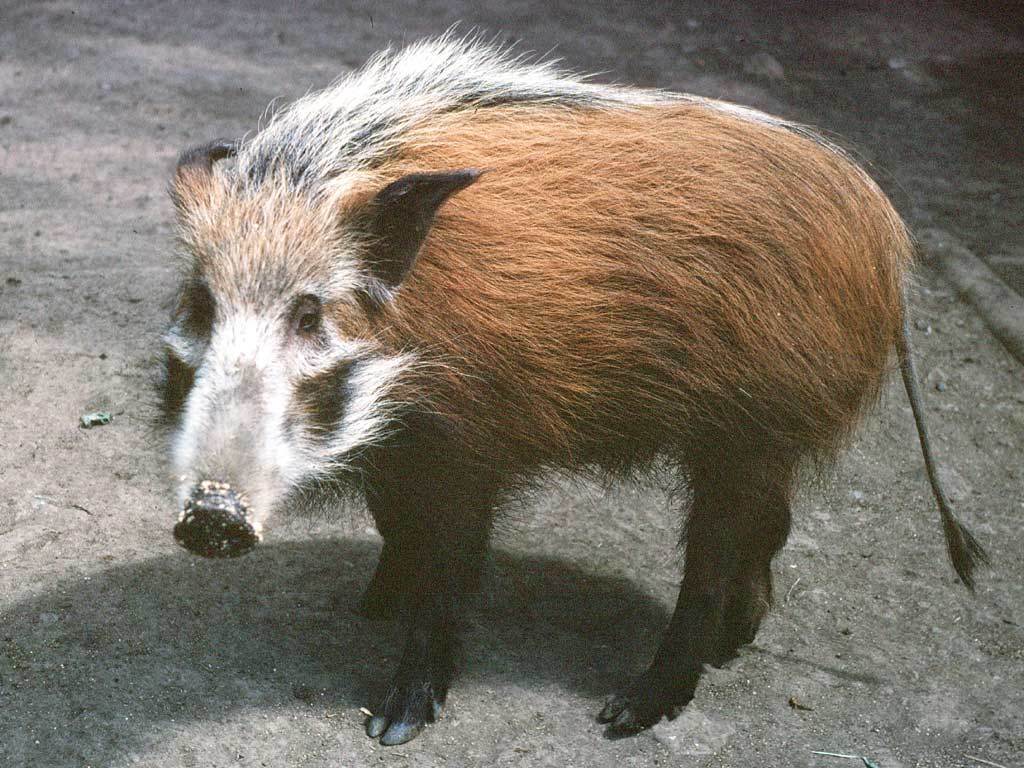
The bushpig is distinguished by its coarse, bristly coat, which varies in color from reddish-brown to dark brown or black. It features a prominent crest of hair on its back, and the males are characterized by their imposing tusks. The distinct appearance of the bushpig sets it apart from other members of the pig family, making it easily identifiable in its natural habitat.

Distribution

Bushpigs are primarily found in East and Southern Africa, inhabiting a range of countries including Kenya, Tanzania, Zambia, and South Africa. They are known to thrive in woodlands, forests, riverine vegetation, and reed beds, adapting to a variety of ecosystems within these regions. While their population density may vary, bushpigs are known to be resilient and adaptable to different environmental conditions.

Habitat Preferences

Bushpigs are versatile creatures that can thrive in a wide range of habitats, from dense cover to open forests, and from sea-level areas to montane forests. They are also known to prefer areas near rivers, swamps, and other water sources. These habitats provide the bushpig with the necessary resources for foraging and reproduction, contributing to their overall well-being and survival.

Facts About Bushpig

  • The bushpig (Potamochoerus larvatus) is a member of the pig family that lives in East and Southern Africa.
  • Bushpigs have coarse fur that varies from red-brown to dark brown and darkens with age.
  • They are mainly nocturnal animals.
  • Bushpigs are known for feeding on crops and are considered to be quite aggressive and extremely powerful.
  • The average daily movements of bushpigs vary from 0.5-5 kilometers (0.3-3 miles).
  • Bushpigs are social animals and are found in sounders (groups).
  • The genetic origins and diversity of bushpigs have been studied, revealing interesting insights into their evolutionary history.
  • Bushpigs have a relatively long lifespan and can live for more than 20 years.
  • The average number of bushpigs sold per hunter in rural areas is low, with an average of 0.8 bushpig/hunter/year.
  • Bushpigs are found in different subspecies, such as the Southern bushpig (P. larvatus koiropotamus) at the San Diego Zoo.


Scientific Provenance & Verified Sources

Biological taxonomy, conservation status, and physical traits are cross-referenced with authoritative global registers:


Peer-reviewed by Wildlife Science Editors โ€ข Updated for 2026

Explore Other Species Profiles