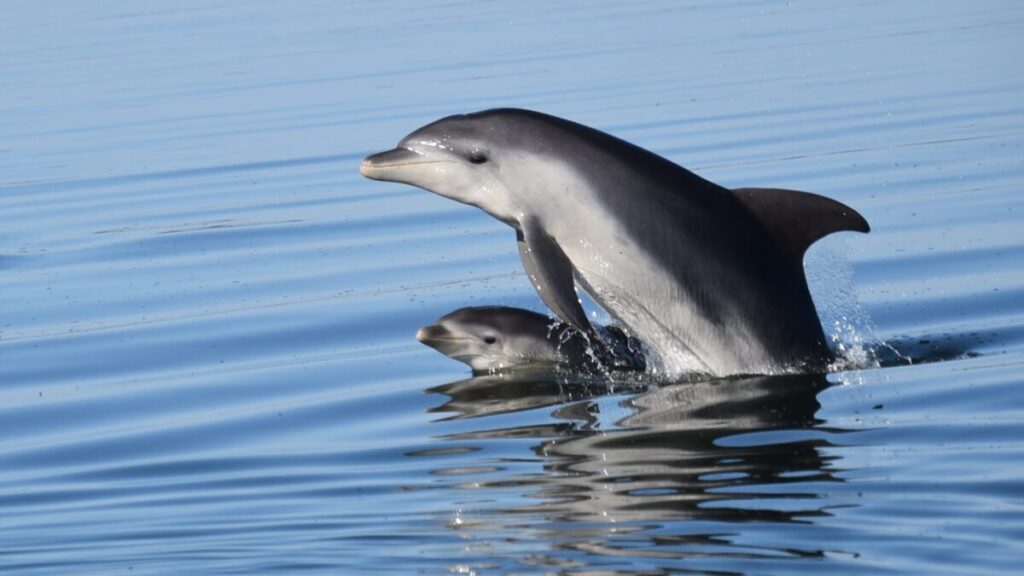
Burrunan Dolphin

IUCN Red List Conservation Status


Data Deficient

This species has no threat category on the IUCN Red List scale (status: Data Deficient), so no threat level is shown.


Species Quick Facts

Scientific Name
Tursiops australis

Average Lifespan
30-40 years in wild, up to 45 years in captivity

Average Weight
180-260 kg (397-573 lbs) – Males: 220 kg, Females: 190 kg

Average Length
250-290 cm (98-114 inches) – head-body length excluding tail

Overview & Identification

The Burrunan dolphin (Tursiops australis) is a small coastal dolphin endemic to the southern coast of Australia. Belonging to the order Cetacea, suborder Odontoceti, and family Delphinidae, it is one of three recognized species of the genus Tursiops. First described in 2011 from genetic and morphological analyses, the species is restricted to the shallow, temperate waters of Port Phillip Bay, Western Port and the Gippsland Lakes in the state of Victoria. It prefers sheltered bays, estuaries and nearโ€‘shore continental shelf habitats where water depths rarely exceed 30โ€ฏm. Adults reach 2.5โ€“2.9โ€ฏm in headโ€‘body length and weigh 180โ€“260โ€ฏkg, making them slightly smaller than the common bottlenose dolphin. Distinguishing features include a relatively short, rounded dorsal fin, a subtle greyโ€‘blue dorsal coloration with a lighter ventral side, and a pronounced, rounded forehead. Genetic studies show clear divergence from T. truncatus and T. aduncus, supporting its status as a distinct species. The International Union for Conservation of Nature (IUCN) currently lists the Burrunan dolphin as Data Deficient, reflecting limited knowledge of its population size and trends. However, recent surveys estimate fewer than 300 mature individuals, indicating a highly vulnerable status. Conservation concerns focus on its restricted range, low genetic diversity, and exposure to human activities such as boating, fishing and coastal development.

Behavior & Social Structure

Burrunan dolphins live in fluid, fissionโ€‘fusion societies that typically consist of two to ten individuals, although larger aggregations of up to 30 have been recorded during feeding events. Groups are usually composed of related females and their offspring, while adult males often associate loosely and may move between groups. The species is diurnal, with peak foraging activity occurring in the early morning and late afternoon; rest periods are taken in sheltered bays during midday. Home ranges are small, generally confined to a 10โ€‘km radius around core habitat patches, and individuals exhibit strong site fidelity, returning to the same bays and haulโ€‘out sites year after year. Communication relies heavily on a repertoire of clicks, whistles and burstโ€‘pulse sounds used for echolocation, coordination of group movements and maintaining social bonds. Visual displays such as leaping, tail slapping and headโ€‘butting supplement acoustic signals, especially in the noisy, shallow waters they inhabit. Territoriality is minimal; instead, overlapping ranges are tolerated, and individuals negotiate space through subtle changes in vocalization frequency and group composition.

Diet & Hunting Patterns

The Burrunan dolphin is a strict carnivore that primarily exploits the abundant schooling fish of coastal Victoria. Stomachโ€‘content analyses and stableโ€‘isotope studies indicate a diet dominated by pelagic species such as Australian herring (Arripis georgianus), pilchard (Sardinops sagax), anchovy (Engraulis australis) and sprat (Sprattus fuegensis). Cephalopods, especially squid (Nototodarus gouldi) and cuttlefish (Sepia apama), constitute a secondary component, while occasional ingestion of small crustaceans like krill has been recorded. Daily food intake is estimated at 3โ€“5โ€ฏ% of body mass, equating to roughly 6โ€“12โ€ฏkg for an adult. Foraging is highly cooperative: dolphins employ herding techniques to concentrate fish into dense bait balls, then use coordinated lunges and rapid bursts of speed to capture prey. In shallow bays, they may also use โ€œstrand feeding,โ€ briefly propelling themselves onto sandbanks to snap up fish trapped by receding tides. Echolocation clicks enable precise detection of individual prey items in turbid water, and acoustic communication synchronizes group hunting efforts. Seasonal shifts in prey availability lead to minor adjustments in diet composition, but the species remains largely piscivorous yearโ€‘round.

Reproduction & Life Cycle

Female Burrunan dolphins reach sexual maturity at about 6โ€“9โ€ฏyears, while males mature slightly later at 8โ€“10โ€ฏyears. Breeding occurs throughout the year but shows a modest peak in the austral spring (Septemberโ€“November), coinciding with increased prey availability. The gestation period lasts approximately 12โ€ฏmonths, after which a single calf is born, weighing 100โ€“150โ€ฏkg and measuring about 1โ€ฏm in length. Calving intervals are typically 3โ€“5โ€ฏyears, reflecting the speciesโ€™ slow reproductive rate. Newborns are nursed for up to 18โ€ฏmonths, during which the mother provides intensive care, protection from predators and guidance in foraging techniques. Calves remain closely associated with their mothers and the natal pod for at least two years before achieving independence, although they may continue to interact with the broader social group. Paternal care is limited to occasional protection and social support within the pod. The low reproductive output, combined with a small population size, makes the species particularly sensitive to increased adult mortality.

Threats & Conservation

The International Union for Conservation of Nature (IUCN) classifies the Burrunan dolphin as Data Deficient, yet population surveys suggest fewer than 300 mature individuals remain, placing the species at high risk of extinction. Its extremely limited distribution makes it vulnerable to a suite of anthropogenic pressures. Boat traffic in Port Phillip Bay and the Gippsland Lakes generates chronic acoustic disturbance and increases the likelihood of vessel strikes, which have been documented in several fatal incidents. Byโ€‘catch in gillโ€‘nets and trawl fisheries poses a direct mortality threat, while entanglement in recreational fishing gear can cause injury or death. Coastal development and habitat modification degrade essential foraging and resting areas, reducing prey abundance and altering water quality through increased sedimentation and pollutant runoff. Noise pollution from shipping and construction interferes with echolocation and communication, potentially impairing hunting efficiency and social cohesion. Climate change may further exacerbate threats by shifting fish distributions and increasing the frequency of harmful algal blooms. Conservation actions currently focus on habitat protection, stricter regulation of fishing gear, speed limits for vessels in key habitats, and public awareness campaigns. Ongoing monitoring and genetic studies are essential to refine population estimates and inform a future IUCN reassessment.

Interesting Facts

โ€ข The Burrunan dolphin was only recognized as a distinct species in 2011 after DNA analysis separated it from the common bottlenose dolphin.
โ€ข It is the smallest member of the Tursiops genus, with adults rarely exceeding 2.9โ€ฏm in length.
โ€ข Populations are confined to a few coastal bays in Victoria, making it one of the worldโ€™s most geographically restricted cetaceans.
โ€ข Genetic studies show low diversity, raising concerns about the speciesโ€™ ability to adapt to environmental changes.
โ€ข Researchers have observed unique โ€œstrand feedingโ€ behavior where dolphins briefly beach themselves to catch fish trapped by receding tides.

Description

Burrunan Dolphin

The Burrunan dolphin, scientifically known as Tursiops australis, is a proposed species of bottlenose dolphin that was first described in 2011. This species is a remarkable marine mammal that exhibits unique characteristics and behaviors, distinguishing it from other dolphin species.

Appearance

Burrunan Dolphin Appearance

The Burrunan dolphin possesses distinguishing features that set it apart from other dolphin species. It is recognized for its distinct coloration, with a dark grey dorsal side and flanks, and a light grey to white ventral side. This striking coloration makes it easily identifiable in its natural habitat. Additionally, the Burrunan dolphin exhibits a robust and sleek body, with a prominent beak and a gentle, intelligent expression.

Distribution

Primarily found in coastal and estuarine waters along the southeastern coast of Australia, the Burrunan dolphin inhabits a range that extends from Port Phillip Bay in Victoria to the Gippsland Lakes. This limited geographical distribution makes it a regionally significant species, with notable population densities observed in these specific areas.

Habitat Preferences

Burrunan Dolphin Habitat

The Burrunan dolphin thrives in a variety of marine environments, including semi-enclosed embayments, estuarine systems, and open coastal waters. These habitats provide the necessary resources for the species’ survival and well-being, including access to prey, suitable water conditions, and sheltered areas for breeding and nurturing offspring.

As a conservation scientist dedicated to wildlife preservation, it is essential to continue studying and protecting the unique habitat and populations of the Burrunan dolphin to ensure the long-term sustainability of this proposed species.

Facts About Burrunan Dolphin

  • The Burrunan Dolphin (Tursiops australis) is a rare and endangered species of bottlenose dolphins found in the coastal waters of southern Australia.
  • They are primarily found in estuaries and sheltered bays along the southern coasts of Australia, making them vulnerable to human activities.
  • The species was officially recognized as a distinct species in 2011, based on genetic and morphological differences from other bottlenose dolphins.
  • Burrunan dolphins can grow up to approximately 2.5 meters in length.
  • These dolphins have a distinct coloration pattern, with a dark gray dorsal area and a lighter gray ventral area.
  • They are known to be social animals, often forming groups of 2 to 13 individuals, and occasionally joining larger groups.
  • Burrunan dolphins are known for their acrobatic behavior, including leaping out of the water and riding the bow waves created by boats.
  • Their diet consists of a variety of fish, squid, and crustaceans found in their coastal habitat.
  • Conservation efforts are underway to protect the Burrunan Dolphin, as they face threats from habitat degradation, pollution, and entanglement in fishing gear.
  • The Burrunan Dolphin is a unique and fascinating species, contributing to the rich biodiversity of the Australian marine environment.


Scientific Provenance & Verified Sources

Biological taxonomy, conservation status, and physical traits are cross-referenced with authoritative global registers:


Peer-reviewed by Wildlife Science Editors โ€ข Updated for 2026

Explore Other Species Profiles