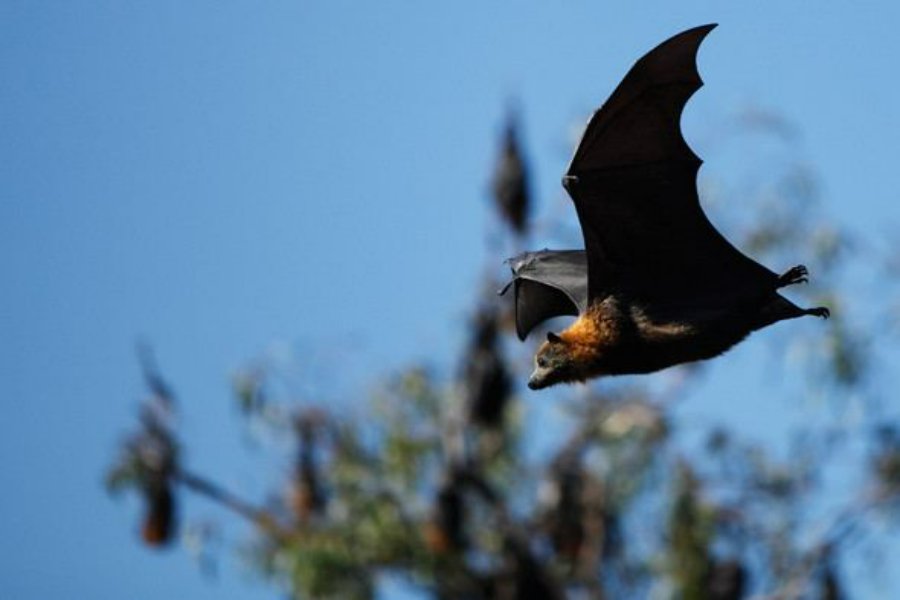
Bulmer's Fruit Bat

IUCN Red List Conservation Status


Critically Endangered

LC
NT
VU
EN
CR
EW
EX

Official assessment evaluated in accordance with the IUCN Red List of Threatened Species criteria: Critically Endangered.


Species Quick Facts

Scientific Name
Aproteles bulmerae

Average Lifespan
10-12 years in wild, 15-20 years in captivity

Average Weight
0.9-1.2 kg (2.0-2.6 lbs) – Males: 1.0 kg, Females: 0.9 kg

Average Length
25-30 cm (9.8-11.8 inches) – head-body length excluding tail

Overview & Identification

Bulmerโ€™s fruit bat (Aproteles bulmerae) is a large megabat in the family Pteropodidae, order Chiroptera. Endemic to the lowโ€‘land tropical rainforests of Papua New Guineaโ€™s Bulmer region in the Sepik River basin, it is one of the worldโ€™s most rangeโ€‘restricted bats, known from fewer than ten specimens collected in the 1970s and a handful of unconfirmed sightings since. Adults have a foxโ€‘like face, dark brown to black fur, and a wingspan that can exceed 1.2โ€ฏm (4โ€ฏft). The species is nocturnal, roosting in small colonies of up to a dozen individuals in the canopy of mature forest trees. Its diet consists almost entirely of ripe figs and other rainforest fruits, which it extracts with a long tongue while in flight. The International Union for Conservation of Nature (IUCN) lists A.โ€ฏbulmerae as Critically Endangered (Possibly Extinct) because no confirmed individuals have been recorded for more than two decades and its habitat has been heavily logged. Conservation efforts are hampered by the batโ€™s cryptic behaviour, the inaccessibility of its remaining forest patches, and limited local awareness. Protecting the remaining primary forest and conducting targeted acoustic surveys are considered the most urgent actions to determine whether any viable population persists.

Behavior & Social Structure

Bulmerโ€™s fruit bat lives in small, loosely structured colonies that occupy the upper canopy of primary rainforest. Individuals are highly social, engaging in mutual grooming, wingโ€‘clasping, and lowโ€‘frequency vocalizations that maintain group cohesion during the night. The species is strictly nocturnal; it emerges at dusk to forage and returns to its roost before sunrise. Home ranges are believed to extend 5โ€“10โ€ฏkm from the roost, following the seasonal fruiting of fig trees. Males defend temporary foraging territories but do not maintain permanent harems; instead, they compete for access to receptive females during the brief breeding window. Communication relies on a repertoire of clicks, squeaks, and a distinctive lowโ€‘pitched โ€œpurrโ€ that can travel several hundred metres through dense foliage. Because the bats are reluctant to travel over open gaps, fragmented forest creates barriers that limit dispersal and increase the risk of local extirpation.

Diet & Hunting Patterns

Bulmerโ€™s fruit bat is a specialist frugivore, relying almost exclusively on the fruit of large canopy figs (Ficus spp.) and a limited selection of other rainforest fruits such as mangoโ€‘like Myristica and wild bananas (Musa spp.). An adult consumes approximately 150โ€“200โ€ฏg of fruit per night, which provides the high carbohydrate and water intake needed for sustained flight. The bat employs a โ€œhoverโ€‘andโ€‘pluckโ€ feeding strategy, using its elongated tongue and sharp incisors to bite into soft pulp while hovering in front of the fruit. Occasionally, it supplements its diet with nectar and pollen from flowering trees, which contributes protein and essential minerals. By discarding seeds beneath the roost and feeding sites, the species acts as an important seed disperser, facilitating forest regeneration across its limited range.

Reproduction & Life Cycle

Sexual maturity in Bulmerโ€™s fruit bat is reached at about two years for both sexes, although females may breed slightly earlier in years of abundant fruit. Breeding is synchronized with the peak fruiting period of the dominant fig species, typically occurring between November and January. After a gestation of roughly 5.5โ€ฏmonths, females give birth to a single pup, which is among the largest newborns of any bat, weighing about 10โ€ฏ% of the motherโ€™s body mass. Newborns are altricial, blind and hairless, and cling to the motherโ€™s ventral fur for the first two weeks. The mother nurses the pup nightly, providing a milk rich in lipids that supports rapid growth; weaning occurs at 8โ€“10โ€ฏweeks when the juvenile begins to accompany the mother on short foraging trips. Juveniles attain full flight capability by three months and reach adult size by one year, after which they integrate into the colonyโ€™s social network.

Threats & Conservation

The IUCN classifies Bulmerโ€™s fruit bat as Critically Endangered (Possibly Extinct) due to an estimated population of fewer than 50 mature individuals, if any remain. The primary threat is habitat loss: commercial logging and slashโ€‘andโ€‘burn agriculture have removed more than 70โ€ฏ% of the original lowโ€‘land forest in the Bulmer region since the 1970s. Hunting pressure, although historically low, has increased as local communities turn to bushmeat for protein, and the batโ€™s large size makes it a desirable target. The speciesโ€™ extreme range restriction amplifies the impact of stochastic events such as cyclones and disease outbreaks. Climate change may further alter fruiting phenology, reducing food availability during the breeding season. Conservation actions proposed include establishing a protected area encompassing the remaining primary forest, implementing communityโ€‘based monitoring, and conducting intensive acoustic and mistโ€‘net surveys to confirm the speciesโ€™ presence.

Interesting Facts

โ€ข Bulmerโ€™s fruit bat was first discovered in 1975 during a shortโ€‘term biological survey in Papua New Guinea.
โ€ข It has one of the smallest known geographic ranges of any mammal, confined to less than 100โ€ฏkmยฒ of lowland forest.
โ€ข The speciesโ€™ wingspan can exceed 1.2โ€ฏm, making it one of the largest fruit bats in the world.
โ€ข Its large, foxโ€‘like face and bright eyes give it a distinctive appearance that inspired the common name โ€œBulmerโ€™s flying fox.โ€
โ€ข Despite its rarity, the bat plays a crucial role in seed dispersal for several fig species, helping maintain forest diversity.

Description

Bulmer's Fruit Bat

Bulmer’s fruit bat, scientifically known as Aproteles bulmerae, is a remarkable megabat species endemic to the island of New Guinea. It holds the distinction of being the sole member of the genus Aproteles. This critically endangered species faces threats primarily from habitat loss and hunting, making conservation efforts crucial for its survival.

Appearance

(Aproteles bulmerae) Appearance

Bulmer’s fruit bat possesses distinct physical characteristics that set it apart from other bat species. It features a medium to large body size, with a wingspan of approximately 1.2 meters. The bat’s fur is predominantly dark in color, and it is known for its striking facial appearance, characterized by large eyes and a unique facial structure. These distinguishing features contribute to the bat’s charismatic presence in its natural habitat.

Distribution

Bulmer’s fruit bat is confined to the island of New Guinea, where it is endemic. Within this region, the bat is known to inhabit specific mountainous areas, particularly in the elevational range of 1800 to 2400 meters. The population density of this species exhibits notable patterns within its limited distribution range, further highlighting the importance of targeted conservation efforts to safeguard its existence.

Habitat Preferences

Aproteles bulmerae

The habitat preferences of Bulmer’s fruit bat are closely linked to its survival and well-being. This species thrives in cave-dwelling colonies within mid-montane forests. These environments provide the necessary resources, including suitable roosting sites and access to its primary food source, which predominantly consists of fruits. The bat’s dependence on specific ecosystems underscores the critical role of preserving these habitats to ensure the continued existence of this endangered species.

This comprehensive profile aims to provide valuable insights into the unique characteristics, distribution, and habitat preferences of Bulmer’s fruit bat, shedding light on the importance of conservation efforts to protect this remarkable species from the brink of extinction.

Facts About Bulmer’s fruit bat

  • Bulmer’s fruit bat (Aproteles bulmerae) is a megabat endemic to New Guinea.
  • It is listed as a critically endangered species due to habitat loss and hunting.
  • The bat forages for fruit nocturnally and roosts in caves socially during the day.
  • Bulmer’s fruit bat is a cave-dweller that occurs in mid-montane forests.
  • It has been found living in a cave at 2300 meters (7500 feet) above sea level.
  • The wingspan of Bulmer’s fruit bat is over three feet.
  • The species was twice thought to be extinct until rediscovered in 1970.
  • Bulmer’s fruit bat is a large blackish-colored animal.
  • They are listed as critically endangered by the IUCN.
  • The species is a large cave-dwelling flying-fox found in Papua New Guinea.


Scientific Provenance & Verified Sources

Biological taxonomy, conservation status, and physical traits are cross-referenced with authoritative global registers:


Peer-reviewed by Wildlife Science Editors โ€ข Updated for 2026

Explore Other Species Profiles