
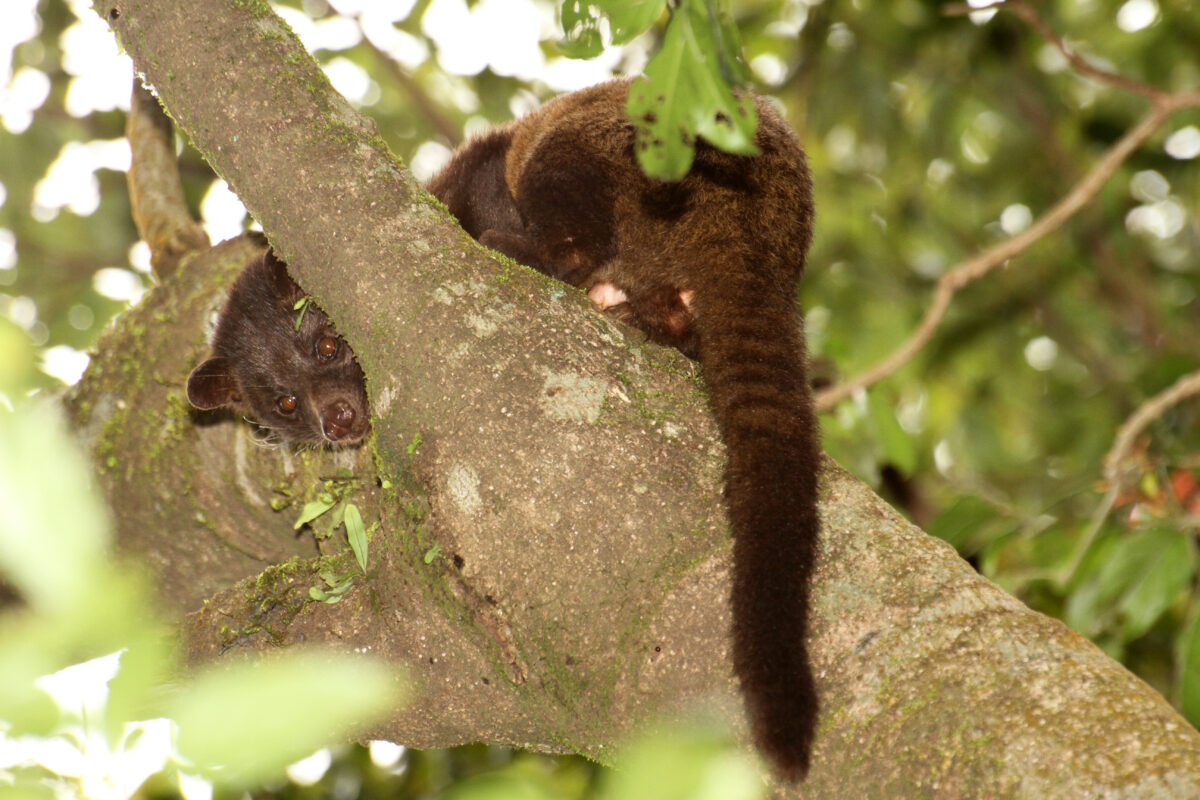
Description

The Brown palm civet (Paradoxurus jerdoni), commonly referred to as Jerdon’s palm civet, is a small, solitary, nocturnal mammal belonging to the family Viverridae. This elusive species is characterized by its slender body, short legs, and a long, bushy tail. It possesses a pointed muzzle and small, rounded ears, contributing to its distinctive appearance.
Appearance

The Brown palm civet is distinguished by its rich brown fur, often with a lighter underside, and dark facial markings. Its fur provides excellent camouflage in the dense vegetation of its natural habitat. This species can be differentiated from similar civet species by its unique coloration and specific anatomical features, such as the shape of its tail and ears.
Distribution
Endemic to the Western Ghats of India, the Brown palm civet is primarily found in the tropical forests and bushy evergreen areas of this region. Its distribution is limited to this specific geographic area, making it a species of great ecological significance within the Western Ghats ecosystem. Due to habitat loss and fragmentation, the population density of the Brown palm civet is facing notable challenges, warranting conservation efforts to ensure its continued survival.
Habitat Preferences

The Brown palm civet thrives in densely forested or bushy evergreen areas, utilizing tree hollows and canopy vine tangles as day-bed sites. Its preference for such habitats underscores the species’ reliance on the integrity of these ecosystems for its survival. As a key mammalian seed disperser in the Western Ghats, the Brown palm civet plays a crucial role in maintaining the ecological balance of its habitat.
By incorporating these key aspects into the species profile, we can enhance awareness and understanding of the unique characteristics, distribution, and habitat preferences of the Brown palm civet, thereby contributing to the conservation and protection of this remarkable species.
Facts About Brown palm civet
- The brown palm civet (Paradoxurus jerdoni) is a viverrid endemic to the Western Ghats of India.
- It is a predominantly frugivorous species, with fruits of native and introduced plants comprising 97% of its diet.
- This species is nocturnal, arboreal, and generally solitary.
- The brown palm civet has a uniformly brown pelage, darker around the head, neck, shoulder, legs, and tail.
- Habitat loss and fragmentation are major threats to the rarely-spotted brown palm civet in the Western Ghats.
- It is also known as Jerdon’s palm civet.
- The species is restricted to the tropical rainforests of the Western Ghats.
- The brown palm civet is rarely spotted due to its elusive nature and preference for dense forest habitats.
- This species plays a role in seed dispersal and contributes to the maintenance of forest ecosystems.
- The conservation status of the brown palm civet is currently listed as Near Threatened on the IUCN Red List.


