

Description
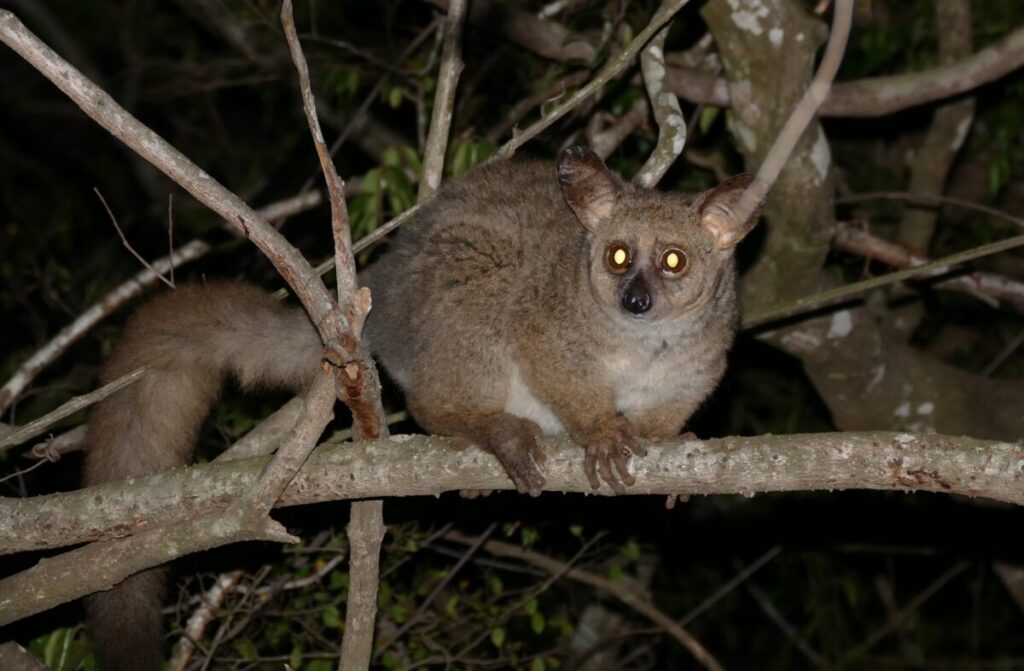
The brown greater galago, also known as the large-eared greater galago or thick-tailed galago, is a remarkable nocturnal primate belonging to the family of galagos. It is distinguished as the largest member of its family, possessing unique physical and behavioral characteristics that set it apart from other galago species. These arboreal mammals are known for their remarkable agility and nocturnal habits, making them a fascinating subject of study for primatologists and wildlife enthusiasts alike.
Appearance
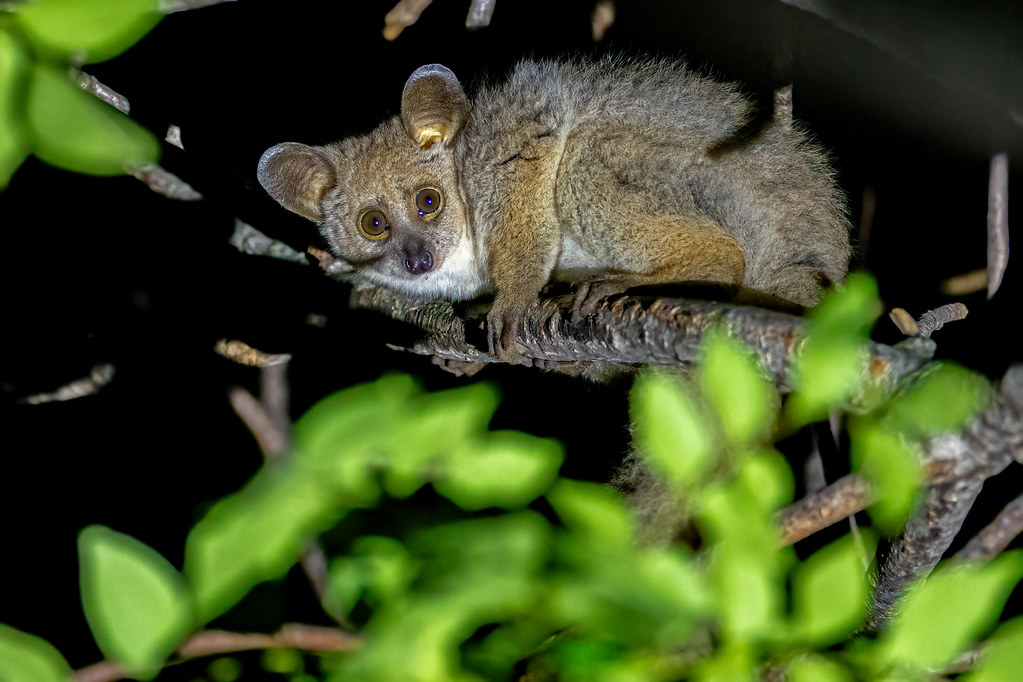
The brown greater galago is easily recognizable by its distinctive large ears, which aid in its exceptional auditory acuity. Its thick, bushy tail serves as a counterbalance during agile movements through the treetops. With a dense, soft fur coat ranging in color from brown to gray, these primates boast large, expressive eyes that contribute to their keen night vision. Their slender build and elongated limbs enable them to navigate their arboreal habitats with remarkable dexterity, setting them apart from other primate species.
Distribution
This species is primarily found in southern, central, and East Africa, inhabiting a range of ecosystems including forests and savannas. The brown greater galago’s distribution spans from southern Sudan to eastern South Africa and through southern Angola. It is known to thrive in well-managed protected areas, indicating a relatively stable presence in these regions. However, the species faces the threat of habitat fragmentation and hunting for bushmeat, emphasizing the importance of conservation efforts to safeguard its population.
Habitat Preferences

Brown greater galagos are primarily arboreal and favor living in relatively wet, higher rainfall areas with high canopy cover. They are adept at navigating through the dense foliage of forests and the open woodlands of savannas, where they find ample food resources and suitable shelter. These habitats provide the necessary conditions for their survival, offering protection from predators and access to a diverse range of food sources crucial to their well-being.
In summary, the brown greater galago is a captivating primate species with unique characteristics that make it an integral part of the ecosystems it inhabits. Its distribution across various African regions underscores the importance of conservation efforts to ensure the preservation of its natural habitats and continued coexistence with other species.
By [Expert Animal Writer and Conservation Scientist](https://www.example.com)
Facts About Brown greater galago
- The Brown greater galago (Otolemur crassicaudatus) is the largest nocturnal primate in the Galagidae family.
- They are primarily arboreal and prefer to live in relatively wet, higher rainfall areas with high canopy cover.
- This species has a long bushy tail that aids in balance and movement through trees.
- Brown greater galagos are native to Ethiopia and are known to live for up to 225.6 months in the wild.
- They are solitary and nocturnal omnivores, feeding on a variety of foods including insects, fruit, and small vertebrates.
- The coloration of their fur is silvery brown to gray with a lighter underside.
- Body size is sexually dimorphic, with males being significantly larger than females.
- Brown greater galagos can grow to a length of 801 mm.
- They inhabit tropical and subtropical forests, preferring riverine and coastal forest environments.
- This species is also known as the large-eared greater galago or thick-tailed galago.


