

Description
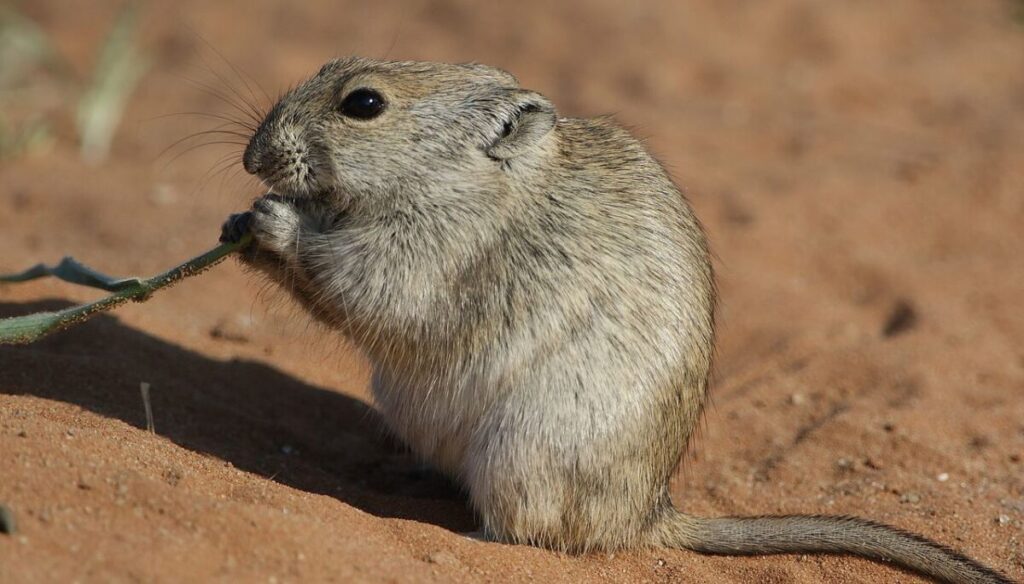
Brants’s whistling rat, also known as Brants’ whistling rat, is a fascinating murid rodent belonging to the genus Parotomys. This species is characterized by its unique behavioral and physical attributes, making it a captivating subject for wildlife enthusiasts and conservationists alike.
Appearance

The Brants’s whistling rat boasts distinctive features that set it apart from other rodent species. It is recognized for its compact size, typically measuring around 20-25 centimeters in length, with a tail that adds an additional 15-20 centimeters. Its fur is a blend of earthy tones, often featuring shades of brown and gray, providing effective camouflage in its natural habitat. Notably, its large, dark eyes and prominent whiskers contribute to its charming and endearing appearance.
Distribution
Brants’s whistling rat is primarily found in the southern African countries of Botswana, Namibia, and South Africa. Within these regions, it inhabits subtropical and tropical dry shrublands, as well as pasturelands. The species’ distribution is notable for its adaptability to varying environmental conditions, showcasing its resilience in diverse ecosystems.
Habitat Preferences

This species thrives in open, sandy habitats within its range, displaying a preference for semi-arid regions. It is commonly found in areas with sparse vegetation, where it constructs intricate burrow systems for shelter and protection. The ability of Brants’s whistling rat to thrive in such arid environments underscores its remarkable adaptation to living in challenging ecological conditions.
Brants’s whistling rat plays a crucial role in its ecosystem, contributing to the intricate balance of its natural habitat. As a conservation scientist, it is imperative to recognize and protect the unique characteristics and habitat requirements of this remarkable species to ensure its continued survival and well-being.
Facts About Brants’s whistling rat
- Brants’s whistling rat (Parotomys brantsii) is found in Botswana, Namibia, and South Africa.
- They are solitary herbivores.
- The species is one of two species of murid rodent in the genus Parotomys.
- Brants’s whistling rat is a gregarious rodent that undergoes marked population fluctuations every few years.
- Densities of heuweltjies account for 56% of the variation in the density of P. brantsii warrens.
- They are found in subtropical or tropical dry shrubland and pastureland.
- Brants’s whistling rat was first described in 1834.
- The species inhabits areas with shallow soils (< 40 cm) in the central regions of its range. 9. It belongs to the family Muridae, which includes old world mice and rats, gerbils, whistling rats, and relatives. 10. Differences in mammalian alarm call systems may be explained relative to the complexity of their habitat, with species inhabiting different habitats having distinct alarm call systems.


