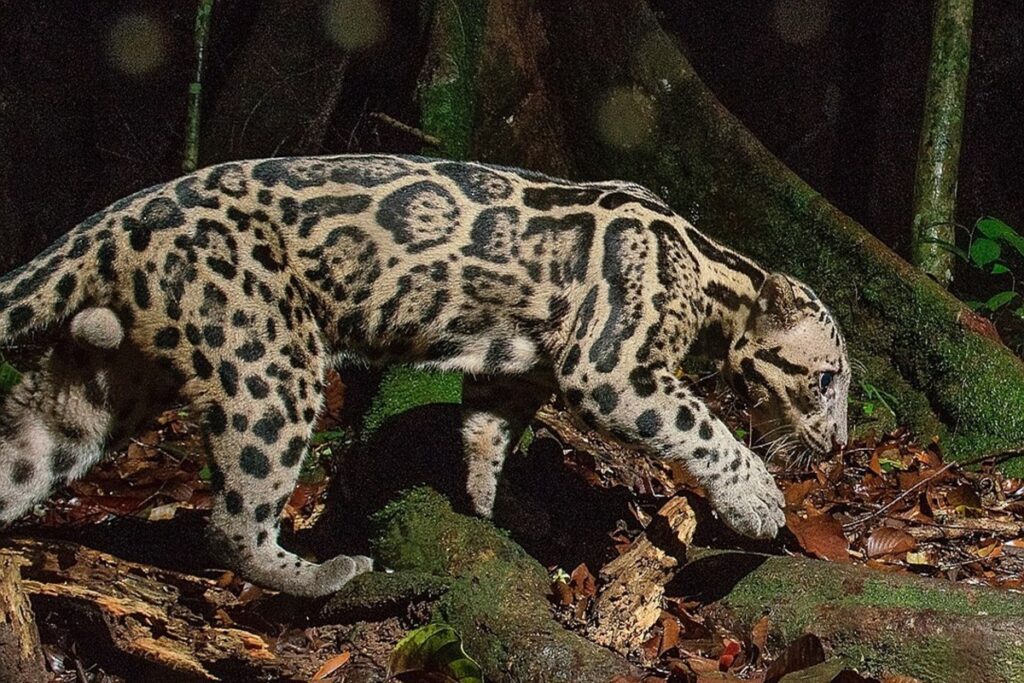
Bornean Clouded Leopard (Neofelis diardi borneensis)

Bornean Clouded Leopard

IUCN Red List Conservation Status


Vulnerable

LC
NT
VU
EN
CR
EW
EX

Official assessment evaluated in accordance with the IUCN Red List of Threatened Species criteria: Vulnerable.


Species Quick Facts

Scientific Name
Neofelis diardi

Average Lifespan
About 12-15 years (up to 17 years in captivity)

Average Weight
16–23 kg

Average Length
Head-body about 70-105 cm (28-41 inches); tail 60-90 cm

Overview & Identification

The Bornean Clouded Leopard (*Neofelis diardi borneensis*) is a critically endangered subspecies of clouded leopard found exclusively on the island of Borneo. These leopards inhabit the high-altitude, mossy forests and montane rainforests of Sabah and Serawak, Malaysia, where they primarily prey on small mammals, birds, and reptiles. Notably, they possess a distinctive, thick white cloud pattern across their coat, providing excellent camouflage within their shadowy habitat and making them one o

Behavior & Social Structure

The Bornean clouded leopard (Neofelis diardi borneensis) is primarily crepuscular and nocturnal, showing peak activity during dawn, dusk, and nighttime hours when it stalks prey beneath the dense canopy of Borneo’s lowland and montane rainforests. This subspecies is exceptionally arboreal, possessing one of the most specialized skeletal adaptations for tree-climbing of any felid, including short, muscular limbs, flexible ankle joints capable of near-180-degree rotation, and an elongated tail used for balance. These adaptations allow it to descend trees head-first, move along the undersides of branches, and hunt both on the ground and in the canopy with remarkable agility.

Socially, this species is solitary and highly territorial outside of brief breeding encounters, with males maintaining larger home ranges that overlap those of multiple females. Home range estimates vary widely by habitat quality and prey density, with radio-collared individuals in Sabah showing ranges from roughly 25 to over 50 square kilometers for males. Communication occurs primarily through scent marking (urine spraying, cheek rubbing, and claw marks on trees), visual signals such as flank displays of its distinctive cloud-shaped rosettes, and a limited vocal repertoire including chuffing (a friendly, non-threatening sound also seen in other big cats), hisses, growls, and a short-range “mew.”

Because of extreme habitat fragmentation from logging and oil palm expansion, individuals increasingly must traverse degraded or secondary forest corridors, and camera-trap studies suggest behavioral flexibility, including greater tolerance of disturbed habitat edges than previously assumed, though core rainforest remains essential for breeding and long-term persistence.

Diet & Hunting Patterns

As an obligate carnivore, the Bornean clouded leopard is an ambush predator that relies on stealth, camouflage, and explosive short-distance pursuit rather than sustained chases. Its diet includes a broad range of prey documented through scat analysis and camera-trap studies, including bearded pigs (Sus barbatus), sambar and muntjac deer, primates such as long-tailed and pig-tailed macaques, proboscis monkeys, slow lorises, palm civets, porcupines, and various birds and reptiles. Its unusually large canine teeth relative to skull size—proportionally the longest of any living cat—allow it to deliver precise killing bites to the nape or throat of prey, some of which can outweigh the leopard itself.

Hunting strategy combines terrestrial stalking with arboreal ambush, and the species is known to cache larger kills in trees to avoid competition with terrestrial predators such as sun bears and reticulated pythons. Water dependency is moderate; the leopard obtains much of its hydration from prey tissue but will drink from streams and pools within its forest range. Dietary composition shows some seasonal flexibility tied to prey abundance, with increased predation on macaques and civets during fruiting seasons when these prey species congregate near food-rich canopy patches.

Reproduction & Life Cycle

Breeding in Bornean clouded leopards does not appear to follow a strict seasonal pattern in equatorial Borneo’s relatively stable climate, though captive and limited wild data suggest peaks can occur during periods of higher prey availability. The mating system is polygynous and promiscuous, with males seeking out multiple receptive females within their overlapping home ranges. Courtship can be intense and occasionally aggressive, a trait noted in captive breeding programs where careful introduction protocols are required to prevent injury to females.

Gestation lasts approximately 85 to 95 days, after which females give birth to litters of one to five cubs, typically two, in secluded den sites such as hollow trees or dense undergrowth. Cubs are born blind and altricial, opening their eyes around 10–12 days and being weaned by roughly three months of age. Females provide sole parental care, and cubs remain with their mother for up to 10 months while learning climbing and hunting skills. Sexual maturity is reached at approximately 24 months for both sexes, though males may not successfully breed until slightly later due to territorial competition.

Threats & Conservation

The foremost threat to the Bornean clouded leopard is habitat loss and fragmentation driven by industrial logging, oil palm plantation expansion, and infrastructure development across Borneo, which has resulted in significant declines in contiguous lowland rainforest—this subspecies’ preferred habitat. Fragmentation isolates subpopulations, reduces genetic connectivity, and increases edge effects that elevate exposure to poachers and human-wildlife conflict. Poaching for the illegal wildlife trade, including skins, claws, and teeth marketed as trophies or traditional ornaments, along with retaliatory killings after livestock predation, continues to suppress population recovery even within protected areas.

Climate change poses an emerging but less immediate threat through altered fruiting cycles that affect prey populations and increased frequency of forest fires exacerbated by El Niño events and land clearing. The IUCN lists Neofelis diardi as Vulnerable, and conservation initiatives include the Heart of Borneo transboundary conservation initiative, camera-trap monitoring networks coordinated by organizations such as Panthera and WWF, community-based anti-poaching patrols, and habitat corridor restoration projects connecting protected forest blocks in Sabah, Sarawak, and Kalimantan.

Interesting Facts

  • Species Split: The Bornean clouded leopard was only recognized as a distinct species (Neofelis diardi, separate from mainland Neofelis nebulosa) in 2006 based on genetic and morphological analysis, making it one of the more recently confirmed big cat species.
  • Largest Canines Relative to Skull Size: Among all living cat species, clouded leopards possess the longest upper canine teeth relative to skull length, drawing comparisons to extinct saber-toothed cats.
  • Extreme Ankle Flexibility: Its hind ankles can rotate nearly 180 degrees, enabling it to climb down tree trunks headfirst—a rare ability shared with only a few other arboreal mammals.
  • Cryptic and Rarely Photographed: Due to its elusive nocturnal habits and dense forest habitat, the Bornean clouded leopard remained poorly documented in the wild until camera-trap technology became widespread in the 2000s.
  • Distinct Coat Pattern: Bornean individuals typically have smaller, more numerous cloud-shaped markings with darker background fur compared to their mainland counterparts, an adaptation possibly linked to Borneo’s darker forest understory.
  • Apex Predator Role: As Borneo’s largest surviving felid predator following historical tiger extinction on the island, it plays a critical ecological role in regulating populations of primates and ungulates.
  • Long Tail for Balance: Its tail can measure nearly as long as its body, functioning as a counterbalance during high-speed arboreal pursuits and branch-to-branch movement.

Description

Bornean Clouded Leopard

The Bornean clouded leopard, scientifically known as Neofelis diardi borneensis, is a striking and elusive subspecies of the Sunda clouded leopard. It is distinguished by its unique characteristics, including differences in the shape and frequency of spots, as well as cranio-mandibular and dental features that set it apart from the Batu-Sumatran clouded leopard.

Appearance
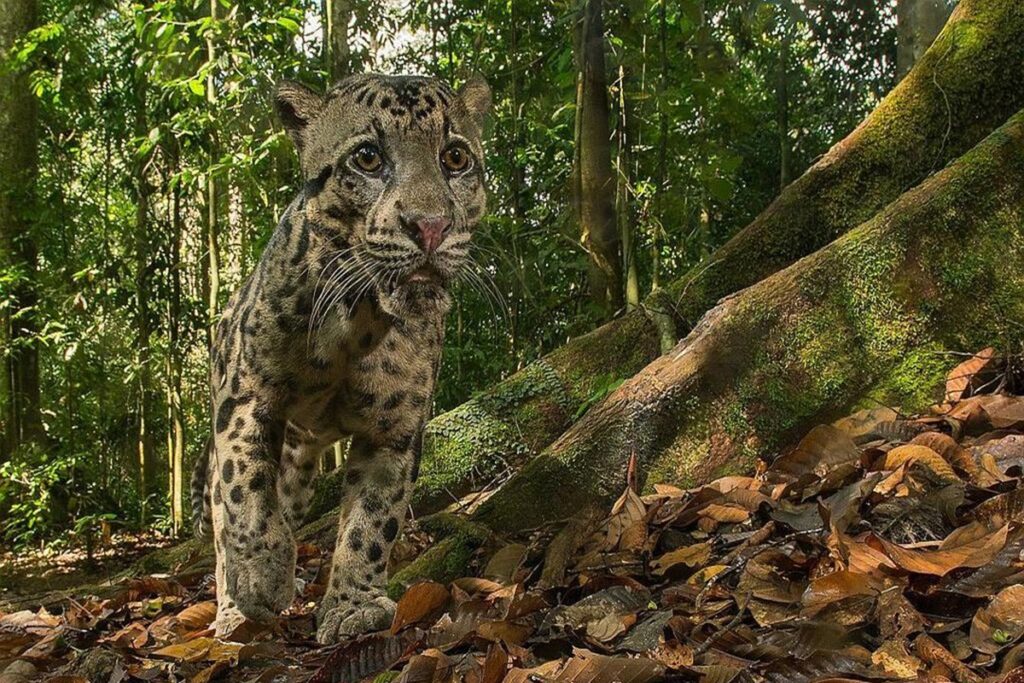
Bornean Clouded Leopard Appearance

The Bornean clouded leopard is known for its mesmerizing coat, which features large, cloud-like patterns on a background of dusky grey or ochre. Its distinctive markings and coloring make it a truly captivating sight in the dense forests it calls home. This subspecies’ appearance sets it apart from other clouded leopard species and contributes to its allure and mystique.

Distribution

The Bornean clouded leopard is primarily found in the lush, biodiverse forests of Borneo, with its range extending across northern Sarawak and other regions of the island. This elusive feline’s distribution is closely tied to the dense lowland and hill forests of Borneo, where it is most commonly encountered. However, it is sensitive to human disturbance and tends to avoid open areas with few trees, highlighting the importance of preserving its natural habitat.

Habitat Preferences
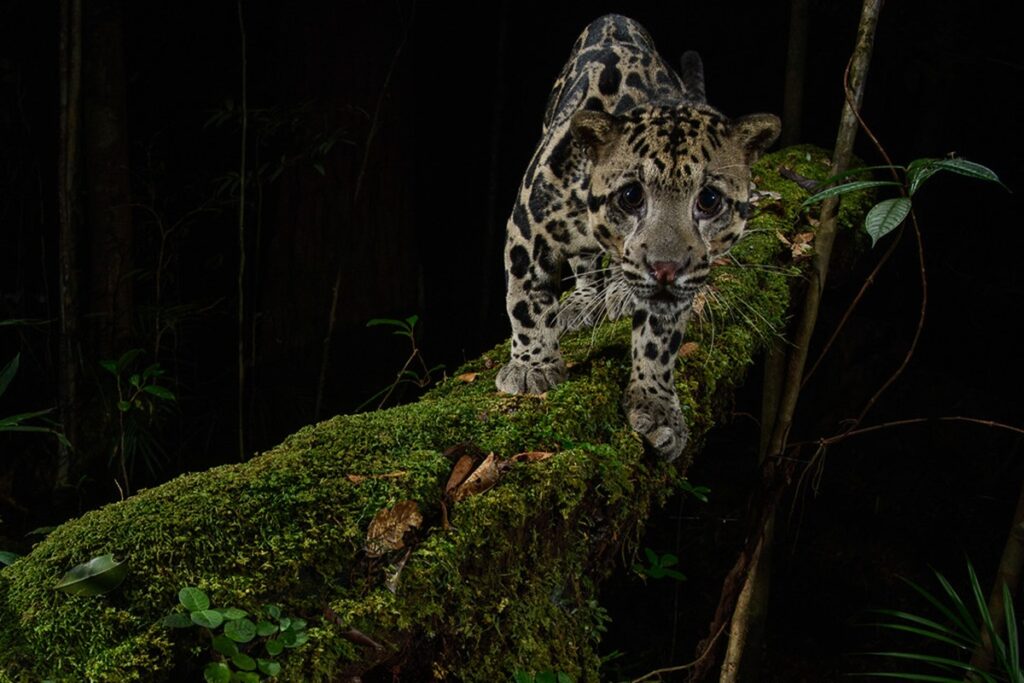
Bornean Clouded Leopard Habitat

The Bornean clouded leopard thrives in dense lowland and hill forests, where it can move with agility and stealth through the treetops and forest undergrowth. These ecosystems provide the ideal cover and hunting grounds for this elusive predator, allowing it to maintain a delicate balance within the intricate web of life in the forest. Protecting these habitats is crucial for the survival and well-being of the Bornean clouded leopard and the diverse array of species that call these forests home.

Facts About Bornean Clouded Leopard

  • The Bornean clouded leopard (Neofelis diardi borneensis) is a subspecies of the Sunda clouded leopard, native to the island of Borneo.
  • It differs from the Batu-Sumatran clouded leopard in its physical characteristics.
  • The Bornean clouded leopard is a medium-sized wild cat and is listed as Vulnerable on the IUCN Red List.
  • Its geographic range includes the islands of Borneo and Sumatra in the Malay Archipelago.
  • This species occurs in lowland rainforest, below 1,500m of elevation, with estimated densities of six to nine cats per 100km2.
  • The Bornean clouded leopard is a secretive, mid-sized carnivore, weighing between 16–23 kg.
  • It is traditionally subdivided into four southeast Asian subspecies.
  • The clouded leopard is found from Nepal, Bangladesh, and Assam through Indochina to Sumatra and Borneo, and northeastward to southern China.
  • Scientists have discovered that the clouded leopard found on the islands of Borneo and Sumatra is an entirely new species.
  • The Bornean clouded leopard is now severely endangered.


Scientific Provenance & Verified Sources

Biological taxonomy, conservation status, and physical traits are cross-referenced with authoritative global registers:


Peer-reviewed by Wildlife Science Editors • Updated for 2026

Explore Other Species Profiles