Bornean bearded pig standing among sunlit logs and rocks

IUCN Red List Conservation Status


Vulnerable

LC
NT
VU
EN
CR
EW
EX

Official assessment evaluated in accordance with the IUCN Red List of Threatened Species criteria: Vulnerable.


Species Quick Facts

Scientific Name
Sus barbatus

Average Lifespan
About 13-16 years.

Average Weight
Commonly 57-83 kg (127-183 lb); large males up to 120-150 kg.

Average Length
Body length 1-2 m (4-6.5 ft); males 137-152 cm, females 122-148 cm.

Overview & Identification

The Bornean Bearded Pig (Sus scrofa borneoensis) is a distinctive pig species native to the rainforests of Borneo, primarily inhabiting swampy areas and riverbanks. These pigs are known for their thick, bristly white beards, which they use to explore the muddy ground for invertebrates, roots, and fruits, making up their omnivorous diet. They are also characterized by their unusual, almost comical, gait and social behavior, often foraging in groups.

Behavior & Social Structure

The Bornean bearded pig (Sus barbatus) is primarily diurnal to crepuscular, though activity patterns shift in response to human disturbance and hunting pressure, with populations near settlements becoming more nocturnal to avoid persecution. In undisturbed forest, these pigs are active throughout the day, alternating between foraging bouts and resting periods in constructed nests or wallows during the hottest hours. Their most famous behavioral trait is a nomadic, migratory lifestyle unusual among suids—large aggregations numbering in the hundreds to thousands periodically move across Borneo in response to the masting cycles of dipterocarp forests, traveling many kilometers to exploit pulses of fruit availability.

Social organization is fluid, typically consisting of small family groups (sounders) of adult females and their offspring, while adult males are largely solitary except during the breeding season, when they compete for access to receptive females. During mast-fruiting events, however, these normally modest groups coalesce into extraordinary herds, a behavior linked to the synchronized, unpredictable fruiting of dipterocarp trees that occurs every several years. Communication includes a range of grunts, squeals, and tooth-clacking, along with scent marking via preorbital and other glands rubbed against trees, plus tactile interactions such as mutual grooming and nuzzling that reinforce social bonds within family units.

Home ranges vary dramatically depending on resource availability, expanding enormously during migratory phases and contracting to more modest areas during periods of local food abundance. Adaptive behaviors include construction of elaborate farrowing nests made of vegetation, an unusual trait among pigs that provides thermoregulation and protection for vulnerable newborns, as well as wallowing in mud to regulate body temperature and reduce ectoparasite loads.

Diet & Hunting Patterns

As opportunistic omnivores, bearded pigs forage primarily on the forest floor, using their elongated snouts to root through leaf litter and soil for fallen fruits, seeds, tubers, roots, fungi, and invertebrates such as earthworms and insect larvae. Dipterocarp fruits and seeds form a critical dietary component, and the pigs act as important seed predators and occasional dispersers within these masting forest ecosystems. They also opportunistically consume small vertebrates, carrion, eggs, and even beach-cast marine organisms in coastal habitats, along with agricultural crops such as oil palm fruit and root vegetables when foraging near plantations—behavior that increasingly drives conflict with farmers.

Foraging strategy is closely tied to the boom-and-bust cycle of Southeast Asian rainforests: during mast-fruiting years, pigs gorge on superabundant fruit and seed falls, building substantial fat reserves that support reproduction and long migratory journeys, while during lean years they shift toward more diffuse, less energy-dense food sources like roots, fungi, and invertebrates. Bearded pigs are moderately water-dependent, requiring regular access to streams, rivers, or wallows both for drinking and thermoregulatory mud-bathing, and their movements are often constrained by proximity to permanent water sources during dry periods.

Reproduction & Life Cycle

Breeding in bearded pigs is closely synchronized with the irregular mast-fruiting events of Bornean forests rather than following a strict fixed seasonal calendar, allowing females to time reproduction with peak food abundance. The mating system is polygynous/promiscuous, with dominant males competing for access to estrous females through vocal displays, posturing, and occasional physical combat. Gestation lasts approximately 90–120 days (roughly three to four months), after which females give birth to litters typically ranging from three to eleven piglets, with litter size often correlating with maternal body condition and food availability.

Prior to giving birth, females construct elaborate nest mounds of vegetation and leaves, a distinctive maternal behavior that provides insulation and protection from predators during the vulnerable neonatal period. Piglets are born with characteristic camouflaging stripes that fade within a few months, and they are weaned at around three to four months of age while remaining with their mothers in small family groups for an extended period afterward. Sexual maturity is typically reached between 12 and 18 months of age, though full adult body size and social dominance are generally attained somewhat later.

Threats & Conservation

Habitat loss and fragmentation represent the most severe threat to Bornean bearded pigs, driven primarily by large-scale conversion of primary and secondary rainforest into oil palm plantations, logging concessions, and agricultural land across Borneo, Sumatra, and the Malay Peninsula. This habitat destruction not only reduces available forest but also disrupts the dipterocarp masting cycles upon which the species’ migratory foraging strategy depends, fragmenting historic migration corridors and isolating populations. Intensive hunting compounds this pressure, as bearded pigs are heavily targeted by indigenous and rural communities for subsistence and commercial bushmeat trade, with traditional mass hunts historically timed to intercept migratory herds—a practice that can decimate local populations when combined with modern firearms and snaring.

Disease outbreaks, notably African Swine Fever, have caused catastrophic population crashes in recent years across parts of Borneo, compounding losses from habitat degradation and hunting. Human-wildlife conflict is increasingly significant as pigs raid oil palm plantations and smallholder crops, prompting retaliatory killing and government-sanctioned culling in some regions. Natural predators include clouded leopards and reticulated pythons, though these pose minimal threat compared to anthropogenic pressures. The IUCN has classified the species as Vulnerable, with conservation initiatives focused on protected area management, anti-poaching enforcement, disease monitoring, and research into sustainable coexistence strategies with expanding agricultural landscapes.

Interesting Facts

  • Mass Migrations: Bearded pigs undertake some of the largest terrestrial mammal migrations in Southeast Asia, with herds of hundreds to thousands traveling long distances in response to unpredictable dipterocarp mast-fruiting events.
  • Distinctive Beard: The species is named for the prominent whisker-like beard covering the lower jaw and cheeks, a feature unique among Southeast Asian pig species and thought to play a role in social signaling.
  • Nest-Building Mothers: Unlike most pig species, pregnant females construct elaborate farrowing nests from leaves and branches, providing thermal insulation and predator protection for newborn piglets.
  • Facial Warts: Adult males develop three pairs of distinctive facial warts and elongated tusks used in male-male combat during the breeding season, a trait shared with several other Sus species.
  • Ecological Engineers: Through their extensive rooting and foraging, bearded pigs influence soil turnover, seed predation dynamics, and nutrient cycling across Bornean rainforest ecosystems.
  • Historical Hunting Tradition: Indigenous Dayak and Iban communities have hunted migratory bearded pig herds for centuries, developing detailed traditional ecological knowledge of masting cycles to predict herd movements.
  • Disease Vulnerability: Recent outbreaks of African Swine Fever have caused unprecedented population crashes in wild bearded pigs, marking one of the first documented cases of this disease severely impacting a wild suid species in Asia.

Description

The Bornean bearded pig, scientifically known as Sus barbatus, is a remarkable species within the pig genus, Sus. It is distinguished by its striking appearance, featuring a prominent “beard” and occasionally tassels on its tail. This species possesses the slimmest torso and longest head among all living pigs, making it a truly unique and intriguing mammal.

Appearance

The Bornean bearded pig is easily recognizable by its distinct facial features, which include two pairs of warts on the face, giving the impression of a “beard.” Additionally, some individuals may exhibit tassels on their tails, further setting them apart from other pig species. These distinguishing characteristics make the Bornean bearded pig a fascinating subject for wildlife enthusiasts and researchers alike.

Distribution

The Bornean bearded pig is primarily found in the lush and biodiverse regions of Borneo, where it plays a crucial role as a keystone species. Its distribution extends across various habitats within Borneo, including tropical forests and other wooded areas. While the species faces conservation challenges, its population exhibits notable adaptability to its natural environment, contributing to its continued presence in these regions.

Habitat Preferences
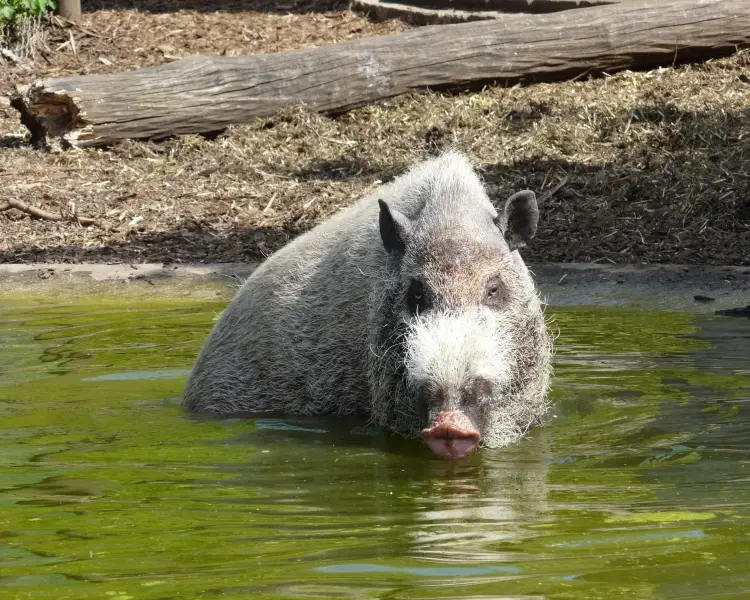
The Bornean bearded pig thrives in diverse ecosystems, ranging from lowland rainforests to montane forests. These habitats provide the pig with abundant food sources, including fruits, roots, fungi, nuts, and vegetation. Additionally, the presence of earthworms and other invertebrates further supports the pig’s well-being. The species’ ability to adapt to these varied environments underscores its resilience and significance within the ecosystems it inhabits.

Facts About Bornean Bearded Pig

  • The Bornean bearded pig (Sus barbatus) is the slimmest torso and longest-headed of all living pigs.
  • They have two pairs of warts on their face, which are distinguishing characteristics.
  • Bornean bearded pigs are omnivorous, feeding on fruit, roots, fungi, nuts, vegetation, and earthworms.
  • These pigs play a prominent role in the lives of many people living on the island of Borneo and are considered a “cultural keystone species” for indigenous groups.
  • The Eurasian wild pig (Sus scrofa) shares the Bornean bearded pig’s range in Borneo.
  • Bornean bearded pigs are known to keep migrating in order to find sufficient food.
  • They were once glorified for their tracking abilities.
  • Bornean bearded pigs are actively hunted and consumed in Borneo.
  • Wild boars and bearded pigs are likely vectors of zoonotic diseases for humans.
  • The Bornean bearded pig populations have spread over large parts of Borneo.


Scientific Provenance & Verified Sources

Biological taxonomy, conservation status, and physical traits are cross-referenced with authoritative global registers:


Peer-reviewed by Wildlife Science Editors • Updated for 2026

Explore Other Species Profiles