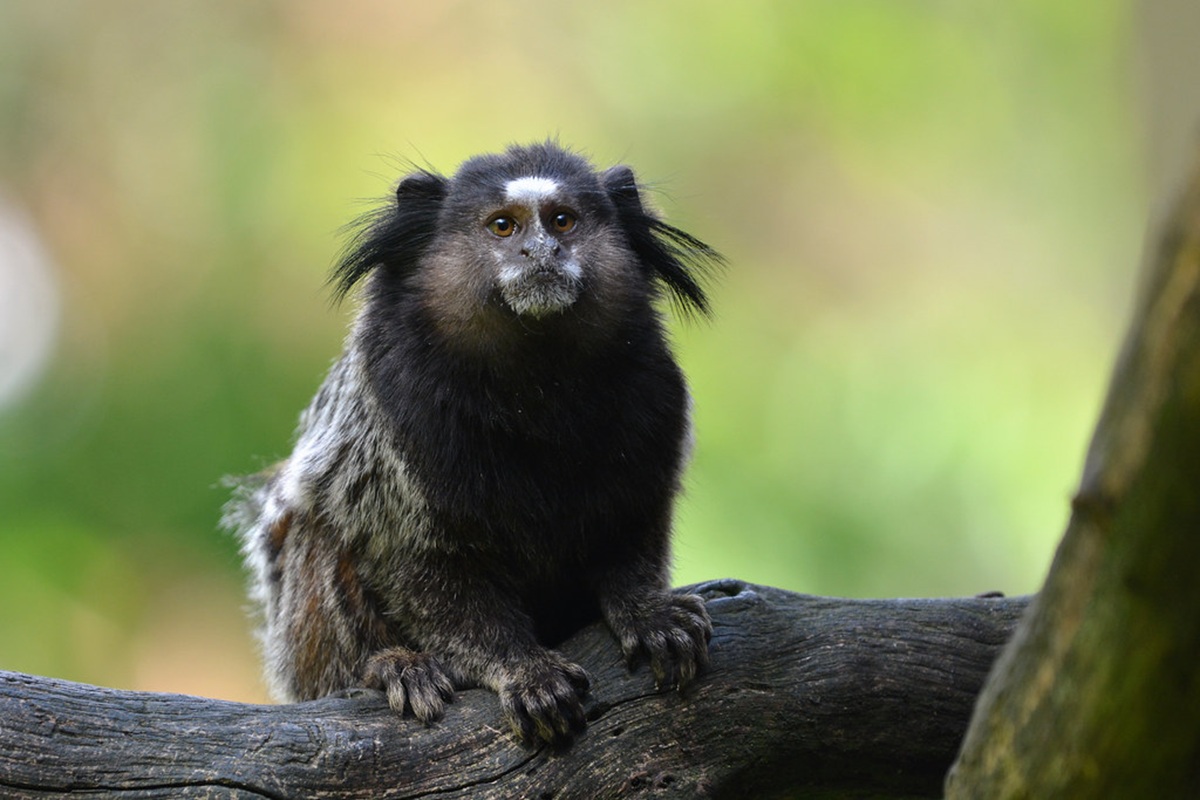
Black-Tufted Marmoset

IUCN Red List Conservation Status


Least Concern

LC
NT
VU
EN
CR
EW
EX

Official assessment evaluated in accordance with the IUCN Red List of Threatened Species criteria: Least Concern.


Species Quick Facts

Scientific Name
Callithrix penicillata

Average Lifespan
Average 15 years in captivity (up to 15.4 years recorded); wild lifespan not well documented

Average Weight
Males average 344 g (12 oz), females 307 g (11 oz)

Average Length
19-22 cm (7-9 inches) head-body length

Overview & Identification

The black-tufted marmoset is a small monkey of the cerrado and gallery forests of central and eastern Brazil, easily recognised by the black tufts of hair around its ears. It lives in family groups and uses specialised teeth to gnaw holes in tree bark, feeding heavily on the gum and sap that flow out, as well as insects and fruit. Agile and quick, it moves through the trees in search of food and shelter.

Behavior & Social Structure

The black-tufted marmoset (Callithrix penicillata) is strictly diurnal, beginning activity shortly after sunrise and retreating to sleeping sitesโ€”typically dense vine tangles, tree holes, or thick foliageโ€”before dusk. Activity follows a bimodal pattern with intense foraging in early morning and late afternoon, punctuated by a midday rest period during hot conditions. This species is highly adaptable behaviorally, readily adjusting activity budgets in response to habitat disturbance, urban proximity, and seasonal temperature fluctuations, which has facilitated its success in fragmented and semi-urban landscapes across eastern Brazil.

Social organization centers on cohesive family groups of 2 to 15 individuals, typically comprising a breeding pair (or occasionally two breeding females in cooperative arrangements), their offspring from multiple litters, and helpers that assist in carrying and provisioning infants. Communication is multimodal: high-pitched trills and long calls maintain group cohesion and mediate inter-group spacing, while specific alarm calls differentiate aerial versus terrestrial predators. Scent marking via specialized circumgenital and sternal glands is used extensively to communicate reproductive status and demarcate territory boundaries, and tactile behaviors such as allogrooming reinforce social bonds and hierarchy.

Home ranges are relatively small, generally between 0.5 and 5 hectares, and are actively defended against neighboring groups through vocal duels, scent marking, and occasional physical chases at boundaries. A key adaptive behavior is exudativoryโ€”the anatomical and behavioral specialization for gouging tree bark with specialized lower incisors to stimulate and consume gum flowโ€”which reduces competition with sympatric primates and allows exploitation of resources unavailable to most other mammals in the same habitat (source: [Animal Diversity Web](https://animaldiversity.org/accounts/Mammalia/)).

Diet & Hunting Patterns

As an omnivorous exudativore-insectivore, the black-tufted marmoset relies heavily on plant exudatesโ€”gums, saps, and resinsโ€”extracted from a variety of tree species including Anadenanthera, Enterolobium, and various Leguminosae, using specialized gouging incisors to create feeding holes that trees continue to exude from over time. This gum-feeding strategy provides a reliable, low-competition carbohydrate source, especially critical during dry-season fruit scarcity, and is complemented by opportunistic insectivory targeting grasshoppers, beetles, spiders, and cocoons, which are actively hunted using a stalk-and-pounce technique across understory vegetation.

Ripe fruits, flowers, nectar, and occasionally small vertebrates such as tree frogs, lizards, and nestling birds round out the diet, with fruit consumption peaking during the wet season when resource abundance is high. Water dependency is generally low, as sufficient moisture is obtained from succulent fruits and dew, though individuals will drink from tree hollows and water sources when available. This dietary flexibility, combined with a slowed metabolic rate relative to body size, allows the species to persist in degraded and fragmented forest patches where more specialized frugivores or insectivores cannot survive (source: [Animal Diversity Web](https://animaldiversity.org/accounts/Mammalia/)).

Reproduction & Life Cycle

Black-tufted marmosets typically breed twice per year, with births often synchronized to periods of higher food availability, though reproduction can occur nearly year-round in favorable conditions. The species exhibits a flexible mating system that ranges from monogamy to polyandry and polygyny depending on group composition and resource availability, though typically only the dominant female in a group reproduces, suppressing ovulation in subordinate females through pheromonal and behavioral mechanisms. Gestation lasts approximately 140 to 150 days, after which females almost always give birth to twins, a hallmark reproductive strategy of callitrichids that imposes significant energetic costs on mothers.

Parental care is markedly cooperative, with fathers, older siblings, and non-breeding helpers carrying, grooming, and provisioning infants extensively, a behavior that allows females to recover reproductive condition quickly between litters. Infants are weaned at approximately 3 months of age but remain within the natal group, contributing as helpers before dispersing. Sexual maturity is reached at around 12 to 18 months in females and slightly later in males, though reproductive suppression often delays actual breeding until an individual disperses to found or join a new group (source: [Animal Diversity Web](https://animaldiversity.org/accounts/Mammalia/)).

Threats & Conservation

Despite its Least Concern status, the black-tufted marmoset faces localized pressures from habitat fragmentation due to agricultural expansion, urbanization, and cattle ranching throughout its native range in the Cerrado and Atlantic Forest transition zones of eastern Brazil. Natural predators include birds of prey such as hawks and forest-falcons, tayras, small wild cats like ocelots and margays, and snakes, particularly boa constrictors, which target vulnerable infants and juveniles. Human-wildlife conflict arises primarily where marmosets raid crops, gardens, and bird feeders in peri-urban areas, occasionally leading to persecution, although the species’ adaptability to disturbed habitats has generally buffered it against severe population decline.

A significant and growing conservation concern is the species’ role as an invasive competitor outside its native range; introduced populations in Rio de Janeiro and other regions hybridize with and displace the threatened native golden lion tamarin (Leontopithecus rosalia) and common marmoset (Callithrix jacchus), prompting active management and removal programs by Brazilian conservation authorities. Climate change impacts remain understudied but could alter fruiting and gum-exudation phenology, potentially affecting food availability. Current IUCN-aligned initiatives focus on monitoring introduced populations, habitat corridor restoration in the Cerrado biodiversity hotspot, and public education campaigns to prevent illegal pet trade releases that have driven range expansions.

Interesting Facts

  • Living Gum Wells: The species carves small holes into tree bark with specialized lower incisors, creating long-term “gum wells” that trees continue to exude from for weeks, effectively farming a renewable food resource.
  • Obligate Twinning: Nearly every pregnancy produces twins, an unusual reproductive strategy among primates that requires extensive cooperative infant care to offset the high energetic burden on mothers.
  • Tactile Tufts: The distinctive black ear tufts are not merely ornamentalโ€”they enhance visual signaling during social displays and help convey identity and status within tight-knit family groups.
  • Invasive Success Story: Introduced populations outside their native range have thrived so successfully that they now threaten the endangered golden lion tamarin through habitat competition and hybridization.
  • Scent-Based Society: Specialized circumgenital scent glands allow individuals to communicate reproductive status, group membership, and territorial boundaries without any visual or vocal contact.
  • Claw-Like Nails: Unlike most primates, marmosets possess modified claws called tegulae rather than flat nails, an adaptation that enables efficient vertical clinging and bark-gouging behavior.
  • Urban Survivors: Their dietary flexibility and tolerance of disturbance have allowed black-tufted marmosets to thrive in urban parks and gardens across Brazilian cities, making them one of the most frequently observed primates by residents of eastern Brazil.

Description

Black-Tufted Marmoset

The black-tufted marmoset, scientifically known as Callithrix penicillata, is a captivating species of New World monkey that captivates with its distinctive appearance and intriguing behavior. This primate, colloquially referred to as Mico-estrela in Portuguese, is renowned for its endearing features and remarkable adaptability.

Appearance

Black-Tufted Marmoset Appearance

The black-tufted marmoset exhibits a striking appearance characterized by its predominantly black fur, accented with distinctive tufts of white on its ears. This unique feature sets it apart from other marmoset species and contributes to its charismatic allure. These primates are relatively small in size, typically weighing between 300 to 500 grams, with a body length of approximately 19 to 22 centimeters, complemented by a luxuriantly long tail.

Distribution

This enchanting species primarily inhabits the Neo-tropical gallery forests of the Brazilian Central Plateau, with its range extending from the state of Bahia to parts of Minas Gerais, Goiรกs, and Tocantins. The black-tufted marmoset’s distribution is intricately linked to these specific regions, where it thrives within the unique ecosystems and habitats that define the Brazilian Central Plateau.

Habitat Preferences

Black-Tufted Marmoset Habitat

Black-tufted marmosets exhibit a preference for living in the lush Neo-tropical gallery forests, where they find refuge in the rich biodiversity of this unique ecosystem. These forests provide an abundance of resources, including diverse plant species, insects, and small vertebrates, which form the basis of the marmoset’s diet. The marmosets are also known to display remarkable adaptability, as they can thrive in degraded or secondary forests, displaying resilience in the face of environmental changes.

In conclusion, the black-tufted marmoset, with its captivating appearance and adaptability, stands as a testament to the remarkable diversity of the Neotropical ecosystems. By understanding and appreciating the unique characteristics and habitat preferences of this species, we can further our efforts in conserving and protecting the invaluable biodiversity of the Brazilian Central Plateau.

Facts About Black-Tufted Marmoset

  • The black-tufted marmoset is also known as Mico-estrela in Portuguese, which translates to “star tamarin” in English.
  • They primarily live in the Atlantic coastal forests of Brazil.
  • Black-tufted marmosets are small in size, with adults typically weighing between 250-450 grams.
  • These marmosets are known for their distinct black tufts of hair around their ears.
  • They are arboreal creatures, spending most of their time in the trees and rarely venturing near the ground.
  • Black-tufted marmosets have a varied diet, including fruits, insects, tree sap, and small vertebrates.
  • The breeding interval for black-tufted marmosets is usually twice a year, and they typically give birth to 1-4 offspring at a time, with an average of 2 offspring.
  • Their natural predators include birds of prey, snakes, and wild cats.
  • Black-tufted marmosets communicate through a variety of vocalizations, including chirps, whistles, and trills.
  • They play a crucial role in seed dispersal and the maintenance of the forest ecosystem through their foraging and feeding habits.


Scientific Provenance & Verified Sources

Biological taxonomy, conservation status, and physical traits are cross-referenced with authoritative global registers:


Peer-reviewed by Wildlife Science Editors โ€ข Updated for 2026

Explore Other Species Profiles