IUCN Red List Conservation Status


Endangered

LC
NT
VU
EN
CR
EW
EX

Official assessment evaluated in accordance with the IUCN Red List of Threatened Species criteria: Endangered.


Species Quick Facts

Scientific Name
Ateles fusciceps

Average Lifespan
20-27 years in wild, 30-40 years in captivity

Average Weight
5-9 kg (11-20 lbs) – Males: 7 kg, Females: 5.5 kg

Average Length
40-55 cm (16-22 inches) – head-body length excluding tail

Overview & Identification

The blackโ€‘headed spider monkey (Ateles fusciceps) belongs to the family Atelidae, subfamily Atelinae, and is one of the most arboreal of the New World primates. Endemic to the Pacific slopes of western Colombia and northโ€‘western Ecuador, it inhabits humid lowland rainforests as well as montane cloud forests up to 1,800โ€ฏm. Its striking black facial mask contrasts with a dark brown to black coat, and a long, prehensile tail that can exceed its body length, providing an extra limb for brachiation. As a diurnal frugivore, it plays a crucial role in seed dispersal, maintaining forest diversity. The species is listed as Endangered by the IUCN due to rapid habitat loss and hunting pressure. Current estimates suggest fewer than 5,000 mature individuals remain, with a fragmented distribution that hampers gene flow. Conservation actions focus on protecting remaining forest blocks, establishing biological corridors, and enforcing antiโ€‘poaching laws.

Behavior & Social Structure

Blackโ€‘headed spider monkeys live in fissionโ€‘fusion societies of 15โ€“30 individuals, typically forming smaller foraging subโ€‘groups of 3โ€“5 that split and reโ€‘merge throughout the day. They are highly arboreal, moving through the canopy by rapid brachiation using their elongated arms and prehensile tail. Activity peaks in the early morning and late afternoon, with a brief midday lull in hotter periods. Home ranges can cover 30โ€“70โ€ฏkmยฒ, overlapping with neighboring groups but defended through vocal displays and occasional chase. Communication relies on a repertoire of loud whistles, barks, and soft contact calls that maintain cohesion across the canopy. Grooming is frequent and reinforces social bonds, while play behavior is common among juveniles, fostering motor skills needed for agile locomotion.

Diet & Hunting Patterns

The blackโ€‘headed spider monkey is primarily frugivorous, consuming a wide variety of ripe fruits such as figs, mombins, and berries, which can constitute up to 70โ€ฏ% of its daily intake. Leaves, flowers, and buds supplement the diet, especially during fruitโ€‘scarce periods, while insects, small vertebrates, and occasional nectar provide protein and micronutrients. Individuals can ingest 1.5โ€“2โ€ฏkg of fruit per day, selecting items based on ripeness, sugar content, and seasonal availability. Feeding occurs high in the canopy, where the monkey uses its prehensile tail as a stabilizing hook while reaching for distant branches. This foraging strategy facilitates efficient seed dispersal, as seeds pass through the gut and are deposited far from the parent tree, enhancing forest regeneration.

Reproduction & Life Cycle

Females reach sexual maturity at 4โ€“5โ€ฏyears, while males mature slightly later at 5โ€“6โ€ฏyears. Breeding can occur yearโ€‘round but peaks during the rainy season when fruit abundance is highest, enhancing infant survival. Gestation lasts 226โ€“232โ€ฏdays, after which a single infant is born, weighing about 300โ€ฏg. Newborns cling to the motherโ€™s belly for the first 2โ€“3โ€ฏmonths before transitioning to the dorsal surface, and they are weaned at roughly 12โ€ฏmonths. Interbirth intervals average 2.5โ€“3โ€ฏyears, reflecting the long maternal investment typical of largeโ€‘bodied primates. Mothers provide intensive care, including protection, transport, and teaching of foraging techniques, while the group offers additional vigilance against predators.

Threats & Conservation

The IUCN classifies the blackโ€‘headed spider monkey as Endangered, with the population estimated at fewer than 5,000 mature individuals and declining. Primary threats include deforestation for agriculture, cattle ranching, and illegal logging, which fragment the remaining habitat and isolate subโ€‘populations. Hunting for the pet trade and bushmeat further reduces numbers, especially in remote forest patches. Climate change exacerbates food scarcity by altering fruiting phenology. Conservation measures involve protecting key forest corridors, enforcing antiโ€‘poaching legislation, and supporting communityโ€‘based ecotourism that provides economic alternatives to hunting. Ongoing monitoring suggests a 30โ€ฏ% decline over the past three generations, underscoring the urgency of coordinated action.

Interesting Facts

โ€ข Blackโ€‘headed spider monkeys have a prehensile tail that can support up to 70โ€ฏ% of their body weight.
โ€ข They are among the most efficient seed dispersers in Neotropical forests, aiding regeneration of over 200 plant species.
โ€ข Their vocal repertoire includes a distinctive highโ€‘pitched whistle that can travel up to 1โ€ฏkm through dense canopy.
โ€ข Unlike many primates, they lack a thumb, possessing instead a highly flexible, hookโ€‘like hand for brachiation.
โ€ข They can swing at speeds of up to 55โ€ฏkm/h, making them one of the fastest arboreal mammals.

Description

The black-headed spider monkey, scientifically known as Ateles fusciceps, is a remarkable New World monkey species found in the lush forests of Central and South America. These primates are renowned for their distinctive physical features and arboreal lifestyle, making them a fascinating subject for primate enthusiasts and conservationists alike.

Appearance

The black-headed spider monkey is characterized by its long, spindly limbs and a prehensile tail, which serves as a fifth limb for swinging between branches while foraging for food. Their forward-facing eyes enable them to accurately judge distances, a trait essential for navigating the dense forest canopy. The fur of the black-headed spider monkey varies in color, ranging from red to black or brown, with hook-like hands adapted for gripping branches and a prehensile tail that aids in locomotion and manipulation of objects in their environment.

Distribution

The black-headed spider monkey is primarily found in the biodiverse regions of Colombia, Ecuador, and Panama in Central and South America. These monkeys inhabit a variety of habitats, including dry forests, humid forests, and cloud forests. Their population densities are estimated to be around 1.2 monkeys per square kilometer, indicating their preference for specific ecological niches within their range.

Habitat Preferences
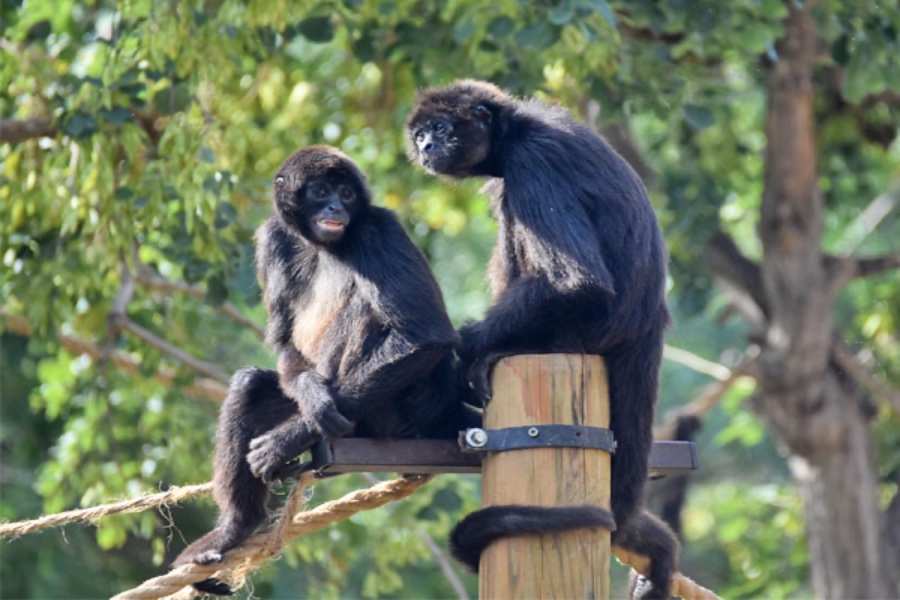
Black-headed spider monkeys thrive in pristine tropical forests, where they demonstrate a strong preference for mature, undisturbed habitats. These primates seldom venture into disturbed environments, highlighting their susceptibility to habitat loss and fragmentation. Their arboreal lifestyle is intricately linked to the rich biodiversity of their forest homes, where they play a crucial role in seed dispersal and maintaining the ecological balance of their ecosystems.

Overall, the black-headed spider monkey’s reliance on intact forest habitats underscores the importance of preserving these ecosystems to ensure the species’ survival and well-being.

Facts About Black-Headed Spider Monkey

  • The black-headed spider monkey (Ateles fusciceps) is found in Central and South America, specifically in Colombia, Ecuador, and Panama.
  • This species of spider monkey is critically endangered due to habitat loss in the Amazon rainforest.
  • Black-headed spider monkeys are arboreal and diurnal, meaning they live in trees and are active during the day.
  • They have a brownish-black body with a brown head, and can be separated into two subspecies: A. f. fusciceps and A. f. robustus.
  • The black-headed spider monkey is listed as endangered by the IUCN and in CITES.
  • They require a large area of the rainforest to live, contributing to their vulnerable status.
  • The genus name “Ateles” means “imperfect,” referring to the animal’s lack of opposable thumbs.
  • Spider monkeys are known for their prehensile tail, which acts as a fifth limb for grasping objects and moving through the trees.
  • Black-headed spider monkeys are primarily frugivorous, meaning their diet consists mainly of fruits.
  • They play a crucial role in seed dispersal within the rainforest ecosystem, contributing to the diversity and health of the forest.


Scientific Provenance & Verified Sources

Biological taxonomy, conservation status, and physical traits are cross-referenced with authoritative global registers:


Peer-reviewed by Wildlife Science Editors โ€ข Updated for 2026

Explore Other Species Profiles