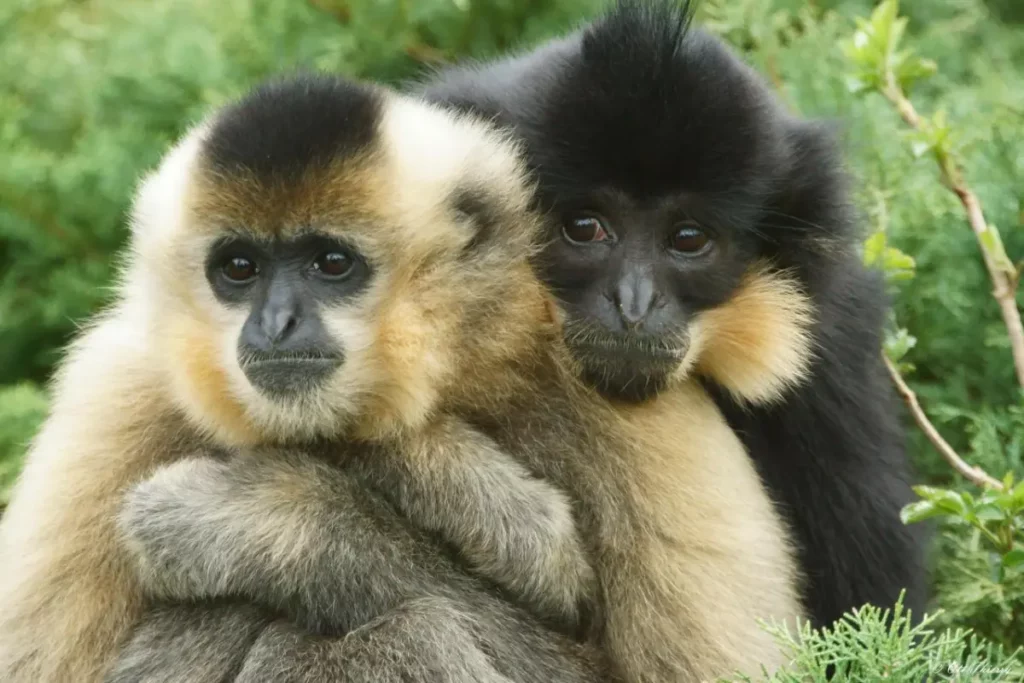
Black Crested Gibbon

IUCN Red List Conservation Status


Endangered

LC
NT
VU
EN
CR
EW
EX

Official assessment evaluated in accordance with the IUCN Red List of Threatened Species criteria: Endangered.


Species Quick Facts

Scientific Name
Nomascus concolor

Average Lifespan
20-30 years in wild, 30-40 years in captivity

Average Weight
6-9 kg (13-20 lbs) – Males: 8 kg, Females: 6.5 kg

Average Length
45-55 cm (18-22 inches) – head-body length excluding tail

Overview & Identification

The Black Crested Gibbon (Nomascus concolor) belongs to the family Hylobatidae, a group of lesser apes distinguished by their long arms and brachiating locomotion. Endemic to the montane and subโ€‘tropical evergreen forests of southern China, northern Vietnam, Laos, and a small fringe of western Myanmar, this species occupies elevations of 500โ€‘1,500โ€ฏm where dense canopy provides both food and protection. Males are uniformly black with a prominent crest, while females display a lighter brownโ€‘gray coat and lack the crest, a striking example of sexual dimorphism. Black Crested Gibbons are diurnal, arboreal primates that spend the majority of their lives high in the canopy, rarely descending to the forest floor. Their diet is primarily frugivorous, supplemented by leaves, flowers, and insects. The species is listed as Endangered on the IUCN Red List due to rapid habitat loss, fragmentation, and illegal hunting. Conservation programs focus on habitat protection, antiโ€‘poaching patrols, and communityโ€‘based education, but the fragmented nature of remaining forests makes population recovery challenging.

Behavior & Social Structure

Black Crested Gibbons live in monogamous pairs that defend a permanent territory ranging from 20 to 50 hectares. The pair is often accompanied by their offspring, forming a small family unit that may include one or two juveniles. Territories are marked by vocal duets performed at dawn and dusk; the maleโ€™s deep, resonant notes blend with the femaleโ€™s higher, melodic calls, creating a complex song that advertises occupancy and deters rivals. Daily activity peaks in the early morning when the pair forages, and again in the late afternoon. They travel by brachiation, swinging from branch to branch with remarkable speed and precision. Home range fidelity is high, and individuals rarely cross into neighboring territories, reinforcing the importance of dense, continuous canopy for social stability. Communication also includes visual displays such as chest beating and branch shaking, which convey aggression or excitement without resorting to physical conflict.

Diet & Hunting Patterns

The Black Crested Gibbon is primarily a frugivore, with fruit comprising roughly 60โ€ฏ% of its diet during peak fruiting seasons. Preferred fruits include figs (Ficus spp.), mangoes, and various berries that are abundant in the upper canopy. Leaves and young shoots account for about 30โ€ฏ% of intake, especially during lean periods when fruit is scarce; the gibbon selectively browses tender foliage of species such as Machilus and Castanopsis. Insects, mainly ants, beetles, and caterpillars, provide an additional 10โ€ฏ% protein source and are captured opportunistically during foraging bouts. Feeding occurs throughout the day, with the pair often moving from one fruiting tree to another, employing precise handโ€‘eye coordination to pluck ripe fruit while maintaining balance on slender branches. Seasonal variation in food availability drives ranging patterns, and the gibbonโ€™s flexible diet helps it survive in fragmented habitats where certain food resources may be limited.

Reproduction & Life Cycle

Sexual maturity in Black Crested Gibbons is reached at about 5โ€“7โ€ฏyears for both sexes, though successful breeding often occurs later when a stable pair bond is established. The breeding season is not strictly seasonal, but peaks during the rainy months (Aprilโ€‘June) when fruit abundance is highest, providing ample nutrition for gestation. Gestation lasts approximately 240โ€ฏdays, after which a single infant is born, weighing around 300โ€ฏg. Newborns cling to the motherโ€™s belly for the first 6โ€‘8โ€ฏweeks, during which both parents participate in protection and occasional feeding. By three months, the infant begins to ride on the motherโ€™s back and learns brachiation by clinging to the fatherโ€™s arms. Weaning occurs at about 12โ€ฏmonths, but juveniles remain with the family group for up to 5โ€ฏyears before dispersing to establish their own territories. Parental investment is high, with both sexes contributing to infant care, grooming, and territory defense.

Threats & Conservation

The IUCN classifies the Black Crested Gibbon as Endangered, with an estimated global population of 5,000โ€“10,000 mature individuals, distributed across highly fragmented forest patches. The principal threats are habitat loss and degradation caused by illegal logging, agricultural expansion (especially tea and rubber plantations), and infrastructure development that fragments the canopy and isolates populations. Hunting for meat and the illegal pet trade further reduce numbers, particularly in remote border regions. Small, isolated groups suffer from reduced genetic diversity and increased vulnerability to stochastic events such as disease outbreaks. Conservation initiatives include the establishment of protected areas like the Bawangling National Nature Reserve in China and communityโ€‘based forest management in Vietnam. Antiโ€‘poaching patrols, habitat corridors, and exโ€‘situ breeding programs aim to stabilize and eventually increase wild populations, but sustained political will and funding are essential for longโ€‘term success.

Interesting Facts

โ€ข The maleโ€™s black coat and prominent crest give the species its common name, while females lack the crest entirely.
โ€ข Their dawn duets can be heard up to 2โ€ฏkm away, serving both territorial and pairโ€‘bonding functions.
โ€ข Black Crested Gibbons have a unique thumb that is opposable, allowing precise manipulation of fruit and leaves.
โ€ข They are one of the few primates that can produce a true โ€œsongโ€ with coordinated maleโ€‘female vocalizations.
โ€ข Despite their endangered status, they have been successfully reโ€‘introduced into several restored forest corridors in northern Vietnam.

Description

Black Crested Gibbon

The Black Crested Gibbon, scientifically known as Nomascus concolor, is a Critically Endangered species of gibbon renowned for its striking appearance and acrobatic agility. These arboreal primates are characterized by their distinct black fur and a crest of long, shaggy hair on top of their heads, which sets them apart from other gibbon species. Known for their melodious calls that echo through the dense forests, black crested gibbons form monogamous family units and are highly territorial, defending their home ranges with vigorous vocalizations and agile movements.

Appearance

Eastern Black Crested Gibbon Appearance

The black crested gibbon exhibits a glossy black coat, with the males and females displaying minimal sexual dimorphism in coloration. Both genders possess the prominent crest of hair on their heads, adding to their regal and majestic appearance. Their long, powerful arms and dexterous hands enable them to swing with remarkable agility through the forest canopy, showcasing their remarkable adaptation to an arboreal lifestyle. These distinguishing features contribute to their unique allure and make them a captivating subject for wildlife enthusiasts and researchers alike.

Distribution

The black crested gibbon is found in the lush, tropical forests of China, Laos, and northern Vietnam, with four recognized subspecies inhabiting specific regions within this range. The populations of these gibbons are notably fragmented due to habitat loss and degradation, leading to isolated groups in various pockets of their range. This fragmentation poses a significant challenge to their long-term survival, making conservation efforts crucial for the preservation of this remarkable species.

Habitat Preferences

Black Crested Gibbon Habitat

Black crested gibbons thrive in a variety of forested habitats, including tropical evergreen, semi-evergreen, and deciduous forests in subtropical and mountainous areas. Their reliance on these diverse ecosystems for food, shelter, and territorial needs underscores the critical role of intact forest habitats in sustaining their well-being. The towering trees and dense canopies provide the ideal environment for their acrobatic movements and contribute to the preservation of the intricate web of life within these biodiverse ecosystems.

As a conservation scientist deeply committed to protecting the world’s biodiversity, I am dedicated to raising awareness about the plight of the black crested gibbon and advocating for the preservation of their natural habitats. Through collaborative efforts and informed conservation strategies, we can work towards securing a future for these remarkable primates and the ecosystems they call home.

Facts About Black crested gibbon

  • The black crested gibbon (Nomascus concolor) is a critically endangered species found in China, Laos, and northern Vietnam.
  • It is listed as critically endangered by the IUCN, with only a global population of about 1300-2000 individuals.
  • Black crested gibbons are mainly found in southern China (Yunnan) and some distribution areas in northwestern Laos and northern Vietnam.
  • They are small arboreal apes, weighing about 8 kg (18 lb), and prefer subtropical and montane evergreen forests.
  • The species is threatened by deforestation due to the steel industry and military activity during political unrest.
  • The black crested gibbon primarily eats leaves, along with some fruits and flowers.
  • It is known for its distinctive call, which can be heard over long distances in the forest.
  • Black crested gibbons live in small family groups consisting of a mated pair and their offspring.
  • The species is divided into four subspecies, each with its own specific geographic range.
  • Conservation efforts are ongoing to protect the remaining populations and their habitats.


Scientific Provenance & Verified Sources

Biological taxonomy, conservation status, and physical traits are cross-referenced with authoritative global registers:


Peer-reviewed by Wildlife Science Editors โ€ข Updated for 2026

Explore Other Species Profiles