IUCN Red List Conservation Status


Least Concern

LC
NT
VU
EN
CR
EW
EX

Official assessment evaluated in accordance with the IUCN Red List of Threatened Species criteria: Least Concern.


Species Quick Facts

Scientific Name
Sapajus apella

Average Lifespan
35-45 years in wild

Average Weight
Males 3.9-4.6 kg, Females 1.7-3.4 kg (4-10 lbs)

Average Length
32-57 cm (13-22 inches) – head-body length

Overview & Identification

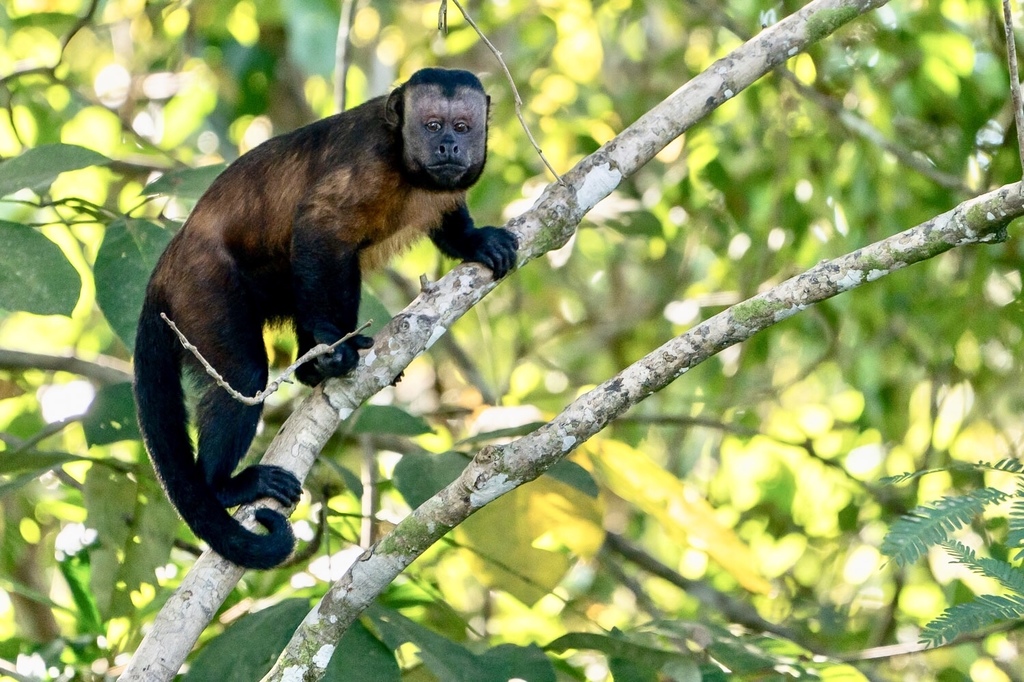
The black-capped, or tufted, capuchin (Sapajus apella) is an intelligent New World monkey of the forests of northern South America. It has a brown body, a dark cap, and tufts of hair on its head. Living in active social groups, it is a clever forager and notable tool user, eating fruit, nuts, insects, and small animals.

Behavior & Social Structure

The black-capped capuchin (Sapajus apella) is a strictly diurnal primate, beginning activity shortly after dawn and continuing through late afternoon before retiring to sleeping trees at dusk. Days are spent traveling through the forest canopy and understory in a coordinated pattern of foraging, resting, and social interaction, with peak activity typically occurring in the cooler morning and late-afternoon hours. This species lives in stable, multi-male, multi-female troops ranging from 8 to 30 individuals, organized around a linear dominance hierarchy for both males and females. A single alpha male typically leads the group, coordinating movement and defending against rival troops and predators, though coalitions of subordinate males may challenge for dominance periodically.

Communication in Sapajus apella is highly sophisticated, involving an extensive vocal repertoire of alarm calls, contact chirps, threat barks, and food-associated calls that convey specific information about predator type or resource quality. Tactile communicationโ€”including grooming, play, and huddlingโ€”reinforces social bonds and reduces tension within the troop, while scent marking via urine-washing (rubbing urine onto hands and feet) serves both thermoregulatory and possible chemical communication functions. Facial expressions and body postures further nuance social signaling, particularly during dominance displays and reconciliation after conflicts.

Troops maintain home ranges of roughly 60 to 200 hectares, which frequently overlap with neighboring groups, leading to vocal and occasionally physical territorial disputes rather than strict exclusive defense. Black-capped capuchins are renowned for their behavioral flexibility and problem-solving intelligence, using tools such as stones to crack open nuts and seeds, probing sticks to extract insects, and even employing rudimentary planning in food processingโ€”an adaptive trait that has made them one of the most cognitively studied New World primates.

Diet & Hunting Patterns

As opportunistic omnivores, black-capped capuchins exploit an extraordinarily broad diet that shifts seasonally based on resource availability. Fruit constitutes the dietary staple, comprising species such as figs (Ficus spp.), palm fruits, and various canopy trees, but the species supplements this with substantial quantities of insects (particularly caterpillars, beetles, and ants), spiders, small vertebrates including lizards and nestling birds, bird eggs, and occasionally small mammals. Their strong jaws and thick tooth enamel allow them to exploit hard-shelled nuts and unripe fruits unavailable to many sympatric primates, giving them a competitive dietary niche.

Foraging strategy relies heavily on extractive techniquesโ€”manipulating bark, dead wood, and bromeliads to unearth hidden invertebratesโ€”and documented tool use, including selecting and transporting stones to anvil sites for cracking palm nuts. During dry seasons when fruit becomes scarce, capuchins increase reliance on invertebrates and extracted resources, demonstrating notable dietary plasticity that buffers them against seasonal food shortages. Water is typically obtained from fruit moisture, tree-hole reservoirs, and bromeliad cups, reducing dependency on ground-level water sources and lowering predation risk associated with descending to rivers or pools.

Reproduction & Life Cycle

Black-capped capuchins do not exhibit a strict breeding season across their range, though births often peak with periods of increased fruit and insect availability. The species follows a promiscuous/polygynandrous mating system in which the dominant alpha male typically secures the majority of matings, though subordinate males may successfully mate when the alpha is inattentive or during periods of female choice, which has been documented as an important factor in this species. Females signal receptivity through proceptive behaviors including pursuing and soliciting males.

Gestation lasts approximately 150 to 160 days (about five months), culminating in the birth of a single offspring; twins are rare. Infants cling to the mother’s back within days of birth and receive intensive maternal investment, including nursing, carrying, and protection, with alloparental care from other troop females (including juveniles) commonly observed. Weaning occurs gradually between 9 and 12 months of age. Females typically reach sexual maturity around 4 to 5 years, while males mature later, around 7 to 8 years, coinciding with troop dispersal and competition for dominance status.

Threats & Conservation

The primary threat to black-capped capuchins is habitat loss and fragmentation driven by deforestation for agriculture, cattle ranching, logging, and infrastructure expansion across the Amazon Basin and surrounding regions. Fragmented forest patches isolate populations, reduce genetic diversity, and force troops into smaller, resource-limited ranges, increasing intraspecific competition and vulnerability to local extinction. Hunting pressure, though variable by region, persists in parts of South America where capuchins are captured for the illegal pet trade or, in some areas, hunted for bushmeat, further compounding population declines.

Natural predators include large raptors such as harpy eagles, felids like jaguars and ocelots, and snakes, against which capuchins rely on vigilance, alarm calls, and mobbing behavior for defense. Climate change poses an emerging concern through altered fruiting phenology and increased frequency of drought and fire events in the Amazon, potentially disrupting food availability. The IUCN currently lists Sapajus apella as Least Concern overall, reflecting its wide distribution and adaptability, though certain regional populations and closely related Sapajus taxa are considered Near Threatened or Vulnerable; conservation initiatives include protected area management, CITES Appendix II trade regulation, and habitat corridor projects supported by regional conservation organizations (source: [IUCN Red List](https://www.iucnredlist.org/)).

Interesting Facts

  • Taxonomic Reshuffling: Until the early 2010s, tufted capuchins were classified within the genus Cebus; genetic and morphological analyses led to their reclassification into the distinct genus Sapajus.
  • Tool-Using Innovators: Wild populations use stone tools to crack open palm nuts on anvil stones, a behavior requiring significant strength, precision, and learned skill passed across generations.
  • Distinctive Cap: The species’ common name derives from the dark, cap-like tuft of fur atop its head, which distinguishes it from other capuchin species.
  • Female Mate Choice: Unlike many primates, female black-capped capuchins actively solicit and choose mating partners, sometimes bypassing the dominant male.
  • Exceptional Brain-to-Body Ratio: Capuchins possess one of the highest brain-to-body mass ratios among New World monkeys, rivaling some Old World primates in problem-solving capability.
  • Urine-Washing Behavior: Individuals rub urine on their hands and feet, a behavior thought to aid thermoregulation and potentially communicate reproductive or social status.
  • Seed Dispersal Engineers: As frugivores that travel widely, capuchins play a critical ecological role dispersing seeds of numerous tree species, supporting forest regeneration across their range.

Description

The Black-Capped Capuchin, scientifically known as Sapajus apella, is a New World primate belonging to the Cebidae family. This highly intelligent and sociable species is commonly referred to as the tufted capuchin, brown capuchin, or pin monkey. It is distinguished by its striking black cap, which gives it a distinctive appearance among other primate species.

Appearance

The Black-Capped Capuchin is characterized by its black or dark brown fur on the crown of the head, which resembles a cap, thus giving it its colloquial name. The rest of its body is covered in lighter brown or beige fur, with a prehensile tail that aids in its arboreal lifestyle. Their expressive faces and long, dexterous fingers make them an intriguing species to observe, and their inquisitive nature adds to their charm.

Distribution

The Black-Capped Capuchin is primarily found in South America, with a range that extends from Brazil to the Caribbean islands of Trinidad and Margarita. Within South America, they inhabit regions of Brazil, Argentina, Paraguay, and Bolivia. Their distribution also includes the Atlantic forests and other tropical and subtropical forests in the region. However, due to habitat loss and fragmentation, their populations are facing increasing threats, particularly in areas where human encroachment is prevalent.

Habitat Preferences
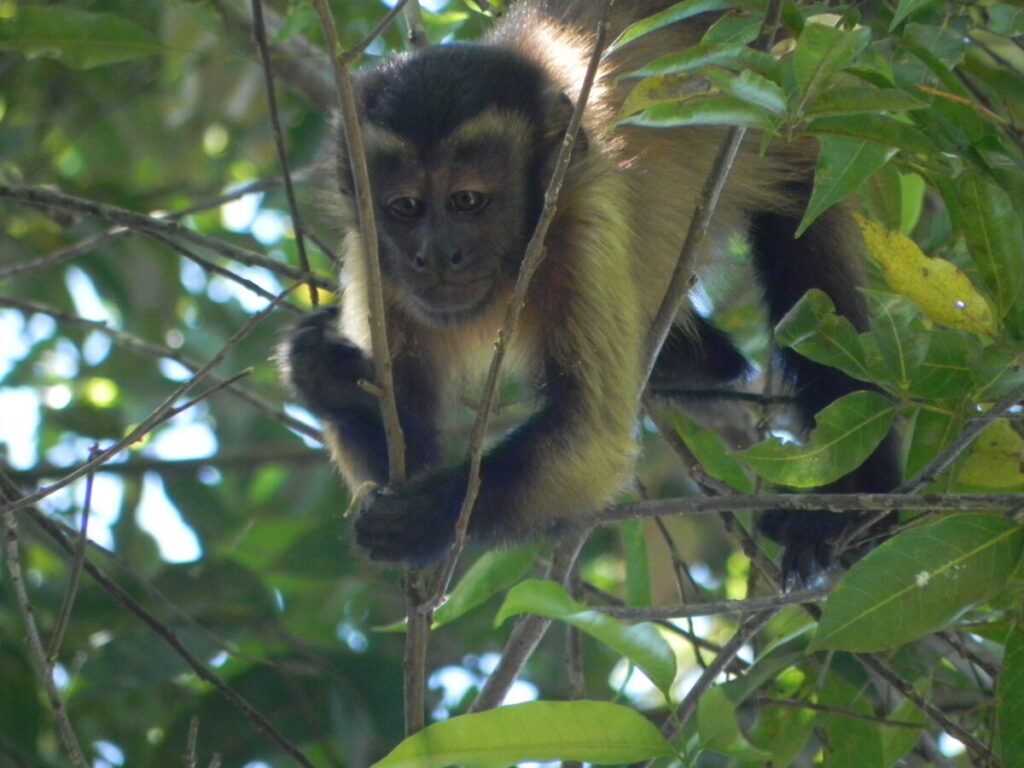
Black-Capped Capuchins are predominantly arboreal, thriving in various forest types such as tropical rainforests, lowland rainforests, and mangrove forests. They are highly adaptable and can also be found in swamp forests and savanna forests. Their ability to forage on the ground and navigate through the canopy showcases their versatility in utilizing different ecosystems. These primates rely on the rich biodiversity of their habitats, utilizing a diverse range of food sources and sheltering in the dense vegetation that characterizes these environments.

Overall, the Black-Capped Capuchin’s survival and well-being are intricately linked to the conservation of its forest habitats and the protection of the diverse ecosystems that support its existence.

Facts About Black-Capped Capuchin

  • The Black-Capped Capuchin is an omnivore, feeding on fruit, leaves, insects, nuts, frogs, and small birds.
  • They are native to South America, including countries such as Brazil, Peru, Ecuador, Venezuela, and Bolivia.
  • These capuchins have a long prehensile tail, which helps them navigate their forest habitat.
  • The average lifespan of a Black-Capped Capuchin is 35-45 years in the wild.
  • They are diurnal, meaning they are active during the day.
  • Black-Capped Capuchins are highly social animals, living in groups consisting of 6 to 20 members.
  • They are known for their tool-using abilities, such as using stones to crack open nuts.
  • The species is listed in CITES Appendix II due to concerns about their conservation status.
  • Black-Capped Capuchins have distinctive black or dark brown hands, feet, and tail.
  • They are highly intelligent and exhibit complex social behaviors within their groups.


Scientific Provenance & Verified Sources

Biological taxonomy, conservation status, and physical traits are cross-referenced with authoritative global registers:


Peer-reviewed by Wildlife Science Editors โ€ข Updated for 2026

Explore Other Species Profiles