Bengal Slow Loris

IUCN Red List Conservation Status


Endangered

LC
NT
VU
EN
CR
EW
EX

Official assessment evaluated in accordance with the IUCN Red List of Threatened Species criteria: Endangered.


Species Quick Facts

Scientific Name
Nycticebus bengalensis

Average Lifespan
15-20 years in wild

Average Weight
About 1-2.1 kg (2.2-4.6 lb); the largest slow loris.

Average Length
Head-to-tail 26-38 cm (10-15 inches).

Overview & Identification

The Bengal slow loris is a nocturnal, slow-moving primate of South and Southeast Asia and the largest of the slow lorises. It has large forward-facing eyes for night vision and a toxic bite produced by combining gland secretions with saliva. It feeds on tree gum, nectar, fruit, and small animals, and is threatened by the illegal pet and traditional medicine trades.

Behavior & Social Structure

The Bengal slow loris (Nycticebus bengalensis) is a strictly nocturnal primate, remaining hidden in dense foliage, tree hollows, or tangled vine masses during daylight hours and emerging after dusk to forage through the forest canopy. Its locomotion is a slow, deliberate quadrupedal climb rather than leaping, an energy-efficient strategy that reduces detection by predators and matches its comparatively low metabolic rate for a primate of its size. This cautious movement, combined with a strong grip enabled by a specialized retia mirabilia vascular network in the limbs, allows the animal to remain motionless in a single position for extended periods without fatigue.

Bengal slow lorises are largely solitary foragers, though their social organization is best described as dispersed rather than truly asocial—individuals maintain overlapping home ranges and periodically meet for social grooming, mating, or brief affiliative contact, particularly between mothers and offspring or established pairs. Home range size varies with habitat quality and food availability, typically spanning several hectares, with males generally ranging farther than females and overlapping the territories of multiple females. Scent marking via urine-washing and specialized brachial gland secretions is the primary mode of communication, used to advertise reproductive status, mark territory boundaries, and facilitate mate recognition in the dark understory.

One of the species’ most remarkable adaptive behaviors is chemical defense: Bengal slow lorises possess a brachial gland on the inner arm that secretes an oily toxin, which, when mixed with saliva, produces a venomous bite—an extremely rare trait among mammals and unique among primates. This venom is used defensively against predators and competitors and is also applied to fur during grooming as a toxic coating for offspring left in nests. Vocalizations are subtle and low-frequency, including soft whistles and clicks, reflecting selective pressure to avoid alerting nocturnal predators such as owls and civets.

Diet & Hunting Patterns

As an omnivore, the Bengal slow loris consumes a varied diet including tree gums and saps, nectar, fruit, insects (particularly ants, beetles, and orthopterans), bird eggs, and occasionally small vertebrates. Gum-feeding is especially important, and the species has specialized dentition, including a toothcomb formed by procumbent lower incisors and canines, used to gouge bark and stimulate exudate flow from trees such as Terminalia and Albizia species. Foraging is slow and methodical, with the animal using stealth to approach insect prey and its keen olfactory and tactile senses to locate hidden food sources in low-light conditions.

Seasonal shifts in diet are pronounced, with gum and sap consumption increasing during dry seasons when fruit and insect availability declines, and insect and nectar intake rising during monsoon and flowering periods. This dietary flexibility supports year-round survival in seasonal subtropical and tropical forests. The species obtains most of its water from succulent plant matter and dew, reducing the need to descend to ground-level water sources, which would expose it to increased predation risk.

Reproduction & Life Cycle

Bengal slow lorises do not exhibit a strict breeding season across their range, though reproductive activity may peak with local food abundance following monsoon seasons. The mating system is best characterized as polygynandrous, with both males and females potentially mating with multiple partners across overlapping home ranges. Gestation lasts approximately 185 to 200 days, unusually long for a small-bodied mammal, and females typically give birth to a single offspring, occasionally twins.

Infants are initially parked on branches while the mother forages, a behavior facilitated by the application of toxic saliva-gland secretions to the infant’s fur for chemical protection against predators. Maternal care is intensive, with infants clinging to the mother’s body for the first several weeks before being parked independently. Weaning occurs around 5 to 9 months of age, and sexual maturity is reached at approximately 18 to 24 months, with generation times of roughly 8 years contributing to slow population recovery rates.

Threats & Conservation

The Bengal slow loris faces severe threats from habitat loss and fragmentation driven by logging, agricultural expansion (particularly rubber and oil palm plantations), and infrastructure development throughout its range in India, Bangladesh, Myanmar, Thailand, Vietnam, Laos, Cambodia, and southern China. Deforestation not only reduces available habitat but isolates populations into small, genetically vulnerable fragments unable to sustain long-term viability. Illegal wildlife trade represents an even more acute threat: the species is heavily poached for the exotic pet trade and for use in traditional medicine, with its teeth often cruelly clipped or removed to prevent bites from vendors and buyers—a practice causing infection, malnutrition, and high mortality in captivity.

Natural predators include large snakes, raptors such as owls, and carnivores like civets, though anthropogenic pressures far outweigh natural predation as a conservation concern. Human-wildlife conflict arises when lorises raid agricultural crops or are killed out of superstition, as the species is associated with folklore in some regions. In response, the IUCN, CITES (which lists the species under Appendix I, prohibiting international commercial trade), and organizations such as the Little Fireface Project and various regional wildlife rescue centers are conducting rehabilitation, anti-poaching enforcement, habitat protection, and public awareness campaigns to curb trade and support wild population recovery.

Interesting Facts

  • Venomous Primate: The Bengal slow loris is one of the only venomous mammals in the world, combining brachial gland secretions with saliva to deliver a toxic, allergenic bite capable of causing anaphylactic shock in humans.
  • Toxic Baby Shield: Mothers coat their infants in venomous saliva-gland secretions before leaving them “parked” on branches, providing a chemical deterrent against predators.
  • Silent Mover: Its slow, deliberate locomotion combined with a powerful, fatigue-resistant grip (aided by specialized limb blood vessels) allows it to remain motionless for hours to avoid detection.
  • Toothcomb Tool: Specialized lower incisors form a “toothcomb” used for gouging tree bark to access gum and sap, as well as for grooming fur.
  • Long Gestation, Small Body: Despite weighing only 1–2 kg, it has one of the longest gestation periods relative to body size among primates, lasting up to 200 days.
  • Superstition-Driven Trade: In parts of its range, folklore attributes medicinal or mystical properties to loris body parts, fueling demand in traditional medicine markets despite lack of scientific basis.
  • Appendix I Protection: All slow loris species, including N. bengalensis, receive the highest level of international trade protection under CITES Appendix I due to catastrophic trade-driven population declines.

Description

Bengal Slow Loris

The Bengal slow loris, scientifically known as Nycticebus bengalensis, is a remarkable strepsirrhine primate native to the Indian subcontinent and Indochina. This species is distinguished by its large, soulful eyes, a dense woolly coat, and a unique slow and deliberate movement that characterizes its behavior. The Bengal slow loris is known for its gentle demeanor and nocturnal habits, spending its days nestled in the safety of tree hollows or dense foliage.

Appearance

Bengal Slow Loris Appearance

The Bengal slow loris is easily recognizable by its large, forward-facing eyes, which are adapted for its nocturnal lifestyle. Its dense, woolly fur provides insulation and protection from the elements. This species also possesses a distinctive white stripe running down its back, setting it apart from other slow loris species.

Distribution

The geographic range of the Bengal slow loris is notably expansive, encompassing regions in the Indian subcontinent and Indochina. This species is found in countries such as Bangladesh, Cambodia, Vietnam, Laos, and parts of India. The Bengal slow loris exhibits adaptability to a variety of habitats within its range, contributing to its ability to thrive in diverse ecosystems.

Habitat Preferences
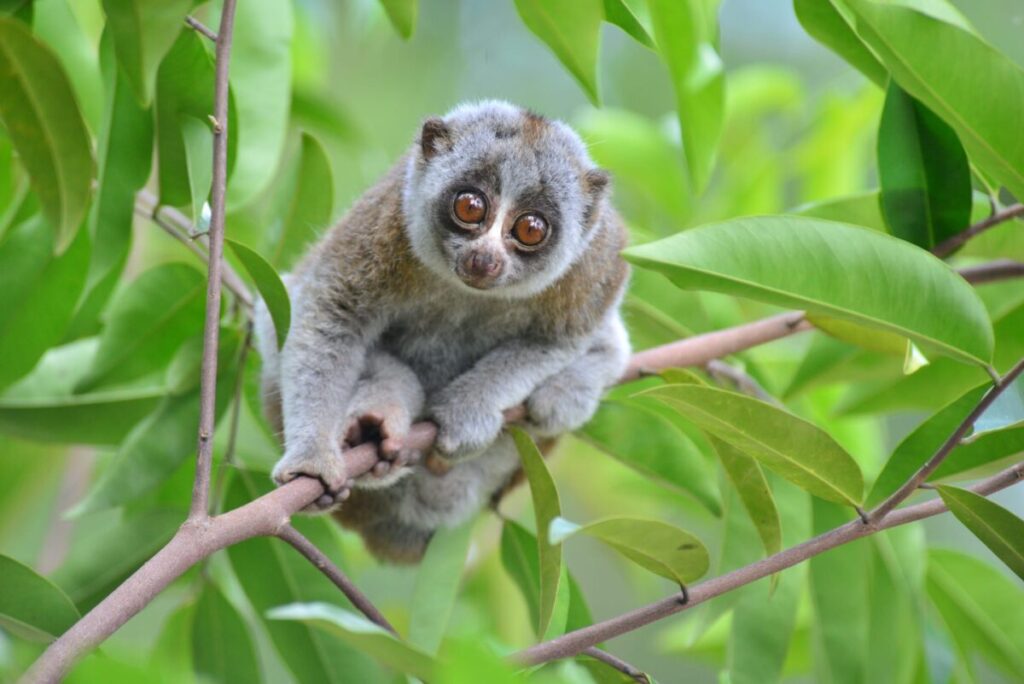
Bengal Slow Loris Habitat

Bengal slow lorises favor rainforests with dense canopies, as well as evergreen and semi-evergreen forests. These habitats provide the necessary cover and resources for their survival, including access to a diverse range of food sources and secure nesting sites. The species’ ability to occupy a range of habitats, from rainforests to montane forests, reflects its resilience and adaptability to varying environmental conditions.

Overall, the Bengal slow loris’s presence in these ecosystems underscores its significance as a key indicator species for the conservation of Southeast Asia’s rich biodiversity.

Facts About Bengal Slow Loris

  • The Bengal slow loris (Nycticebus bengalensis) is the largest species of slow loris, measuring 26 to 38 cm (10 to 15 in) from head to tail and weighing between 1 and 2.1 kg (2.2 and 4.6 lb) (source: Wikipedia).
  • They have a lifespan of 15-20 years (source: Animalia.bio).
  • Bengal slow lorises are nocturnal and arboreal, occurring in both evergreen and deciduous forests (source: Thai National Parks).
  • Breeding season: Bengal slow lorises probably breed throughout the year. They typically give birth to 1 to 2 offspring (source: Animal Diversity Web).
  • The Bengal slow loris is found in parts of Southeast Asia, including Bangladesh, Northeast India, Myanmar, and Thailand (source: Britannica).
  • They prefer rainforests with dense canopies and are often found in fragmented forest patches (source: Population Survey of the Bengal Slow Loris).
  • The Bengal slow loris primarily feeds on insects, tree gum, nectar, and fruits (source: Critter Science).
  • They have a strong grip and can hang upside down from branches for long periods using their specialized hands and feet (source: Critter Science).
  • The Bengal slow loris is known for its large, distinctive eyes, which are adapted for its nocturnal lifestyle (source: Britannica).
  • Conservation status: The Bengal slow loris is listed as Vulnerable on the IUCN Red List due to habitat loss and illegal wildlife trade (source: GBIF).


Scientific Provenance & Verified Sources

Biological taxonomy, conservation status, and physical traits are cross-referenced with authoritative global registers:


Peer-reviewed by Wildlife Science Editors • Updated for 2026

Explore Other Species Profiles