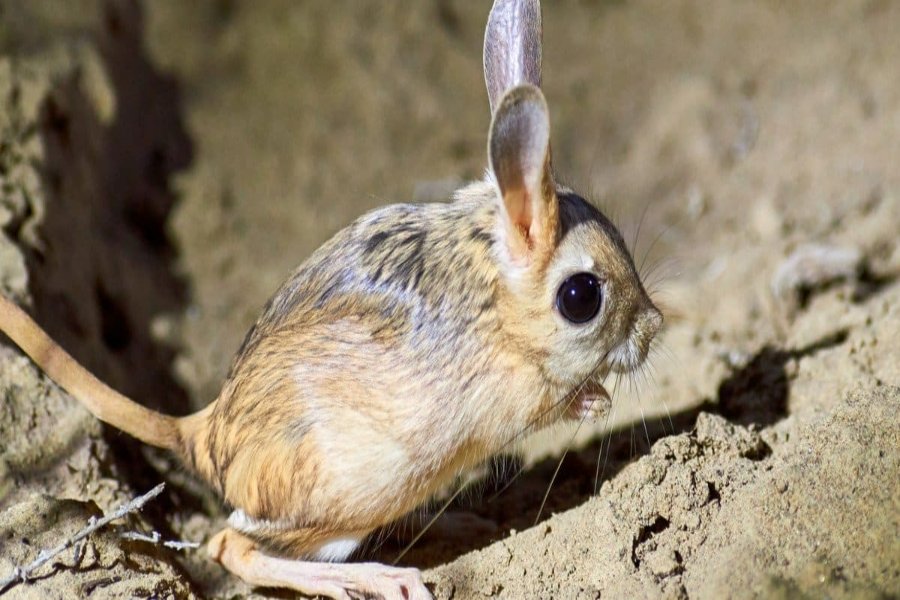
Baluchistan Pygmy Jerboa

IUCN Red List Conservation Status


Data Deficient

This species has no threat category on the IUCN Red List scale (status: Data Deficient), so no threat level is shown.


Species Quick Facts

Scientific Name
Salpingotulus michaelis

Average Lifespan
2-3 years in wild, 3-4 years in captivity

Average Weight
0.003-0.006 kg (0.0066-0.0132 lbs) – Males: 0.004 kg, Females: 0.005 kg

Average Length
4-5 cm (1.6-2.0 inches) – head-body length excluding tail

Overview & Identification

The Baluchistan pygmy jerboa (Salpingotulus michaelis) is a diminutive member of the family Dipodidae, endemic to the arid foothills and desert plains of southwestern Pakistan and southeastern Iran. Classified within the order Rodentia, this species occupies sparsely vegetated, stony habitats where it can burrow beneath loose sand and gravel. Its compact body, elongated hind limbs, and tufted tail enable rapid bipedal locomotion, allowing it to escape predators and forage over large distances despite its minute size. The jerboa’s pelage is a sandyโ€‘brown hue that provides camouflage against the desert substrate. Although little is known about its population trends, the IUCN currently lists S. michaelis as Data Deficient due to limited field surveys. Ongoing habitat degradation from overgrazing and mining poses potential risks, underscoring the need for targeted ecological studies and conservation measures.

Behavior & Social Structure

Baluchistan pygmy jerboas are primarily nocturnal, emerging at dusk to forage and retreat to burrows before sunrise. They are solitary foragers, each individual maintaining a home range of approximately 200โ€‘300 square meters, which they defend through scent marking and occasional vocal chirps. Territorial disputes are resolved by rapid footโ€‘stomping displays and tail flicks. Social interactions are limited to brief mating encounters; otherwise, individuals avoid conspecifics to reduce competition for scarce food resources. Communication relies on a repertoire of highโ€‘frequency squeaks and footโ€‘drumming, both of which are inaudible to many predators but convey alarm and reproductive status within the species. Seasonal shifts in activity patterns correspond with temperature extremes, with increased foraging during cooler winter nights.

Diet & Hunting Patterns

The diet of the Baluchistan pygmy jerboa is predominantly insectivorous, supplemented by seeds and succulent plant parts. Field observations indicate a preference for coleopteran larvae, orthopteran nymphs, and arachnids, which provide high protein content essential for rapid growth. During periods of low insect abundance, individuals increase consumption of desert grasses, chenopod seeds, and the fleshy tips of dwarf shrubs such as Haloxylon. Food intake averages 0.5โ€‘1.0 grams per night, representing roughly 15โ€‘30% of body mass. Jerboas employ a sitโ€‘andโ€‘wait foraging strategy, using their keen hearing to detect prey movements, and they also actively sift through loose sand with their forepaws to uncover hidden insects. Water requirements are minimal; metabolic water derived from food suffices, allowing survival in extremely arid conditions.

Reproduction & Life Cycle

Baluchistan pygmy jerboas reach sexual maturity at about three months of age. Breeding occurs once annually, typically between March and May, timed with the brief spring bloom of desert vegetation. Males locate receptive females by following scent trails and emitting ultrasonic calls. After a gestation period of roughly 23โ€‘25 days, females give birth to litters of two to four altricial pups in shallow, lined burrows. The young are born hairless and blind, relying entirely on maternal milk for the first two weeks. Females nurse the pups for an additional three weeks before weaning, after which juveniles begin independent foraging. Parental care is solely maternal; males do not participate in offspring rearing. Juveniles attain full adult size by eight weeks and are capable of rapid bipedal hopping, essential for predator evasion.

Threats & Conservation

The IUCN classifies Salpingotulus michaelis as Data Deficient, reflecting a paucity of systematic population assessments. Nevertheless, habitat loss emerges as the principal threat. Overgrazing by livestock degrades the sparse vegetation cover, reducing food availability and exposing burrows to erosion. Unregulated mining activities in Baluchistan and adjacent Iranian provinces fragment the desert landscape, creating barriers to dispersal and increasing mortality from machinery. Climate change intensifies desertification, potentially shrinking suitable microhabitats. Predation by introduced feral cats and domestic dogs adds additional pressure. Current estimates suggest a total population of fewer than 10,000 mature individuals, though this figure remains speculative. Conservation actions recommended include habitat protection through the establishment of protected desert reserves, monitoring programs to establish baseline population data, and community outreach to mitigate livestock overgrazing.

Interesting Facts

โ€ข One of the smallest rodent species, weighing less than a teaspoon of sugar
โ€ข Can leap up to 30 centimeters in a single bound despite its tiny size
โ€ข Uses its long hind feet like springs, achieving speeds of up to 8 km/h
โ€ข Has a specialized kidney that concentrates urine to conserve water in arid environments
โ€ข Emits ultrasonic chirps that are inaudible to most predators but crucial for mate location

Description

Baluchistan Pygmy Jerboa

The Baluchistan pygmy jerboa, scientifically known as Salpingotulus michaelis, is an incredibly small rodent belonging to the family Dipodidae. This diminutive creature gained recognition in the 1999 Guinness Book of Records, where it was listed as tied for the smallest rodent in the world alongside the African pygmy mouse. The Baluchistan pygmy jerboa is renowned for its petite size and unique physical attributes, making it a fascinating subject of study and admiration.

Appearance

Baluchistan Pygmy Jerboa Appearance

This species is distinguished by its minuscule size, with an average length of approximately 4.4 to 9 centimeters, including its tail. The Baluchistan pygmy jerboa possesses distinctively elongated hind limbs, which enable it to execute prodigious leaps, and large ears that aid in thermoregulation and auditory acuity. Furthermore, its soft, dense fur provides insulation and contributes to its endearing appearance.

Distribution

The Baluchistan pygmy jerboa is primarily found in the arid regions of Pakistan, with potential occurrences in neighboring areas of Afghanistan. This species exhibits an affinity for sand dunes, gravel flats, and plains within hot desert environments. The population density of the Baluchistan pygmy jerboa is notable in these specific habitats, reflecting its adaptation to arid and sandy landscapes.

Habitat Preferences

Baluchistan Pygmy Jerboa Habitat

The Baluchistan pygmy jerboa thrives in dry and arid desert environments, favoring sandy dunes, gravel flats, and plains. These habitats provide the necessary conditions for the species to fulfill its ecological requirements, including burrow construction and foraging for sustenance. The ability of the Baluchistan pygmy jerboa to thrive in such challenging ecosystems underscores its remarkable adaptability and resilience.

Facts About Baluchistan Pygmy Jerboa

  • The Baluchistan Pygmy Jerboa (Salpingotulus michaelis) is the world’s smallest rodent, with an average head and body length of only 4.3 cm and a tail averaging 8 cm.
  • Adult females of this species weigh around 3.2 grams.
  • They inhabit dry and arid desert environments, preferring sandy dunes and gravel flats, and enjoy altitudes of 1,000-1,600m (3,280-5,249ft).
  • The Baluchistan Pygmy Jerboa has a distinct appearance with a cotton ball-like body and adorable long ears.
  • Their habitat consists of northern sandy semi-deserts with sparse sod-forming grasses, with specific habitats varying regionally.
  • These tiny creatures are about 2 inches long, earning them the title of the world’s smallest rodent.
  • Baluchistan Pygmy Jerboas are found in a few areas in Asia, including the Ubsu-Nur Depression of the Tuva Republic in Russia.
  • They are known for their hopping locomotion, similar to kangaroos, and are well adapted to their desert habitat.
  • The diet of Baluchistan Pygmy Jerboas primarily consists of seeds, plants, and insects.
  • This species is rare and unique, making it a subject of interest for researchers and wildlife enthusiasts.


Scientific Provenance & Verified Sources

Biological taxonomy, conservation status, and physical traits are cross-referenced with authoritative global registers:


Peer-reviewed by Wildlife Science Editors โ€ข Updated for 2026

Explore Other Species Profiles