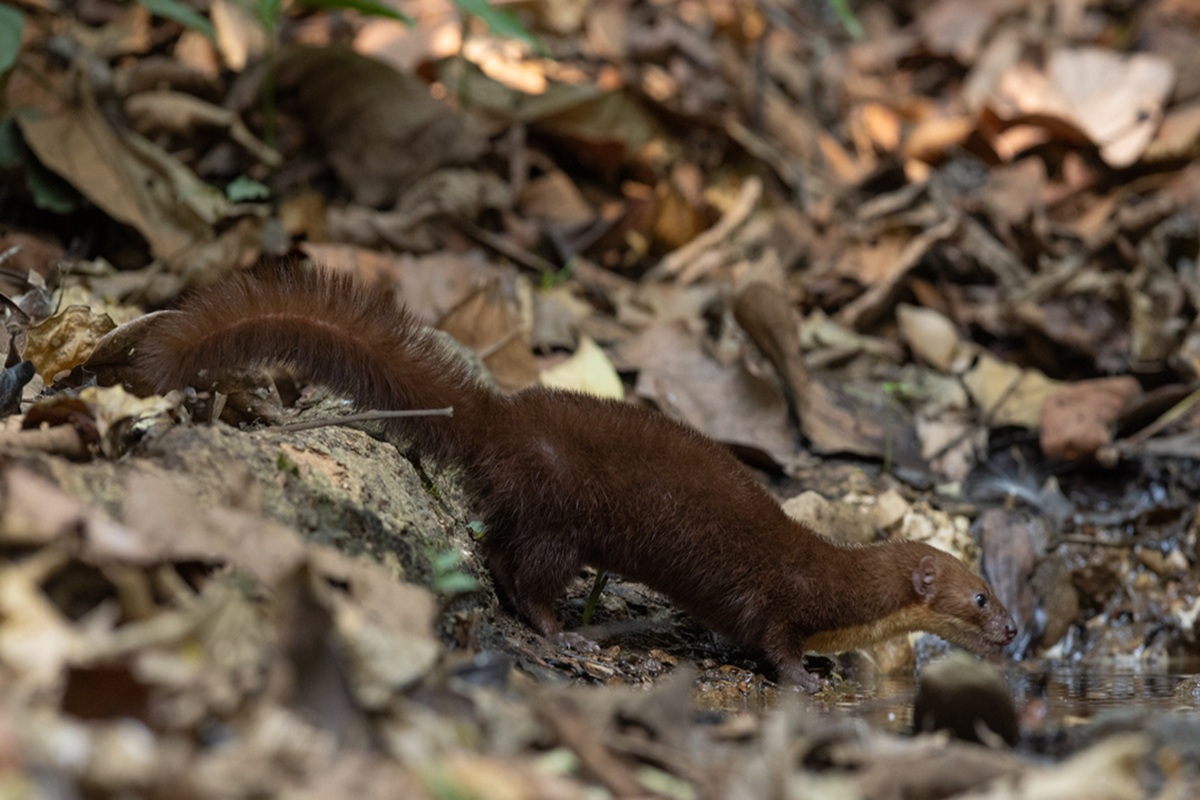
Back-Striped Weasel

IUCN Red List Conservation Status


Least Concern

LC
NT
VU
EN
CR
EW
EX

Official assessment evaluated in accordance with the IUCN Red List of Threatened Species criteria: Least Concern.


Species Quick Facts

Scientific Name
Mustela strigidorsa

Average Lifespan
Undocumented for this species; closely related Siberian weasel lives up to 6 years in the wild

Average Weight
1-2 kg (2.2-4.4 lbs)

Average Length
Body 30-36 cm (11.8-14.2 inches); tail 18-20 cm (7.1-7.9 inches)

Overview & Identification

The back-striped weasel is a slender mustelid of Southeast Asia and the eastern Himalayas, ranging from northeastern India and Nepal through Myanmar, Laos, and southern China. It is recognised by a narrow silvery stripe running down the centre of its dark brown back. Secretive and rarely seen, it inhabits evergreen forests and grasslands where it preys on small rodents and other animals.

Behavior & Social Structure

The back-striped weasel (Mustela strigidorsa) is widely considered to exhibit both crepuscular and nocturnal tendencies, though direct behavioral observations remain scarce due to its secretive nature and low population densities across its Southeast Asian range. Like most mustelids, it is presumed to be primarily solitary outside of breeding encounters, moving through dense vegetation, forest edges, and grassland-forest mosaics with the characteristic low-slung, elongated body plan and rapid, bounding gait typical of the genus Mustela. Its long, slender body and short legs allow it to navigate burrows, rock crevices, and dense undergrowth in pursuit of prey or to evade predators.

Communication in this species likely relies heavily on scent marking via well-developed anal scent glands, a trait shared across the weasel family, used to signal territorial boundaries, reproductive status, and individual identity to conspecifics. Vocalizations, while undocumented in detail for this specific species, are presumed to include the hisses, screeches, and chattering calls common to related Mustela species during agonistic encounters or mating interactions. Tactile communication would be most relevant during mother-offspring interactions and brief courtship encounters.

Home range size and territorial behavior remain poorly quantified for M. strigidorsa due to the difficulty of studying this elusive species in the dense, often remote habitats it occupies, including grasslands adjacent to forested and montane terrain from Nepal through Myanmar, Thailand, Laos, Vietnam, and into southern China. Camera trap data suggest the species may be more habitat-flexible than once believed, tolerating some degree of habitat disturbance, which likely contributes to its Least Concern status despite low recorded encounter rates.

Diet & Hunting Patterns

As an obligate carnivore, the back-striped weasel forages opportunistically on small vertebrates and invertebrates, employing the agile, investigative hunting style typical of small mustelidsโ€”probing burrows, leaf litter, and crevices for prey. Documented and inferred prey items include small rodents, shrews, birds and their eggs, reptiles, amphibians, and a variety of invertebrates such as earthworms and insects. Its slender body shape is a key adaptation enabling it to pursue prey into narrow burrows and tunnel systems that larger predators cannot access.

Mustelids in general possess a high metabolic rate relative to body size, necessitating frequent feeding, and M. strigidorsa is presumed to follow this pattern, requiring regular caloric intake to sustain its energetic lifestyle. Seasonal dietary shifts likely occur in response to prey availability, with greater reliance on amphibians and invertebrates during wetter months and a shift toward small mammals during drier periods. Water dependency is thought to be moderate, with hydration needs largely met through prey consumption supplemented by opportunistic drinking from streams and pools within its grassland-forest habitat mosaic.

Reproduction & Life Cycle

Specific reproductive data for the back-striped weasel remains limited due to the paucity of field studies and captive breeding records, but its reproductive biology is inferred to closely parallel other small Mustela species. Breeding is thought to be seasonal, with mating systems presumed to be promiscuous or polygynous, involving brief courtship and copulation encounters followed by minimal to no involvement of the male in offspring care. Gestation in related Mustela species typically ranges from 30 to 40 days, and litter sizes for the back-striped weasel are estimated at 2 to 6 young, though confirmed data specific to this species is exceedingly limited.

Maternal care is expected to be the primary form of parental investment, with females rearing young in secluded dens located within burrows, rock piles, or dense vegetation. Weaning likely occurs at approximately 6 to 8 weeks of age, consistent with related species, after which juveniles begin to accompany the mother on short foraging excursions before achieving full independence. Sexual maturity is estimated to be reached within the first year of life, mirroring the rapid reproductive turnover characteristic of small mustelids adapted to high-mortality environments.

Threats & Conservation

The primary threats facing the back-striped weasel stem from habitat loss and fragmentation driven by agricultural expansion, logging, and infrastructure development throughout its Southeast Asian range, which spans Nepal, India, Myanmar, Thailand, Laos, Vietnam, and southern China. Although classified as Least Concern by the IUCN, this designation reflects the species’ broad geographic distribution and presumed behavioral adaptability rather than confirmed population stability, as robust population data remain scarce. Incidental capture in snares set for other wildlife, along with low-level hunting and trapping pressures in parts of its range, pose ongoing but poorly quantified risks.

Natural predators likely include larger carnivores such as civets, larger mustelids, raptors, and snakes, though specific predation records for this species are limited. Climate change impacts on its grassland and forest-edge habitats, including altered precipitation patterns affecting prey availability, represent an emerging but under-researched concern. Conservation initiatives specific to M. strigidorsa are minimal, with the species largely benefiting indirectly from broader protected area networks and habitat conservation programs targeting co-occurring flagship species across its range; continued camera-trap monitoring and taxonomic research are recommended to better assess true population trends.

Interesting Facts

  • Distinctive Dorsal Stripe: The species is named for the pale, cream-to-buff colored stripe running along its dark brown back, a marking that distinguishes it from most other Mustela species and aids in field identification.
  • Elusive Rediscoveries: Due to its secretive habits, the back-striped weasel is frequently recorded only through incidental camera trap captures during surveys targeting other species, making confirmed sightings valuable additions to range maps.
  • Broad Elevational Range: This weasel has been documented from lowland grasslands to montane forests exceeding 3,000 meters in elevation, showcasing notable ecological flexibility.
  • Taxonomic Rarity: M. strigidorsa is one of the least-studied members of the genus Mustela, with no dedicated long-term field ecology study having been published as of the current date.
  • Mustelid Scent Glands: Like its relatives, it possesses potent anal scent glands used for territorial marking and possibly defense, a hallmark adaptation of the weasel family.
  • Efficient Predator Morphology: Its elongated, tubular body shapeโ€”shared with other weaselsโ€”allows it to pursue rodents directly into their burrow systems, a specialized hunting adaptation refined over millions of years of mustelid evolution.
  • Wide but Patchy Distribution: Despite ranging across seven or more countries in South and Southeast Asia, confirmed occurrence records remain patchy and sparse, reflecting both genuine rarity and significant survey gaps.

Description

Back-Striped Weasel

The back-striped weasel, scientifically known as Mustela strigidorsa, is a fascinating mammal widely distributed in Southeastern Asia. This sleek and agile creature is also referred to as the stripe-backed weasel, displaying a striking appearance and remarkable behavioral adaptations that set it apart from other species within its habitat.

Appearance

Back-Striped Weasel Appearance

The back-striped weasel is characterized by its slender body, short legs, and long, bushy tail. It exhibits a distinctive dorsal pattern of black or dark brown stripes running along its back, giving rise to its common name. This unique feature distinguishes it from other weasel species and serves as a key identifier in the wild.

Distribution

The back-striped weasel is primarily found in the lush and diverse landscapes of Southeastern Asia, with its range extending across countries such as Thailand, Vietnam, Malaysia, and Indonesia. Notably, it thrives in various habitats within this region, displaying adaptability to different ecosystems and elevations. Despite its wide distribution, localized population densities may vary, influenced by factors such as habitat suitability and human activity.

Habitat Preferences

Mustela strigidorsa

This resilient species exhibits a preference for a range of habitats, including tropical and subtropical forests, grasslands, and even human-modified landscapes. Its adaptability to diverse environments allows it to navigate through fragmented habitats, demonstrating a level of resilience in the face of environmental changes. The back-striped weasel relies on these ecosystems for food, shelter, and breeding, highlighting the importance of preserving its habitat for the species’ survival and well-being.

As a conservation scientist dedicated to the preservation of biodiversity, it is crucial to recognize the significance of protecting the back-striped weasel and its habitat. By understanding its unique characteristics, distribution, and habitat preferences, we can work towards ensuring the continued existence of this remarkable species in the wild.

Facts About Back-striped weasel

  • The back-striped weasel (Mustela strigidorsa) is native to Southeastern Asia.
  • It is widely distributed in the Indo-Malayan realm and the Palearctic.
  • The stripe-backed weasel is one of the rarest and least-known species in the family Mustelidae.
  • This species is found in the foothills of the eastern Himalayas in northeast India and across much of Southeast Asia.
  • The back-striped weasel is also known as the stripe-backed weasel.
  • It has been described as one of the rarest and least-known mustelids in the world.
  • The taxonomy, ecology, distribution, and status of the stripe-backed weasel have been subjects of research and study.
  • Mustela strigidorsa is known for its elusive nature and limited understanding in the scientific community.
  • This species has a distinctive back-striped appearance, contributing to its unique and engaging characteristics.
  • The back-striped weasel plays a significant role in the ecosystem of Southeastern Asia, despite its elusive nature and limited understanding.


Scientific Provenance & Verified Sources

Biological taxonomy, conservation status, and physical traits are cross-referenced with authoritative global registers:


Peer-reviewed by Wildlife Science Editors โ€ข Updated for 2026

Explore Other Species Profiles