Australian fur seal resting on a sandy beach

IUCN Red List Conservation Status


Endangered

LC
NT
VU
EN
CR
EW
EX

Official assessment evaluated in accordance with the IUCN Red List of Threatened Species criteria: Endangered.


Species Quick Facts

Scientific Name
Neophoca cinerea

Average Lifespan
17-25 years (up to ~24 years in captivity)

Average Weight
Males 250-300 kg, Females 61-104 kg (134-660 lbs)

Average Length
Males 2-2.5 m, Females 1.3-1.8 m (4.3-8.2 feet)

Overview & Identification

The Australian Sea Lion (Neophoca australis) is a smaller subspecies of sea lion found primarily along the southern coast of Australia and New Zealand. They inhabit rocky shores, reefs, and estuaries, spending much of their time hauled out on rocks to rest and breed. As opportunistic predators, Australian Sea Lions primarily feed on fish, squid, and crustaceans, and are distinguished by their relatively small size and the males’ prominent, often brightly colored, whiskers.

Behavior & Social Structure

Australian sea lions (Neophoca cinerea) are unusual among otariids in that they exhibit an irregular, asynchronous breeding cycle of approximately 17-18 months rather than the annual cycle typical of most eared seals, and this unusual reproductive timing shapes much of their broader activity pattern. They are primarily diurnal on land, hauling out on sandy beaches, rocky platforms, and dune systems to rest, thermoregulate, and socialize, while foraging trips at sea can occur both day and night depending on prey depth and availability. Individuals show strong site fidelity, with females in particular returning to the same natal colony to breed and forage throughout their lives, a trait that has made isolated subpopulations genetically distinct and complicates recovery when local colonies decline.

Socially, the species forms loose colonies during the breeding season where adult males establish and defend temporary territories on the beach, engaging in vocal displays, posturing, and physical confrontations to control access to groups of females rather than maintaining strict long-term harems. Vocal communication includes barks, growls, and guttural threat calls used in male-male competition, while mothers and pups rely on distinctive individual vocal signatures to reunite after foraging trips, an essential adaptation given the crowded, chaotic nature of breeding colonies. Outside the breeding season, sea lions are more gregarious and relaxed, often seen lounging in loose non-territorial aggregations along the coast.

Home ranges at sea are comparatively small for a marine mammal, with foraging trips typically confined to the continental shelf near the colony, reflecting a benthic, localized foraging strategy rather than long-distance pelagic travel. This restricted range increases vulnerability to localized environmental change and human activity but also reflects a highly specialized adaptation to Australia’s productive nearshore shelf ecosystems.

Diet & Hunting Patterns

Australian sea lions are opportunistic benthic foragers, diving to the seafloor to hunt a wide variety of prey including cephalopods (squid and octopus), teleost fish, small sharks and rays, rock lobsters, and other invertebrates. Foraging dives are typically deep and prolonged for an otariid, often exceeding 100 meters and lasting several minutes, reflecting physiological adaptations such as elevated myoglobin concentrations, bradycardia during dives, and flexible rib cages that allow lung collapse under pressure. Unlike many pinnipeds that target schooling pelagic fish, this species forages mostly individually along the seafloor, using tactile whisker (vibrissae) sensitivity to detect prey in murky or low-light benthic environments.

Dietary composition varies regionally and seasonally depending on local prey availability, with some colonies showing heavier reliance on cephalopods and others favoring demersal fish species. Because lactating females must balance foraging trips with nursing duties, dietary and foraging effort shifts noticeably across the extended, non-annual breeding cycle, with females increasing trip duration and diving depth as pups grow. The species obtains virtually all of its water metabolically and from prey tissue, requiring no freshwater sources, an adaptation shared broadly among marine mammals.

Reproduction & Life Cycle

Breeding in Australian sea lions is polygynous, with dominant males defending territories or receptive female groups on breeding beaches, though the mating system is more accurately described as serial defense polygyny due to the prolonged and unsynchronized breeding season. Unusually for pinnipeds, breeding is not annual but occurs on an approximately 17.5-month cycle that is asynchronous between colonies, meaning different populations may be breeding at different calendar times in a given year. Gestation lasts around 14.5 to 17.5 months, including a period of delayed implantation, and females typically give birth to a single pup per pregnancy.

Maternal care is intensive and prolonged, with females remaining ashore for about a week after birth before beginning a pattern of alternating multi-day foraging trips at sea with nursing bouts on land, a cycle that can continue for 15-18 months until weaning. Pups are precocial but entirely dependent on maternal milk and vocal recognition to reunite with mothers amid crowded colonies. Sexual maturity is reached at around 4-6 years in females and closer to 8-10 years in males, though males typically do not achieve breeding territoriality until several years after physical maturity due to intense male-male competition.

Threats & Conservation

The Australian sea lion is classified as Endangered, primarily due to its small, fragmented population (estimated at roughly 10,000-12,000 individuals) distributed across more than 80 small breeding colonies along the coasts of South and Western Australia, most of which are demographically isolated due to strong female philopatry. Historic commercial sealing in the 18th and 19th centuries drastically reduced numbers, and the species has shown little recovery since, partly because its slow, non-annual reproductive cycle limits population growth rates. Bycatch mortality in demersal gillnet and rock lobster fisheries has been identified as a major ongoing threat, prompting the implementation of fishery exclusion zones and spatial management measures around key colonies in Australian waters.

Additional threats include disease outbreaks (such as hookworm infection in pups), harmful algal blooms, entanglement in marine debris, and localized human disturbance at breeding sites. Natural predation by white sharks and occasionally orcas exerts additional pressure, particularly on pups and juveniles near colony waters. Conservation initiatives led by the Australian government and organizations such as the Department for Environment and Water (South Australia) include the National Recovery Plan for the Australian Sea Lion, bycatch mitigation regulations, protected marine parks encompassing key colonies, and ongoing population monitoring, though the species’ unique biology means recovery is expected to remain slow even under strong protection.

Interesting Facts

  • Non-Annual Breeding: Australian sea lions are one of the only pinniped species with an asynchronous, non-annual breeding cycle of roughly 17-18 months, unique among the world’s 33 pinniped species.
  • Extreme Colony Fidelity: Females show such strong site fidelity that genetic studies reveal distinct, isolated subpopulations even between colonies just a few dozen kilometers apart.
  • Endemic to Australia: Unlike many wide-ranging pinnipeds, this species breeds nowhere else on Earth, found only along the southern and western coastlines of Australia.
  • Deep Benthic Divers: They regularly dive beyond 100 meters to forage along the seafloor, among the deepest average diving depths recorded for any otariid seal.
  • Slow Recovery Species: Because of their long reproductive cycle and small population size, they are considered one of the slowest-recovering marine mammal species relative to threat removal.
  • Historical Near-Extinction: Commercial sealers nearly extirpated the species in the 19th century, and numbers have never rebounded to pre-exploitation levels.
  • Marine Park Milestone: Several dedicated marine parks and sanctuary zones in South Australia were specifically established around breeding colonies to reduce fishery-related bycatch mortality.

Description

The Australian sea lion, scientifically known as Neophoca cinerea, is a remarkable species of sea lion that is the only endemic pinniped in Australia. These marine mammals are known for their agility in the water and their distinct social behaviors on land. With a streamlined body and powerful flippers, Australian sea lions are well-adapted to their aquatic lifestyle. They are known for their inquisitive nature and playful interactions, making them a captivating species to observe in their natural habitat.

Appearance
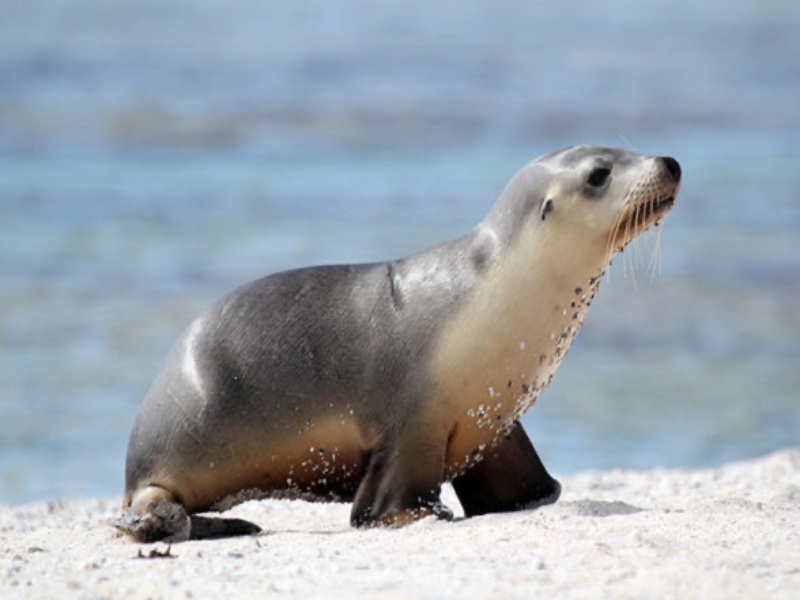
Australian sea lions have a sleek and agile build, with males reaching lengths of about 2.5 meters and females being smaller in size. Their large, wide heads and blunt muzzles set them apart from similar species, such as the southern fur seals. These sea lions have a light tan to reddish-brown coat, with males often having a darker coloration as they mature. Their distinct appearance and behaviors make them a unique and captivating species to study and observe.

Distribution

The Australian sea lion is primarily found along the southern coast of Australia, with breeding colonies established on offshore islands and remote coastal areas. Their range extends from the Houtman Abrolhos in Western Australia to the Pages Islands in South Australia. While their population density is relatively small compared to other seal species, Australian sea lions play a vital role in the coastal ecosystems of Australia.

Habitat Preferences

Australian sea lions thrive in a variety of coastal habitats, including sandy beaches, rocky shores, and offshore islands. They rely on these environments for breeding, molting, and resting. The pristine and undisturbed nature of these coastal ecosystems is crucial for the survival and well-being of Australian sea lions. Their dependence on specific coastal habitats underscores the importance of conservation efforts to protect these vital areas.

By shedding light on the unique characteristics, distribution, and habitat preferences of the Australian Sea Lion, it is my hope that this profile will contribute to a greater understanding and appreciation of this remarkable species, ultimately fostering efforts for its conservation and protection.

Facts About Australian Sea Lion

  • Australian sea lions are sexually dimorphic, with males growing to about 2.5 meters in length.
  • The population of Australian sea lions is estimated to be around 12,000, with approximately 6,500 mature individuals.
  • Breeding events for Australian sea lions occur in a 17.6- to 18-month cycle and are not synchronized between colonies.
  • The Australian sea lion is the only pinniped species endemic to Australia.
  • This species is one of the most endangered pinnipeds in the world.
  • They have stocky bodies, large heads, and short narrow flippers.
  • Breeding colonies of Australian sea lions are spread among 67 locations.
  • The charming Australian sea lion was recently listed as endangered.
  • The breeding range of Australian sea lions extends from Houtman Abrolhos, Western Australia, to the Pages Islands, South Australia.
  • Thirty percent of the Australian sea lion population is found in Western Australia.


Scientific Provenance & Verified Sources

Biological taxonomy, conservation status, and physical traits are cross-referenced with authoritative global registers:


Peer-reviewed by Wildlife Science Editors โ€ข Updated for 2026

Explore Other Species Profiles