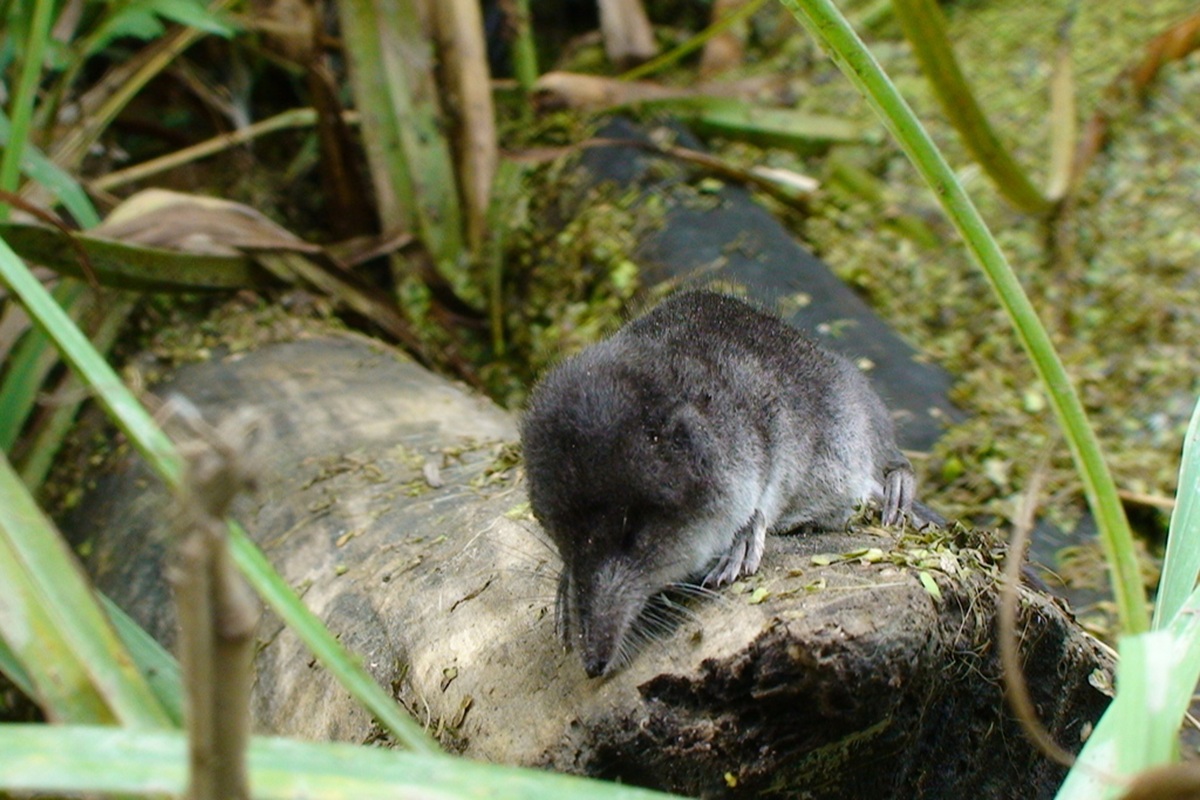
American Water Shrew

IUCN Red List Conservation Status


Least Concern

LC
NT
VU
EN
CR
EW
EX

Official assessment evaluated in accordance with the IUCN Red List of Threatened Species criteria: Least Concern.


Species Quick Facts

Scientific Name
Sorex palustris

Average Lifespan
1-2 years in wild, 2-3 years in captivity

Average Weight
0.005-0.012 kg (0.011-0.026 lbs) – Males: 0.006 kg, Females: 0.007 kg

Average Length
5-7 cm (2.0-2.8 inches) – head-body length excluding tail

Overview & Identification

The American water shrew (Sorex palustris) belongs to the order Eulipotyphla and the family Soricidae. It inhabits the boreal and subโ€‘arctic zones of North America, ranging from Alaska through western Canada to the northern United States, including the Rocky Mountains and the Great Lakes region. This diminutive mammal favors cold, fastโ€‘flowing streams, alpine bogs, and riparian wetlands where it can forage on aquatic prey. Its dense, waterโ€‘repellent fur and partially webbed hind feet enable it to swim and dive with remarkable agility. With a basal metabolic rate among the highest of any mammal, it must eat almost constantly, often consuming up to 80โ€ฏ% of its body weight each day. The species is classified as Least Concern by the IUCN, reflecting a broad distribution and stable overall population, although local declines have been noted where water quality deteriorates. Conservation efforts focus on preserving pristine freshwater habitats and monitoring water pollution levels to ensure the longโ€‘term viability of this specialized shrew.

Behavior & Social Structure

American water shrews are solitary and fiercely territorial, maintaining home ranges of 0.2โ€“0.5โ€ฏha that they defend through scent marking and tailโ€‘slap displays. They are active both day and night, with peak foraging occurring during twilight hours when insect activity is highest. Their high metabolism drives continuous movement; individuals can travel up to 1โ€ฏkm each night while hunting underwater and along stream banks. Communication is primarily chemical, using secretions from anal glands, but they also emit lowโ€‘frequency chirps that may serve in shortโ€‘range social interactions. Overwintering shrews reduce activity and rely on stored fat reserves, yet they remain capable of foraging under ice if water flow persists. Predators such as river otters, hawks, and larger mustelids influence their cautious behavior, prompting frequent retreats to submerged vegetation.

Diet & Hunting Patterns

The American water shrew is a strict insectivore with a strong preference for aquatic invertebrates. Its diet consists primarily of mayfly and caddisfly nymphs, stonefly larvae, aquatic beetles, and small crustaceans such as amphipods and isopods. It also opportunistically consumes earthworms, small mollusks, and occasionally amphibian larvae or tiny fish when available. The shrew employs a rapid, snapping bite aided by venomous saliva that immobilizes prey, a rare adaptation among soricids. Because of its high metabolic demand, an adult consumes roughly 80โ€ฏ% of its body weight each day, feeding continuously for short bursts of 2โ€“3โ€ฏminutes before returning to the surface to breathe. Foraging occurs both underwaterโ€”using its whiskers and keen hearing to locate preyโ€”and on the banks, where it probes leaf litter and moss. Seasonal shifts in prey availability lead to increased consumption of terrestrial insects during winter when streams freeze over.

Reproduction & Life Cycle

Sexual maturity is reached at about one year of age for both sexes. Breeding commences in late spring (Mayโ€“June) when water temperatures rise above 10โ€ฏยฐC, prompting females to enter estrus. After a gestation period of roughly 21โ€ฏdays, litters of 3โ€“7 altricial young are born in shallow burrows lined with dry moss and plant material near water edges. Neonates weigh only 0.5โ€ฏg and are blind and hairless. The mother provides exclusive care, nursing the pups for 3โ€“4โ€ฏweeks while keeping the nest dry and warm. By three weeks, the juveniles begin to explore the water surface, practicing swimming and prey capture under maternal supervision. Weaning is complete by 4โ€ฏweeks, after which the young disperse to establish their own territories. Annual reproductive output is limited by the short summer season, making successful rearing critical for population stability.

Threats & Conservation

The IUCN lists the American water shrew as Least Concern, citing its wide distribution and presumed large population. Nevertheless, the species faces several localized threats. Habitat degradation from logging, road construction, and agricultural runoff reduces the quality of riparian zones and increases sedimentation, which can smother benthic invertebrate communities that the shrew depends on. Water pollution, particularly from pesticides and heavy metals, directly impacts both shrew health and prey abundance. Climate change poses a longerโ€‘term risk by altering stream temperature regimes and reducing snowpack, potentially shortening the brief summer window needed for successful breeding. Predation by introduced species such as the American mink (Neovison vison) adds additional pressure in some regions. Population estimates are sparse, but regional surveys suggest stable numbers in most of its range, with declines noted in heavily industrialized watersheds. Conservation actions focus on protecting highโ€‘quality freshwater habitats, monitoring water quality, and maintaining buffer vegetation along streams.

Interesting Facts

โ€ข The American water shrew can run at speeds up to 13โ€ฏkm/h on land and swim equally fast underwater.
โ€ข It possesses venomous saliva, one of the few mammalian species with a toxic bite, which helps subdue larger prey.
โ€ข Its metabolic rate is so high that it must eat almost constantly, often losing up to 30โ€ฏ% of its body weight each night.
โ€ข Water shrews can close their ears and nostrils while diving, preventing water entry during underwater foraging.
โ€ข Despite its small size, it can dive for up to 30โ€ฏseconds and remain submerged while hunting for insects.

Description

American Water Shrew

The American water shrew, scientifically known as Sorex palustris, is a remarkable semi-aquatic mammal belonging to the Soricidae family. This species is renowned for its unique adaptations to an aquatic lifestyle, making it a fascinating subject for wildlife enthusiasts and conservationists alike.

Appearance

American Water Shrew (Sorex palustris)

The American water shrew is distinguished by its sleek, dark brown fur and a long, slender body, typically measuring around 4 to 5 inches in length. Notably, it possesses a distinctive fringe of stiff hairs on its hind feet, which aid in propulsion and stability during its aquatic pursuits. This adaptation sets it apart from other shrew species and underscores its specialization for life in and around water bodies.

Distribution

The American water shrew is predominantly found in the nearctic faunal region, specifically inhabiting the mountainous areas of the northern United States, Canada, and Alaska. Its distribution encompasses a range of habitats, including cold mountain streams, boreal forests, and relict habitats in southern mountains. Notably, its occurrence in these regions underscores its preference for cooler, well-oxygenated aquatic environments.

Habitat Preferences

American Water Shrew Habitat

This species thrives in semi-aquatic habitats, displaying a particular affinity for small, cold mountain streams with dense overhanging vegetation. It is also associated with rivers, lakes, and bogs, where the presence of abundant aquatic prey and suitable cover contribute to its survival and well-being. The American water shrew’s preference for these pristine, unspoiled environments underscores its reliance on intact ecosystems for its continued existence.

In conclusion, the American water shrew, with its unique adaptations and specialized habitat preferences, represents an intriguing example of the diverse and specialized wildlife that inhabits the northern mountainous regions of North America. Understanding and conserving its preferred habitats is essential for ensuring the long-term survival of this fascinating semi-aquatic mammal.

Facts About American water shrew

  • The American water shrew (Sorex palustris) is a relatively large shrew with dark gray or black fur and a silvery-white belly.
  • It is a semiaquatic species, often found near freshwater habitats.
  • American water shrews are known for their exceptional swimming abilities and can dive and forage underwater for food.
  • They are solitary creatures and are active throughout the day and night.
  • The total length of an American water shrew ranges from 5.5 to 6.3 inches.
  • They have a long bicolored tail and large hind feet fringed with short stiff hairs.
  • American water shrews are found in the nearctic faunal region, primarily in the mountain ranges of North America.
  • Their activity patterns are characterized by two periods, one between sunset and 2300 hours.
  • The species is associated with freshwater habitats and is found in a large range in the boreal and montane regions of North America.
  • The American water shrew is one of the largest shrew species in eastern North America, with a weight of up to 0.42 ounce.


Scientific Provenance & Verified Sources

Biological taxonomy, conservation status, and physical traits are cross-referenced with authoritative global registers:


Peer-reviewed by Wildlife Science Editors โ€ข Updated for 2026

Explore Other Species Profiles