
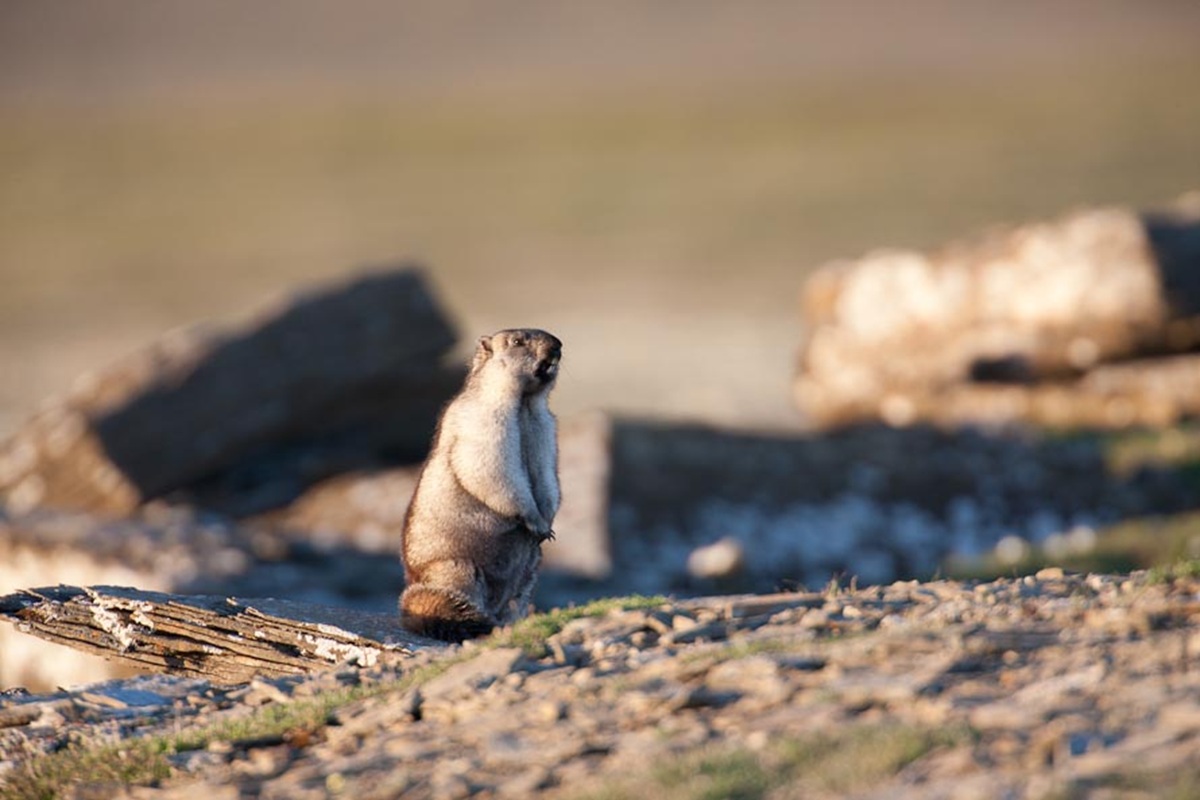
Description

The Alaska marmot, scientifically known as Marmota broweri, is a fascinating rodent species belonging to the family Sciuridae. Once thought to be the same species as the hoary marmot, it is now recognized as a distinct and unique species. These marmots are predominantly herbivorous and are known for their social nature, often living in colonies of up to fifty individuals. They are characterized by their burrowing behavior and are often found near food sources such as grasses, flowering plants, berries, roots, and mosses.
Appearance

Distinctive features of the Alaska marmot include a robust body, short legs, a short bushy tail, and a dense coat of fur that provides insulation in their cold alpine environment. Their fur coloration can vary, but it generally consists of a mix of grays, browns, and tans. Their appearance sets them apart from other marmot species and contributes to their ability to thrive in their unique habitat.
Distribution
The Alaska marmot is primarily found in the northern regions of Alaska, particularly in habitats throughout much of the Brooks Range, the Ray Mountains, and the Kokrines Hills north of the Yukon River. This species’ distribution is relatively localized, and its population density is notably concentrated in these specific regions.
Habitat Preferences

These marmots thrive in alpine environments, favoring rocky terrain, alpine meadows dominated by grasses and sedges, and Krummholz forest edges. The unique ecosystems they inhabit provide them with the necessary resources for survival, including suitable burrowing sites and abundant vegetation for foraging. Their ability to thrive in these challenging environments is a testament to their remarkable adaptations and resilience.
This comprehensive species profile provides a detailed overview of the Alaska marmot, shedding light on its unique characteristics, distribution, and habitat preferences.
Facts About Alaska marmot
- The Alaska marmot (Marmota broweri) is a large, ground-dwelling rodent with a heavy body, short neck, and bushy tail.
- They are found in the Brooks Range of Alaska, hence the name “Alaska marmot.”
- Alaska marmots weigh up to 6 kg (13 pounds) and have a body length of up to 50 cm (about 20 inches) with a short, bushy tail up to 18 cm.
- These marmots are herbivores, consuming grass, flowering plants, berries, roots, moss, and lichen.
- Alaska marmots hibernate for up to 8 months of the year, from September to May.
- They are sometimes hunted by Alaskan Natives for food and their warm fur, which was worth about US$6 to US$8 in 1956.
- The species is listed as Marmota broweri in the family Sciuridae under the order Rodentia.
- Alaska marmots are well-adapted to the cold climate of their habitat, with a thick fur coat for insulation.
- These marmots are known for their loud, high-pitched warning calls to alert others of potential predators.
- The conservation status of the Alaska marmot is currently listed as “Least Concern” on the IUCN Red List.


