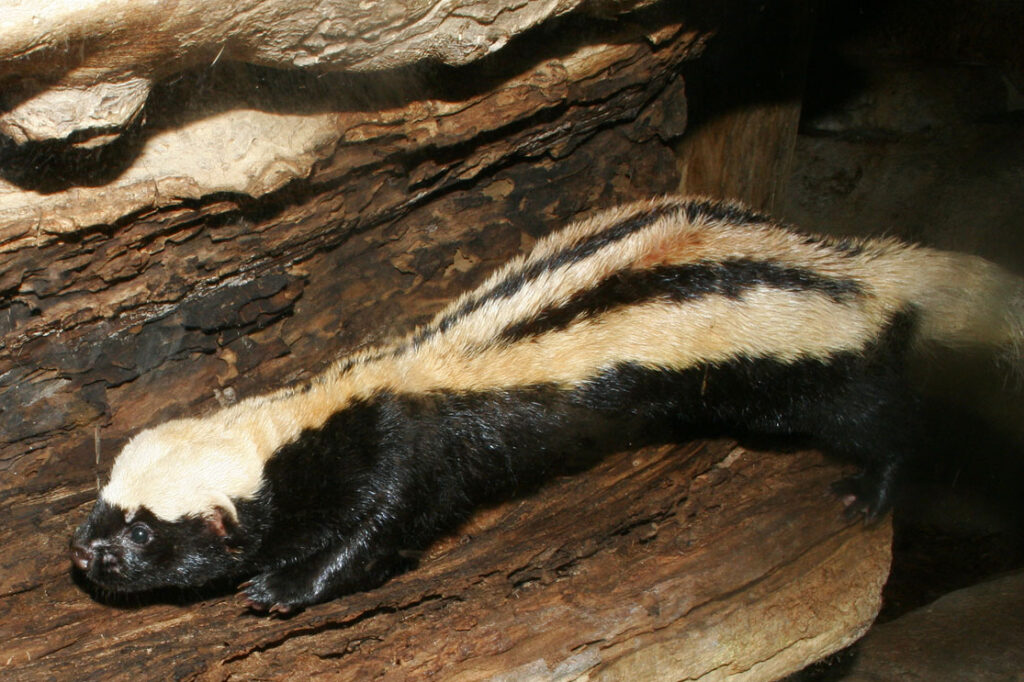
African Striped Weasel

IUCN Red List Conservation Status


Least Concern

LC
NT
VU
EN
CR
EW
EX

Official assessment evaluated in accordance with the IUCN Red List of Threatened Species criteria: Least Concern.


Species Quick Facts

Scientific Name
Mustela striata

Average Lifespan
2-3 years in wild, 4-5 years in captivity

Average Weight
0.12-0.18 kg (0.26-0.40 lbs) – Males: 0.15 kg, Females: 0.12 kg

Average Length
22-30 cm (8.7-11.8 inches) – head-body length excluding tail

Overview & Identification

The African striped weasel (Mustela striata) belongs to the family Mustelidae, a diverse group that includes otters, badgers, and other weasels. It is the only true weasel species endemic to subโ€‘Saharan Africa, ranging from Senegal and Ethiopia in the north to South Africa and Namibia in the south. Its preferred habitats are open savannas, dry grasslands, and woodland edges where tall grasses and scattered shrubs provide cover for hunting. The coat is a striking combination of a reddishโ€‘brown dorsal stripe flanked by dark lateral bands, giving the animal its common name. The tail is relatively short, ending in a black tip, and the body is elongated with short limbs, adaptations that facilitate rapid, serpentine movement through dense vegetation. The species is listed as Least Concern by the IUCN due to its wide distribution, but localized declines have been noted where agricultural expansion and pesticide use reduce prey availability. Its ecological role as a mesopredator helps regulate rodent populations, contributing to the health of African grassland ecosystems.

Behavior & Social Structure

African striped weasels are primarily solitary hunters, maintaining exclusive territories that can span 2โ€“5 kmยฒ depending on prey density. They are crepuscular to nocturnal, with peak activity at dawn and dusk when small mammals are most active. Scent marking using anal gland secretions and urine delineates boundaries and communicates reproductive status. Vocalizations are limited to sharp chirps or hisses during confrontations or courtship. Home ranges overlap minimally between sexes, but males may temporarily expand their range during the breeding season to locate receptive females. The species exhibits high agility, using rapid lunges and short bursts of speed to capture prey, and can swim modestly when required to cross watercourses.

Diet & Hunting Patterns

The African striped weasel is a strict carnivore, preying primarily on small vertebrates. Its diet consists of 60โ€“70% rodents such as gerbils, multimammate mice, and African grass rats, supplemented by shrews, small birds, lizards, and amphibians. Insect consumption, especially beetles and grasshoppers, can account for up to 15% of intake during periods of low vertebrate prey availability. An adult weasel requires roughly 5โ€“8% of its body weight in food daily, obtained through a series of short, highโ€‘intensity hunts. Hunting strategy relies on stealth and rapid bursts of speed; the weasel enters rodent burrows or stalks prey in open grass, delivering a quick bite to the neck or spinal region. Digestive efficiency is high, allowing rapid assimilation of protein and fat, which supports the energetic demands of its active lifestyle.

Reproduction & Life Cycle

Sexual maturity is reached at about 10โ€“12 months for both sexes, though females may breed earlier in regions with abundant prey. Breeding can occur yearโ€‘round but peaks during the rainy season (Aprilโ€“June) when rodent populations surge. After a gestation period of 35โ€“45 days, females give birth to litters of 2โ€“4 kits, which are born altricial, blind, and hairless. The mother constructs a shallow nest of grass and leaves, providing intensive care for the first three weeks. Kits are weaned at 4โ€“5 weeks and begin to accompany the mother on short foraging trips. Juveniles attain independence by 8โ€“10 weeks, after which they disperse to establish their own territories. Longevity in the wild is limited by predation and disease, but successful breeding females can produce up to three litters per year under optimal conditions.

Threats & Conservation

The IUCN classifies Mustela striata as Least Concern, reflecting its broad distribution and presumed large population. However, recent field surveys indicate localized declines linked to habitat conversion for agriculture and livestock grazing, which reduce cover and prey abundance. Pesticide runoff diminishes rodent populations and can cause secondary poisoning in weasels that ingest contaminated prey. Road mortality is a growing threat in expanding rural networks, with an estimated 5% of adult mortality attributed to vehicle collisions in some regions. Climate change may alter rainfall patterns, affecting the seasonal availability of prey and suitable habitat. Conservation actions focus on preserving mosaic savanna landscapes, promoting integrated pest management to reduce chemical exposure, and monitoring population trends through cameraโ€‘trap networks.

Interesting Facts

โ€ข The African striped weasel is the only true weasel species native to the African continent.
โ€ข Its distinctive dorsal stripe provides camouflage among tall grasses and reed beds.
โ€ข Unlike many Mustelidae, it can tolerate relatively arid environments, thriving in semiโ€‘desert savannas.
โ€ข Females can produce up to three litters per year when prey is abundant, contributing to rapid local population rebounds.
โ€ข The species’ scent glands produce a musky odor that has been used in traditional African medicine for its purported antiseptic properties.

Description

African Striped Weasel

The African striped weasel, scientifically known as Poecilogale albinucha, is a small, black and white mammal belonging to the family Mustelidae. It is the only member of its genus, making it a unique and intriguing species within the weasel family. This elusive creature is characterized by its slender body, short legs, and distinctive black and white stripes that run along its back, giving it a striking appearance.

Appearance

African Striped Weasel Appearance

The African striped weasel is easily distinguished by its striking coloration, with a black body adorned by prominent white stripes. Its sleek and agile build allows it to move swiftly through its natural habitat. The contrast of its color pattern aids in camouflage and serves as a visual warning to potential predators, making it a remarkable example of evolutionary adaptation.

Distribution

This species is primarily found in sub-Saharan Africa, inhabiting regions south of the Congo Basin. Its range extends across various countries in this region, including but not limited to Ethiopia, and other sub-Saharan countries. The African striped weasel’s distribution is notable for its adaptability to diverse habitats, making it a fascinating subject for ecological studies.

Habitat Preferences

African Striped Weasel Habitat

The African striped weasel displays a preference for a range of habitats, including savannahs, forests, grasslands, and marshy areas. It thrives in environments with adequate vegetation cover and a sufficient supply of small rodents, which form a significant part of its diet. The species’ survival and well-being are closely linked to the availability of suitable prey and adequate shelter, highlighting the delicate balance of ecosystems that support its existence.

By shedding light on the unique characteristics, appearance, distribution, and habitat preferences of the African striped weasel, we gain a deeper understanding of this captivating species and its significance in the intricate web of African biodiversity. This knowledge is essential for conservation efforts aimed at preserving the natural heritage of sub-Saharan Africa and safeguarding the future of this remarkable mammal.

I hope this profile meets your expectations! If you need any further information or details, feel free to ask.

Facts About African striped weasel

  • The African striped weasel (Poecilogale albinucha) is one of the smallest mammalian carnivores in Africa.
  • Adults have a head-body length of approximately 27 centimeters.
  • They have a body length between 25 and 35 centimeters and a tail length between 15 and 23 centimeters.
  • The weasel has an elongated body, short legs, and a relatively bushy tail.
  • Their body is black with a white cap and distinct longitudinal black and white stripes along the back.
  • African striped weasels may reach their highest densities in moist grasslands.
  • Human population expansion has increased the number of dogs that often kill African Striped Weasels or compete for food.
  • The weasel is native to sub-Saharan Africa.
  • They weigh about 250-350 grams.
  • The numbers of African striped weasels are not very great, but they are not considered to be endangered.


Scientific Provenance & Verified Sources

Biological taxonomy, conservation status, and physical traits are cross-referenced with authoritative global registers:


Peer-reviewed by Wildlife Science Editors โ€ข Updated for 2026

Explore Other Species Profiles