African golden cat sitting among fallen leaves and grass in a woodland setting

IUCN Red List Conservation Status


Near Threatened

LC
NT
VU
EN
CR
EW
EX

Official assessment evaluated in accordance with the IUCN Red List of Threatened Species criteria: Near Threatened.


Species Quick Facts

Scientific Name
Caracal aurata

Average Lifespan
10-12 years in wild, 15-20 years in captivity

Average Weight
5-13 kg (11-29 lbs) – Males: 9-13 kg, Females: 5-9 kg

Average Length
55-115 cm (22-45 inches) – head-body length excluding tail

Overview & Identification

The African golden cat (Caracal aurata) is a mediumโ€‘sized felid belonging to the subfamily Felinae. First described by Temminck in 1827, it is the sole member of the genus Caracal that is not closely allied with the caracal (Caracal caracal) but rather forms a distinct lineage within the African smallโ€‘cat clade. Its distribution spans the humid forests of West, Central and East Africa, from Sierra Leone and Liberia eastward through the Congo Basin to Uganda, Rwanda, Burundi and western Kenya, and southward into northern Angola and the Democratic Republic of the Congo. The species inhabits primary lowland rainforest, montane and subโ€‘montane forest, as well as swampy forest and occasionally forestโ€‘edge savanna where dense understory provides cover. Adults possess a short, sleek coat that varies from deep goldenโ€‘brown to reddishโ€‘black, often marked with faint dark spots or rosettes; the ventral side is lighter, and the ears are rounded without the prominent tufts seen in some relatives. The African golden cat is listed as Near Threatened on the IUCN Red List because of ongoing habitat loss, hunting pressure, and its naturally low population density. Conservation actions focus on protecting large tracts of forest, enforcing antiโ€‘poaching laws, and improving survey techniques to better assess its status.

Behavior & Social Structure

African golden cats are solitary and primarily nocturnal, although they may be active at dawn and dusk in areas with limited human disturbance. Each individual maintains a home range that can exceed 30โ€ฏkmยฒ for males and 15โ€ฏkmยฒ for females, marked by scent rubs, urine sprays, and scratch marks on trees. Territorial overlap is minimal; encounters are resolved through vocalizations such as low growls, hisses, and a distinctive โ€œyowlโ€ that can travel several hundred metres. The species is an adept climber and can navigate dense understory, but it also hunts on the ground, using stealth and short bursts of speed to ambush prey. Communication is largely chemical and auditory; visual signals are limited to body posture and ear position. While generally reclusive, individuals have been recorded traveling short distances along established forest trails, especially when searching for food or mates.

Diet & Hunting Patterns

The African golden cat is a strict carnivore that exploits a wide spectrum of vertebrate prey. Its diet includes small to medium forest ungulates such as duikers (Cephalophus spp.) and bushbucks (Tragelaphus scriptus), as well as rodents, hares, birds, reptiles, and amphibians. In some regions, it also preys on arboreal mammals like tree squirrels and primates such as galagos. Studies of scat from the Congo Basin reveal that mammals constitute roughly 70โ€ฏ% of dietary mass, with birds and reptiles accounting for the remainder. The cat employs a sitโ€‘andโ€‘wait ambush strategy, using dense vegetation for concealment before launching a rapid chase of less than 30โ€ฏseconds. It can also climb trees to capture arboreal prey or to cache kills away from scavengers. Daily food intake is estimated at 1โ€“2โ€ฏ% of body weight, equivalent to 100โ€“250โ€ฏg for an adult, depending on prey size and availability.

Reproduction & Life Cycle

Sexual maturity is reached at about 24โ€“30โ€ฏmonths for both sexes, with females typically breeding for the first time at two to three years of age. Mating can occur throughout the year, but peaks have been observed during the rainy season when prey abundance rises. After a gestation period of 78โ€“80โ€ฏdays, a female gives birth to a litter of one to four kittens, most commonly two. Kittens are born blind and covered in a dense, silveryโ€‘gray natal coat that fades to the adult coloration by three months. The mother provides all care, nursing the young for up to three months and teaching them hunting techniques until they are independent at around 12โ€ฏmonths. Juveniles remain with their mother for several months before dispersing to establish their own territories.

Threats & Conservation

The IUCN classifies the African golden cat as Near Threatened, estimating fewer than 10,000 mature individuals worldwide, with a declining trend. The principal threat is habitat loss; logging, agricultural expansion, and oilโ€‘pipeline development fragment the continuous forest blocks that the species relies on for hunting and denning. Hunting for bushmeat and the illegal wildlife trade also impact populations, especially in Central Africa where the catโ€™s pelts are valued locally. Road mortality and conflict with humans are emerging concerns as infrastructure penetrates remote forest areas. Climate change may further alter forest composition, reducing suitable habitat. Conservation measures include the establishment and effective management of protected areas such as the Dzangaโ€‘Sangha Reserve in the Central African Republic, antiโ€‘poaching patrols, and communityโ€‘based initiatives that provide alternative protein sources to reduce bushmeat hunting. Ongoing research using camera traps and genetic sampling aims to refine population estimates and inform habitat connectivity strategies.

Interesting Facts

โ€ข The African golden cat can change its coat color slightly with the seasons, becoming darker during the wet season.
โ€ข It is one of the few African felids that can climb trees as adeptly as it moves on the ground.
โ€ข Despite its name, the catโ€™s fur is not truly golden; it ranges from deep brown to reddishโ€‘black.
โ€ข Its vocal repertoire includes a unique โ€œyowlโ€ that can be heard up to 500โ€ฏmeters away.
โ€ข The species was only formally described in 1827, and many aspects of its ecology remain poorly known due to its secretive nature.

Description

The African golden cat, scientifically known as Caracal aurata, is a medium-sized wild cat that remains relatively enigmatic to science. It is shrouded in tribal superstition within its native range, adding to its mystique and allure. This elusive feline is often referred to as the “leopard’s brother” by local communities, who believe that it trails the leopard, further adding to its enigmatic reputation.

Appearance

The African golden cat is characterized by its strikingly beautiful coat, which can vary in color from reddish-brown to gray, and occasionally black. Its fur may also display faint spots or rosettes, adding to its aesthetic appeal. This unique coat sets it apart from other wild cat species and contributes to its captivating allure.

Distribution

This species is endemic to the rainforests of West and Central Africa, with its range spanning countries such as Nigeria, Cameroon, Gabon, and the Democratic Republic of the Congo. The African golden cat’s distribution is primarily confined to equatorial Africa, where it inhabits the lush, biodiverse forests of the region. However, due to habitat loss and human encroachment, the population density of this species is under threat, making conservation efforts crucial for its survival.

Habitat Preferences
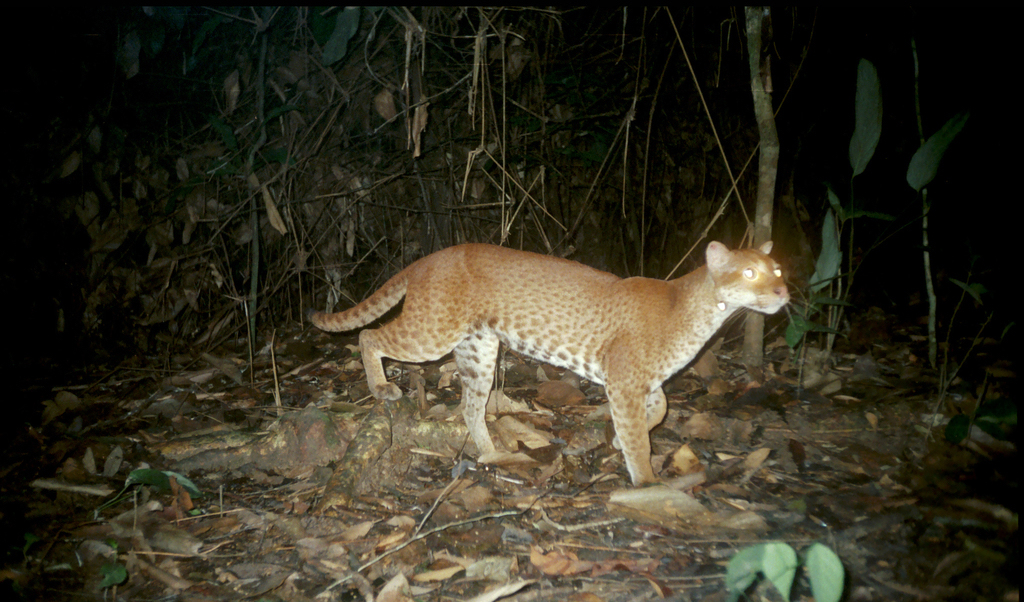
The African golden cat thrives in the dense, tropical rainforests of its native range. It is uniquely adapted to this lush and biodiverse ecosystem, where it relies on the cover provided by the dense vegetation for hunting and shelter. These forests also offer a rich array of prey species, including small mammals, birds, and primates, which form the basis of the African golden cat’s diet. However, deforestation and habitat degradation pose significant challenges to the well-being of this species, highlighting the importance of preserving its forest habitat for its continued survival.

By shedding light on the captivating nature of the African golden cat, we can foster greater appreciation and understanding of this enigmatic species, ultimately contributing to its conservation and the preservation of its natural habitat.

Facts About African Golden Cat

  • The African Golden Cat (Caracal aurata) is one of the least-known felids in the world.
  • It is about twice the size of a domestic cat, making it a medium-sized wild cat.
  • The geographic range of African Golden Cats spans across equatorial Africa.
  • The species is considered rare and is endemic to tropical Africa.
  • The African Golden Cat has two recognized subspecies: Caracal aurata aurata and Caracal aurata celidogaster.
  • Its weight ranges from 6.2 to 18 kg, and its length varies from 61 to 102 cm.
  • The population size of the African Golden Cat is currently unknown.
  • Its lifespan is estimated to be around 15 years in the wild.
  • The African Golden Cat is classified as Vulnerable (VU) on the endangered status scale.
  • This species is known for its elusive nature and is one of the world’s least-studied felids.


Scientific Provenance & Verified Sources

Biological taxonomy, conservation status, and physical traits are cross-referenced with authoritative global registers:


Peer-reviewed by Wildlife Science Editors โ€ข Updated for 2026

Explore Other Species Profiles